

Ainfluencer Alternatives: Best Influencer Marketing Platforms
Managing creator partnerships at scale requires more than manual outreach and spreadsheets, which is why influencer marketing software has become essential for handling discovery, communication, campaign workflows, and performance tracking in one place. Ainfluencer is often considered an accessible starting point thanks to its free marketplace model, built-in escrow payments, and simple campaign setup, but it comes with trade-offs that lead many teams to explore Ainfluencer alternatives. Common limitations include limited analytics and ROI tracking (with no native support for conversions or revenue attribution), basic influencer discovery and filtering that makes it harder to find niche creators efficiently, and inconsistent influencer quality and responsiveness due to its open marketplace structure; in addition, some reporting relies on manual inputs rather than direct integrations, which can slow down decision-making.
In this article, we’ll compare the 10 best Ainfluencer alternatives—Influencer Hero, Upfluence, Aspire, SARAL, CreatorIQ, Sprout Social, GRIN, Modash, Influencity, and IZEA—to help you find the right platform for your needs.
Criteria for Suggesting Platform Alternatives
Core Features
Evaluation of each platform’s essential capabilities, including influencer discovery, outreach, CRM, campaign reporting, gifting, UGC and content collection, affiliate tracking and payments, storefronts, application pages, and AI-powered tools.
Supported Social Media Platforms
Assessment of how well each platform integrates with major social networks such as Instagram, YouTube, TikTok, Facebook, Pinterest, and many more
Pricing & Contract Flexibility
Comparison of pricing models, subscription costs, and contract requirements to help brands choose solutions that match their budget and scalability needs.
Standout & Differentiating Features
Highlighting unique or innovative functionalities that set each platform apart, such as real-time tracking dashboards, creator benchmarking, TikTok email discovery, or advanced automation tools.
Customer Reviews & User Satisfaction
Analysis of verified user feedback from credible platforms like G2, TrustRadius, Capterra, focusing on usability, reliability, value for money, customer support, and real-world performance.
Ainfluencer Overview
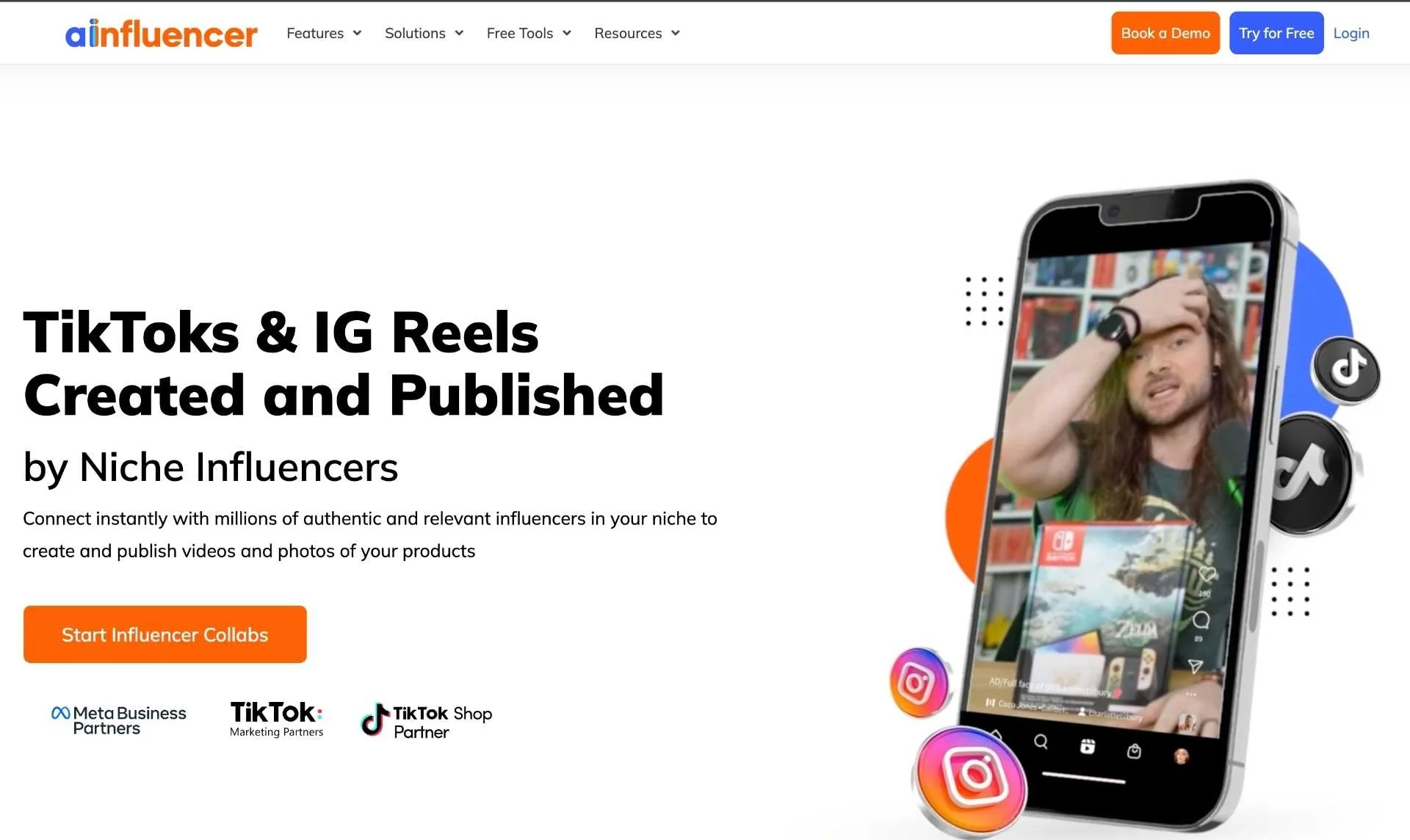
Ainfluencer is a marketplace-based influencer marketing platform designed to connect brands with creators at scale, particularly across Instagram and TikTok. Built with a strong focus on accessibility, it enables brands to run influencer campaigns without upfront software costs, positioning itself as a cost-effective entry point for small to mid-sized businesses. The platform combines influencer discovery, campaign management, communication, and secure payments into a single ecosystem, allowing brands to manage collaborations end-to-end or opt for fully managed campaign services.
Key Features
• Influencer Marketplace (5M+ Creators)
Ainfluencer provides access to a large pool of influencers across Instagram and TikTok, allowing brands to search and connect with creators based on filters like niche, audience demographics, engagement, and pricing.
• Campaign Creation & Application-Based Collaboration
Brands can create detailed campaign briefs outlining deliverables, goals, and compensation. Influencers can either apply directly via the app or be invited by brands, streamlining the collaboration process.
• Built-in Messaging & Negotiation
The platform includes communication tools with pre-built and customizable templates, enabling brands to negotiate deliverables, timelines, and pricing without leaving the platform.
• Escrow Payment System
Payments are held securely in escrow and only released once deliverables are completed and approved. This reduces risk for brands and ensures accountability from influencers.
• Content Library & Ownership
All influencer-generated content is stored in a centralized library, where brands can review, approve, download, and reuse assets. Content ownership is transferred to the brand based on platform terms.
• AI-Powered Campaign Assistance
Ainfluencer includes AI tools to help generate outreach messages and campaign communication, reducing manual effort in influencer outreach.
• Chrome Extension for Influencer Outreach
A browser extension allows brands to identify influencers directly on Instagram and invite them to campaigns with pre-filled AI-generated messages.
• Basic Performance Tracking
Campaign analytics include core engagement metrics such as likes, comments, and views at the influencer level.
Platform Coverage
Instagram and TikTok
Pricing
Ainfluencer stands out with a free-to-use model for brands managing campaigns themselves:
• Self-Service Plan
• Free to use (no subscription or platform fees)
• Brands only pay influencers (minimum ~$10 per collaboration)
• Managed Campaign Packages (Optional)
For brands that want hands-off execution, Ainfluencer offers campaign packages:
• Viral Plan – $7,999 (1 month, ~25 influencers)
• Scale Plan – $9,999 (2 months, ~50 influencers)
• Super Scale Plan – $15,000 (3 months, ~75 influencers)
• Turbo Viral Plan – $29,999 (4 months, ~200 influencers)
These packages include additional campaign management fees and guaranteed reach estimates. Pricing is project-based rather than subscription-based, making it flexible but less predictable for scaling teams.
Reviews
4.8 / 5.0 (G2)
Ainfluencer Standout Features
• Zero-Cost Entry with Full Marketplace Access
Unlike most influencer platforms that require subscriptions or annual contracts, Ainfluencer allows brands to access its marketplace and core features entirely free—making it highly attractive for startups and small teams.
• Secure Escrow-Based Payment Protection
The built-in escrow system ensures brands only release payments after deliverables are completed, significantly reducing fraud risk and improving trust in influencer collaborations.
• Dual-Sided Marketplace with In-App Creator Experience
Influencers actively browse and apply to campaigns through a dedicated mobile app, creating a more engaged, opt-in ecosystem compared to cold outreach-heavy platforms.
Limitations (Why Users Look for Ainfluencer Alternatives)
Limited Analytics & ROI Tracking
The platform focuses mainly on surface-level metrics (likes, comments, views), with no built-in tracking for conversions, clicks, or revenue—making it difficult to measure true campaign ROI.
Basic Influencer Discovery & Filtering
Compared to more advanced platforms, search capabilities and filtering options are relatively limited, which can slow down the process of finding highly targeted or niche creators.
Inconsistent Influencer Quality & Responsiveness
As an open marketplace, not all influencers are equally professional or responsive, leading to variability in campaign execution and longer outreach cycles.
Manual Data & Reporting Processes
Some campaign data (such as performance insights) relies on manual uploads or screenshots from influencers rather than direct integrations, reducing accuracy and efficiency.
10 Best Influencer Marketing Platform Alternatives:
| TOOL | REVIEWS | BEST FOR | TRIAL INFO | PRICING | ||
|---|---|---|---|---|---|---|
1 |

|
⭐ | Influencer CRM & automation | Book Demo | Pricing | Website |
2 |

|
⭐ | Influencer discovery | Book Demo | Pricing | Website |
3 |

|
⭐ | Influencer partnerships | Book Demo | Pricing | Website |
4 |

|
⭐ | Influencer outreach | Book Demo | Pricing | Website |
5 |

|
⭐ | Enterprise influencer marketing | Book Demo | Pricing | Website |
6 |
|
⭐ | Influencer marketing & Social media analytics | Book Demo | Pricing | Website |
7 |

|
⭐ | DTC creator management | Book Demo | Pricing | Website |
8 |

|
⭐ | Influencer discovery | Book Demo | Pricing | Website |
9 |

|
⭐ | Campaign management | Book Demo | Pricing | Website |
10 |

|
⭐ | Influencer marketplace | Book Demo | Pricing | Website |
Influencer Hero

Influencer Hero is an all-in-one influencer marketing platform built for DTC brands, ecommerce teams, and agencies that want to run discovery, outreach, gifting, affiliate tracking, UGC collection, and reporting from one place. Its positioning is notably performance-oriented: rather than stopping at creator search, it connects influencer activity to clicks, conversions, orders, and revenue through ecommerce integrations and structured CRM workflows.
Key Features
• Influencer discovery with advanced filtering: Brands can search creators by niche, audience demographics, location, engagement quality, fake follower signals, and lookalike profiles, which helps narrow large prospect lists to higher-fit creators.
• AI-assisted outreach and automation: The platform supports bulk outreach, drip sequences, and AI-personalized messaging, reducing manual work for teams scaling creator recruitment.
• Campaign-centric CRM: Influencer Hero’s CRM is built around campaign execution, with boards, relationship stages, bulk actions, notes, and workflow automation for approvals, follow-ups, and deliverables.
• Affiliate and sales tracking: It can generate affiliate links and discount codes, then tie clicks, orders, and revenue back to individual creators and campaigns.
• Product gifting and ecommerce workflows: Shopify, WooCommerce, Magento, Amazon, Webflow, Squarespace, and other ecommerce integrations support gifting, order tracking, and revenue attribution.
• UGC and content management: Creator content is auto-collected into a content library for repurposing, internal review, and paid media use.
• Application pages and storefronts: Brands can launch creator signup pages and storefront-style workflows to scale inbound recruitment.
• API access and free tools: Beyond the core platform, Influencer Hero also offers an API and a broad set of free tools for analytics, fake follower checks, lookalikes, and competitive research.
Platform Coverage
Instagram, TikTok, YouTube, Facebook, Pinterest, Snapchat, X, and Twitch
Pricing
Influencer Hero offers flexible pricing based on outreach volume, and you can have unlimited creators in your CRM with Influencer Hero:
• Standard — $649/month (up to 1,000 reachouts/month)
• Pro — $1,049/month (up to 5,000 reachouts/month)
• Business — $2,490/month (up to 10,000 reachouts/month)
• Custom / Agency — Tailored pricing
Reviews
5.0/5.0 (Capterra)
Standout Features
• AI-powered Chrome extension: The extension surfaces engagement data, fake follower percentages, audience demographics, and even generates an AI-personalized intro sentence based on a creator’s latest content, making live prospecting far more actionable.
• Influencer brand-follower and customer discovery: Influencer Hero can identify creators who already follow your brand or have purchased from your store, which is especially useful for sourcing warmer, higher-converting partnerships.
• Deep ecommerce attribution beyond Shopify: Unlike many mid-market tools, it supports a broader ecommerce stack and connects influencer workflows directly to real order and revenue data.
Ainfluencer vs Influencer Hero
Ainfluencer is stronger for brands that want a free, marketplace-style entry point and escrow-protected collaborations on Instagram and TikTok, while Influencer Hero is built for teams that need structured outreach, CRM automation, affiliate tracking, and deeper revenue attribution. Ainfluencer keeps things simple and low-risk, but Influencer Hero offers broader platform coverage, stronger ecommerce integrations, and far more advanced reporting for scaling influencer programs.
Upfluence
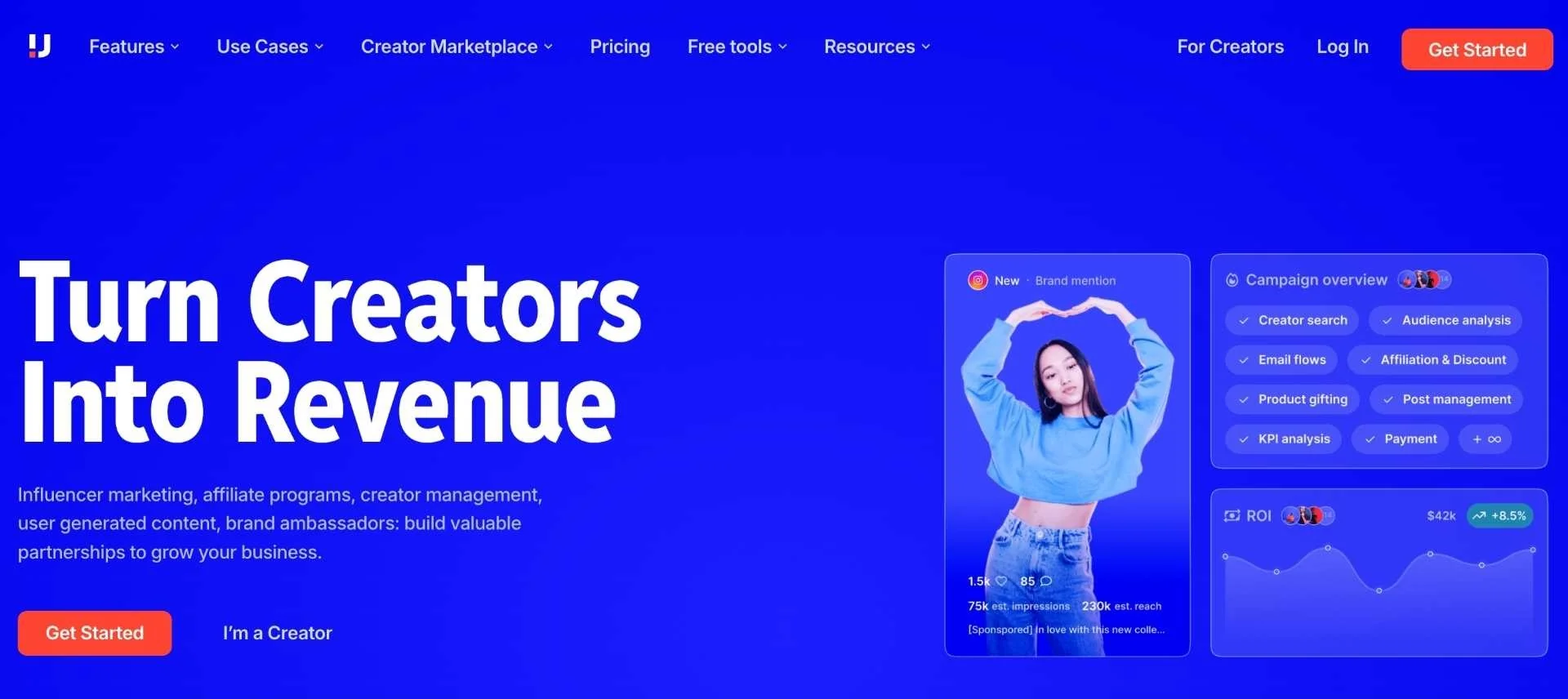
Upfluence is a mature influencer marketing platform geared heavily toward ecommerce brands that want to combine creator discovery, large-scale outreach, affiliate activation, and revenue attribution in one system. Its biggest strength is the connection between influencer marketing and commerce data, especially for brands selling through Shopify, Amazon, and other ecommerce platforms.
Key Features
• Large creator database and advanced search: Upfluence gives brands access to a large influencer database with filters for niche, location, audience data, engagement, and brand affinity.
• AI-powered campaign setup and outreach: Jaice AI helps teams move from planning to live campaigns faster by recommending creators, generating outreach, and shaping campaign structure.
• Bulk outreach and email automation: The platform supports mass outreach, templates, follow-up sequences, and Gmail/Outlook integrations, which is useful for outbound-heavy influencer programs.
• CRM and relationship management: Brands can upload past creators, manage lists, tag contacts, and centralize communication history.
• Shopify and Amazon integrations: Upfluence is especially strong for affiliate and gifting workflows tied to ecommerce, including product seeding, code generation, and sales attribution.
• Social listening and creator recruitment: It helps identify creators already mentioning your brand or competitors, adding a proactive brand-affinity layer to discovery.
• Payments and compliance workflows: Higher tiers include global payouts, multi-currency payments, invoicing, and tax-form handling.
Platform Coverage
Instagram, TikTok, YouTube, Facebook, Twitch, Pinterest, and blogs.
Pricing
On average plans start around $2,000/month ($24,000 yearly)
Reviews
4.3 / 5.0 (Capterra)
Standout Features
• Jaice AI campaign co-pilot: Upfluence’s AI layer now goes beyond email assistance and helps turn a brand brief into a live creator program much faster than traditional manual setup.
• Customer-to-creator matching: Through ecommerce and CRM syncing, Upfluence can identify influential customers and subscribers who are already close to your brand.
• Native Amazon Attribution workflows: Upfluence stands out for brands that sell on Amazon, with dedicated tools for creator-driven Amazon affiliate campaigns and attribution.
Ainfluencer vs Upfluence
Ainfluencer is a lighter, marketplace-led platform with no software fee for self-service users, whereas Upfluence is a much more robust commerce platform built for outbound discovery, affiliate management, and ecommerce attribution. Ainfluencer is easier to test on a budget, but Upfluence is better suited to brands that need broader channel support, stronger integrations, and measurable sales tracking.
Aspire
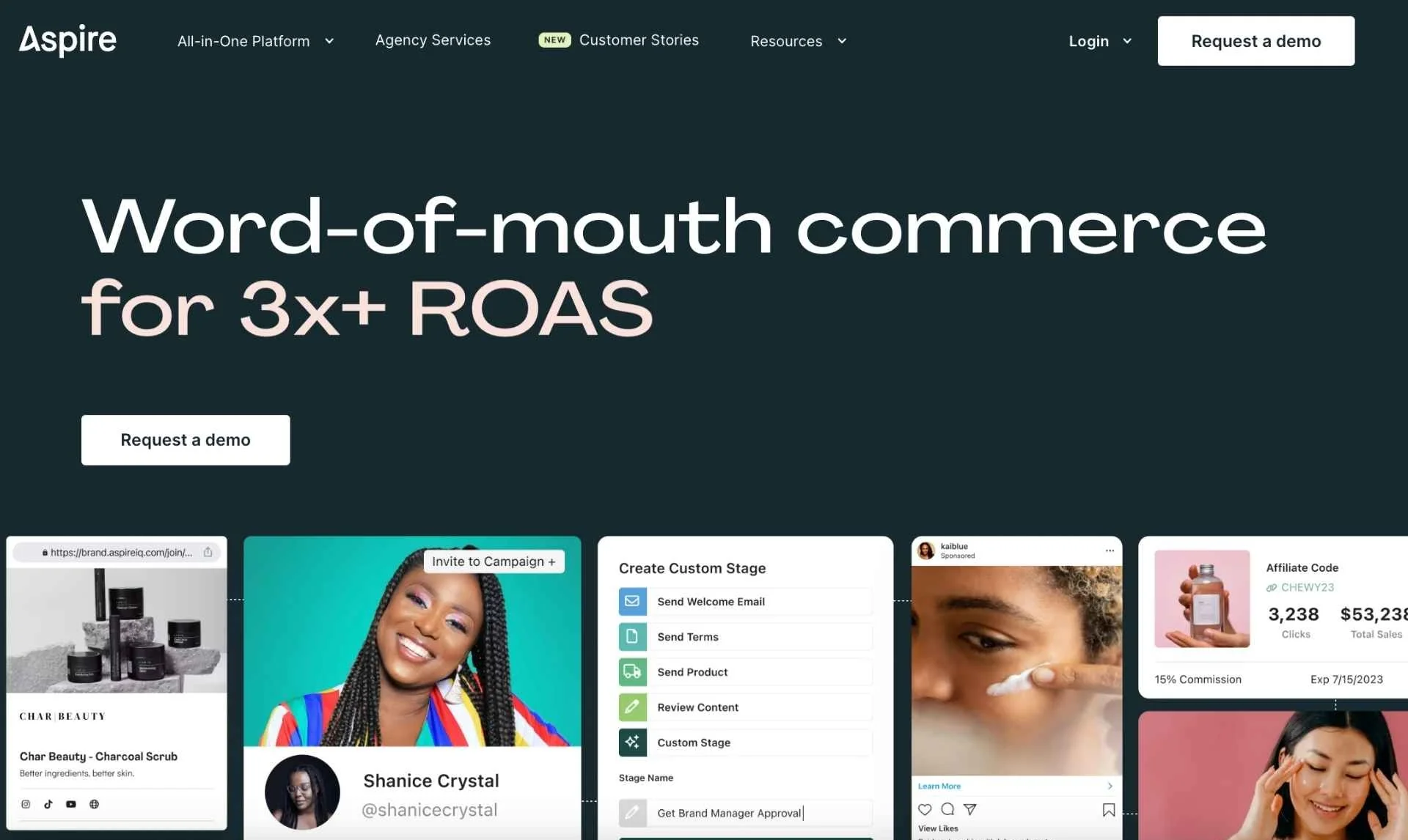
Aspire is an influencer marketing platform designed to help brands manage the full lifecycle of creator partnerships, from discovery and inbound applications to contracts, product seeding, affiliate tracking, content approvals, and reporting. It is particularly well suited to DTC and ecommerce brands that care about workflow structure, creator relationships, and UGC-heavy programs.
Key Features
• Dual discovery model: Aspire combines a searchable creator database with a built-in creator marketplace, giving brands both outbound and inbound recruitment options.
• Campaign workflow automation: Teams can manage contracts, briefs, follow-ups, content approvals, and deliverables from one workflow-driven dashboard.
• Product gifting and seeding: Aspire supports product seeding campaigns with shipment tracking, creator follow-ups, and UGC capture.
• Affiliate and commerce tools: The platform supports discount links, codes, sales tracking, and CreatorStores for influencer-led commerce.
• UGC rights and content workflows: Aspire is strong on digital terms, content licensing, and content approvals, which helps brands repurpose creator content more safely.
• Social listening and brand-fan discovery: It can surface creators already mentioning a brand and now extends that to Instagram Story tracking.
• Shopify and Gmail integrations: These integrations help connect product, outreach, and campaign workflows more tightly.
Platform Coverage
Instagram, TikTok, Pinterest, YouTube, and Facebook
Pricing
Aspire starts with tiered pricing and can be customized, with a mid-tier quote of about $2,300/month for a use case involving multiple team members and up to 500 creators in CRM.
Reviews
4.0 /5.0 (Capterra)
Standout Features
• Expanded Creator Marketplace: Aspire’s marketplace now gives brands access to 1M+ creators and lets brands generate inbound applications without fees or commissions on creator interest.
• Instagram Story Social Listening: Aspire recently added Story mention capture through its Instagram messaging integration, helping brands track a part of creator activity that is usually harder to measure.
• CreatorStores for micro-commerce: Aspire’s co-branded CreatorStores let creators showcase curated products in storefront-like experiences designed to lift conversion rates and capture first-party data.
Ainfluencer vs Aspire
Ainfluencer works better as a low-cost marketplace for brands that want to recruit influencers and manage simple collaborations on Instagram and TikTok, while Aspire is much more workflow-heavy and ecommerce-ready. Aspire offers stronger creator applications, UGC rights management, product seeding, and affiliate commerce, making it the better fit for brands running structured, repeatable creator programs.
SARAL

SARAL is an influencer marketing platform built primarily for consumer and ecommerce brands that want a simpler operating system for creator discovery, outreach, relationship management, gifting, and affiliate tracking. Its positioning is notably practical: transparent pricing, free trial access, and a workflow designed to replace spreadsheets and disconnected tools for growing brands.
Key Features
• Influencer discovery engine: SARAL helps brands find creators through public-profile search, audience insights, contact information, and creator filtering across major social platforms.
• Automated outreach: Brands can run outreach at scale with email workflows and follow-ups, reducing manual prospecting time.
• Built-in CRM: The platform centralizes creator stages, relationship tracking, shipping status, discount codes, and profile management under one roof.
• Store integrations for gifting and affiliate campaigns: SARAL integrates with Shopify and WooCommerce for sending free products, generating links/codes, and tracking performance.
• Social listening and post tracking: Higher tiers include social listening and post tracking so brands can monitor mentions and see which partnerships are working.
• Chrome extension: The extension helps save creators directly while browsing and surfaces fair-fee estimates, engagement data, predicted likes, and fan-quality insights.
• Software plus strategy support: SARAL pairs the platform with onboarding, consulting, a dedicated success manager, and access through shared Slack and Zoom support.
Platform Coverage
Instagram, TikTok, and YouTube.
Pricing
There are different plans:
• Starter: $3.6k/quarter
• Business: $4.5k/quarter
• Professional: $7.5k/quarter
Reviews
4.7/5.0 (G2)
Standout Features
• Transparent pricing with free trial: SARAL is one of the easier platforms in this group to evaluate upfront because pricing is public and trial access is available.
• Chrome extension with fair-fee guidance: Its extension does more than save creators; it also surfaces fair-fee estimates, predicted likes, and fan insights to make vetting faster.
• Software-and-strategy model: SARAL bundles onboarding, strategic support, and creator-program guidance into the platform experience, which can be especially valuable for smaller teams building their first repeatable program.
Ainfluencer vs SARAL
Ainfluencer is more of a creator marketplace with zero software cost for self-service users, while SARAL is a structured operating system for brands that want consistent discovery, outreach, CRM, and ecommerce-linked workflows. Ainfluencer is easier for lightweight campaign testing, but SARAL gives growing ecommerce brands stronger process control, better store integrations, and more scalable relationship management.
CreatorIQ
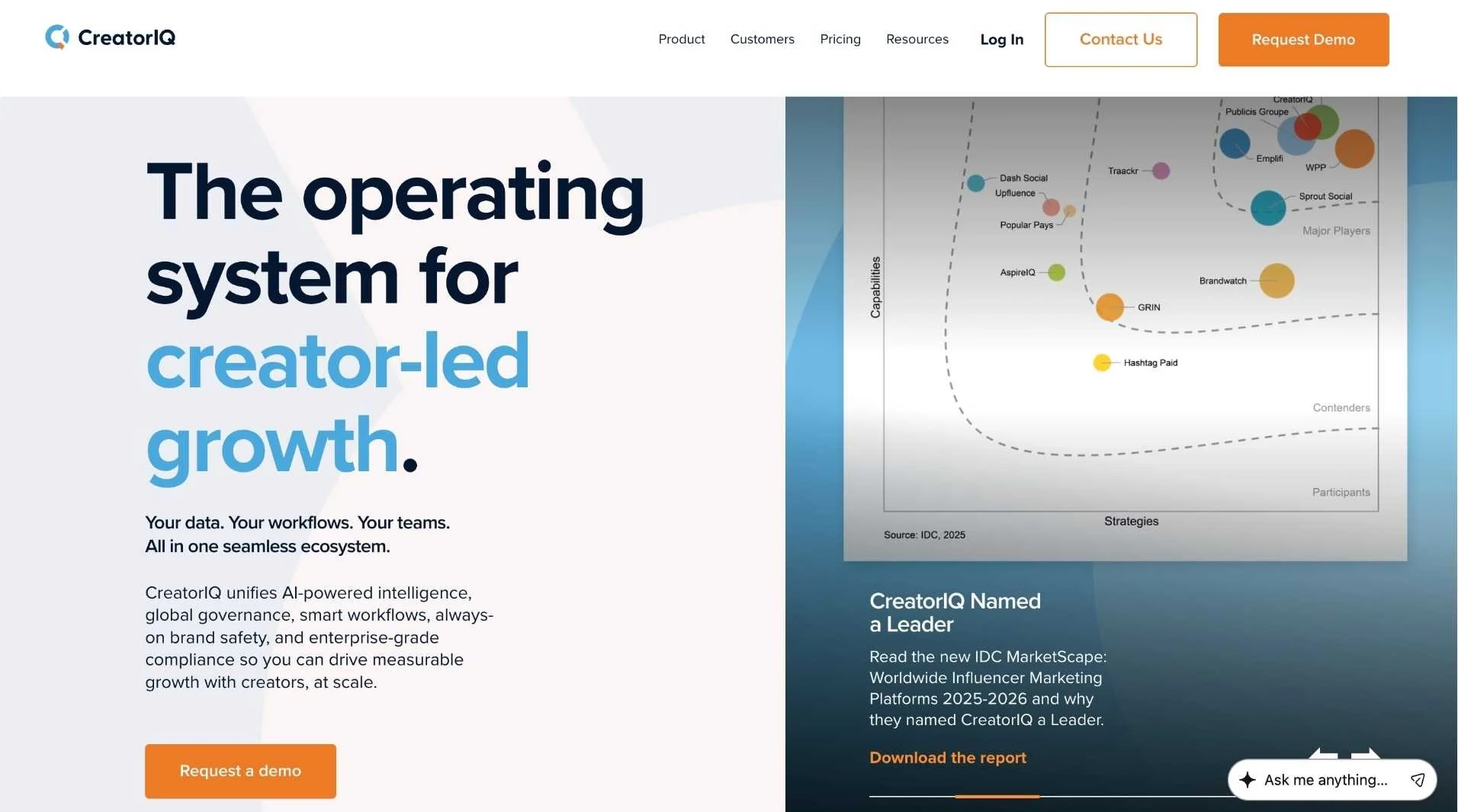
CreatorIQ is an enterprise-grade creator marketing platform built for large global brands that need scalable discovery, campaign execution, reporting, payments, and governance across markets. The company now describes itself as an AI-native operating system for creator-led growth, emphasizing unified workflows, data infrastructure, and competitive benchmarking for mature creator programs.
Key Features
• Public creator discovery with granular filtering: CreatorIQ supports deep creator search across platforms, including audience demographics, niche, keywords, prior brand mentions, and verified/business status.
• Private CRM and creator network management: Brands can build a private creator database with tags, notes, campaign history, questionnaires, and communication records.
• Campaign workflows and approvals: The platform supports campaign setup, shareable approval sheets, briefs, content review, contracts, and centralized communication.
• Shopify integration and commerce workflows: CreatorIQ includes product gifting support, link/code generation, and commerce-related reporting.
• Creator payments and compliance: CreatorIQ Pay supports international payments, compliance controls, permissions, and audit-ready workflows at scale.
• Reporting and benchmarking: The platform is particularly strong in custom dashboards, live reporting, campaign measurement, and competitive analysis.
• Enterprise integrations and API infrastructure: CreatorIQ emphasizes data unification through API and integration tooling for organizations that need creator data connected to internal systems.
Platform Coverage
Instagram, YouTube, TikTok, Facebook, Twitter, Pinterest, and more.
Pricing
• Basic Plan: Starts at $35,000/year. Includes 1,000 contact creators per month
• Standard Plan: Starts at $50,000/year. Includes 2,500 contact creators per month
• Professional Plan: Starts at $90,000/year. Includes 5,000 contact creators per month
• Enterprise Plan: Starts at $200,000/year. Includes 7,500 contact creators per month
Reviews
4.4 / 5.0 (Capterra)
Standout Features
• BenchmarkIQ: CreatorIQ’s competitive benchmarking product now spans dozens of markets and gives enterprise teams visibility into share of voice, exposure, engagement, and influence relative to competitors.
• CreatorIQ Pay global expansion: CreatorIQ Pay has expanded to support payouts in 60+ currencies across 80+ markets, strengthening its global-enterprise appeal.
• New AI-native platform architecture: The newer CreatorIQ platform brings discovery, workflow, commerce, and measurement into one updated operating system designed for scale, governance, and content-first creator programs.
Ainfluencer vs CreatorIQ
Ainfluencer is built for simpler, budget-friendly marketplace collaborations, while CreatorIQ is designed for enterprise teams that need approvals, governance, global payments, benchmarking, and cross-market reporting. The biggest difference is complexity and scale: Ainfluencer favors ease of entry, whereas CreatorIQ is better for large brands treating creator marketing as an integrated business function.


Sprout Social

Sprout Social’s influencer marketing product, built from its Tagger acquisition and now branded as Sprout Social Influencer Marketing, is aimed at mid-market and enterprise teams that want creator discovery, campaign management, brand safety, approvals, and reporting inside a broader social media software ecosystem. The platform’s current positioning leans heavily on AI-assisted creator vetting, collaborative workflows, and analytics depth rather than a lightweight marketplace model.
Key Features
• AI-powered creator discovery: Sprout uses topic-led search to help teams surface creators based on what they actually talk about, rather than relying only on static category filters.
• Brand Fit Score: This AI-driven score helps teams quantify how closely a creator’s content, audience interests, and location align with a target customer profile, speeding up vetting.
• Brand safety reporting: Teams can set custom risk parameters and proactively flag potentially problematic creator content before activation.
• Creator Lists and workflow management: The platform supports shared creator lists, review stages, approvals, contracts, and campaign tracking so cross-functional teams can work from one workflow.
• Content approval and campaign tracking: Brands can manage proposals, pre-approve content, monitor engagement, EMV, audience growth, and post-level performance from one dashboard.
• Shopify and payout workflows: Sprout’s influencer product supports product seeding through Shopify and affiliate commission payouts through PayPal-based workflows.
• Competitive and industry analysis: The platform can compare creator overlap, benchmark engagement, and surface creators talking about relevant industries and trends.
Platform Coverage
Instagram, YouTube, Facebook, TikTok, and X (Twitter)
Pricing
Starts around $1,600/month per user plus $600 per extra user.
Reviews
4.5 / 5.0 (Capterra)
Standout Features
• Brand Fit Score: Sprout’s newer Brand Fit Score gives teams a faster, more defensible way to qualify creators using content topics, audience interests, and geography rather than gut feel alone.
• Brand Safety Reports: The reimagined platform introduced more customizable AI-powered safety reports so brands can flag content risk before creator activation.
• “More Like This” creator recommendations: Sprout added AI-powered similar-creator suggestions directly from profiles and creator lists, making expansion from known good-fit creators much easier.
Ainfluencer vs Sprout Social
Ainfluencer is built around a free-to-use marketplace and escrow-protected collaborations, which makes it much easier for small teams to get started at low cost. Sprout Social, by contrast, is a higher-end operating system for creator programs, with stronger vetting, approvals, brand safety, and analytics. If Ainfluencer is optimized for affordability and quick marketplace access, Sprout is built for brands that need more governance, more collaboration, and more reporting depth.
GRIN
GRIN is a creator management platform built primarily for DTC and ecommerce brands that want to run discovery, outreach, gifting, affiliate tracking, payments, and reporting in one place. Its positioning has recently shifted toward being “free to start,” with a stronger emphasis on AI assistance, creator management, and flexible pricing than the older enterprise-only image many buyers still associate with the platform.
Key Features
• Creator discovery and CRM: GRIN helps brands discover creators, manage relationship pipelines, store notes and tags, and centralize outreach history.
• Integrated email and campaign workflows: Teams can run creator outreach from their own inbox environment, manage briefs and approvals, and keep deliverables organized in one system.
• Ecommerce-native gifting: GRIN is especially strong in product seeding, allowing brands to sync ecommerce stores, let creators choose products, automate fulfillment, and track order status.
• Affiliate and commission tracking: The platform connects creator discovery, gifting, commission tracking, and shoppable experiences for long-term creator revenue programs.
• Creator payments: GRIN includes PayPal-based payout workflows and broader financial management inside the platform.
• Content library and usage rights: GRIN stores creator content, including Stories, in a searchable library and includes media rights management features in its workflow.
• Social listening and ROI reporting: It supports real-time social listening, campaign performance monitoring, and ROI reporting tied to creator programs.
• Gia AI assistant: GRIN’s AI assistant is meant to help creator marketers prioritize work, surface creators, and automate more day-to-day tasks.
Platform Coverage
Facebook, Instagram, TikTok, X, Pinterest, YouTube, and Twitch
Pricing
Annual pricing starts at $25,000/year (approx. $2,050/month)
Reviews
4.5/5.0 (G2)
Standout Features
• Gia agentic AI: GRIN’s most distinctive recent push is Gia, positioned as an “always-on” AI creator marketer designed to assist with workflow execution, not just surface-level copy generation.
• Free-to-start and cancel-anytime pricing: The newer pricing model is a notable shift from the platform’s older annual-commitment reputation and makes GRIN more accessible to scaling teams.
• Unified ecommerce workflow: GRIN remains unusually strong at combining gifting, affiliate tracking, content collection, and creator payouts inside one ecommerce-oriented system.
Ainfluencer vs GRIN
Ainfluencer is the simpler and much lower-cost option, with free self-service access and escrow-backed deals that suit brands testing influencer marketing for the first time. GRIN is much more operationally sophisticated, especially for ecommerce teams that need integrated gifting, affiliate tracking, media rights handling, and creator CRM. The tradeoff is complexity and cost: Ainfluencer is easier to enter, while GRIN is designed to scale structured creator programs.
Modash

Modash is an end-to-end influencer marketing platform focused on discovery, outreach, campaign tracking, gifting, affiliate management, and payments, with a particularly strong fit for Shopify-connected brands. Its biggest appeal is that it works from public creator data rather than opt-in databases, which gives teams broader discovery coverage while still keeping the workflow lean and relatively transparent.
Key Features
• Large public creator database: Modash says it indexes 350M+ public creator profiles across Instagram, TikTok, and YouTube, helping teams search broadly without relying on creators to sign up first.
• Advanced discovery and filtering: Users can search by niche, captions, hashtags, engagement, audience demographics, geography, and creator history.
• AI discovery: Modash includes AI-powered search and lets marketers describe the type of creator they want, including aesthetic or vibe-based prompts.
• Influential fans / brand-follower discovery: Higher plans can identify creators who already follow or engage with your brand, which is useful for sourcing warmer leads.
• CRM and inbox integrations: The platform includes relationship management and Gmail/Outlook integration so outreach and follow-up sit inside the same workflow.
• Automatic campaign tracking: Modash tracks creator content and campaign performance without requiring creators to upload screenshots manually.
• Shopify gifting and affiliate workflows: It can generate discount codes, send product links, track orders, monitor content, and manage affiliate sales from Shopify.
• Creator payments: Modash supports global creator payouts, affiliate payouts, tax compliance, and bundled invoicing.
Platform Coverage
Modash supports influencer marketing on platforms such as Instagram, YouTube, and TikTok, providing comprehensive campaign tracking and influencer management tools.
Pricing
• Essentials: $199/month (paid annually)
• Performance: $499/month (paid annually)
• Custom Enterprise: Contact for pricing
Reviews
4.9 / 5.0 (Capterra)
Standout Features
• AI-powered discovery at public-data scale: Modash’s biggest differentiator remains its public-database model combined with AI-assisted search across 350M+ creators.
• Influential fans: On Performance and above, brands can discover creators who already follow and engage with them across Instagram, YouTube, or TikTok, which is a meaningful edge for conversion-focused outreach.
• Integrated payments and affiliate payouts: Modash has strengthened its payouts stack with global creator payments, affiliate payout automation, and fee-free payout thresholds before commissions apply.
Ainfluencer vs Modash
Ainfluencer is a marketplace with built-in escrow and a low-friction, free self-service model, which makes it attractive for budget-conscious brands. Modash is less about marketplace dynamics and more about operating a scalable creator program from public data, especially if you need stronger discovery, better tracking, Shopify gifting, and affiliate payouts. Ainfluencer is simpler and cheaper to start; Modash is stronger for data-driven sourcing and performance workflows.
Influencity

Influencity is a full influencer marketing platform that combines creator discovery, relationship management, campaign execution, reporting, social listening, and increasingly social media management into one system. Its main appeal is breadth: it is designed for teams that want flexible workflows, large-scale creator search based on public data, and the ability to add or remove capabilities without locking into a rigid long-term contract.
Key Features
• Large creator discovery database: Influencity says its discovery tools track 200M+ global creators, with filtering and analysis designed to support niche targeting.
• Influencer relationship management: Teams can build a creator database, store contact details and first-party fields, record interactions, and monitor outreach activity.
• Campaign management: Influencity supports campaign boards, workflow tracking, approvals, and performance reporting across multi-creator programs.
• Outreach and email tracking: The platform includes email outreach, templates, follow-up sequences, and performance indicators like opens, clicks, and replies.
• Shopify seeding and affiliate support: Ecommerce teams can connect Shopify for gifting, code assignment, and sales attribution.
• Influencer payments: Influencity now supports paying multiple influencers in multiple currencies inside the workflow.
• Social Hub and social listening: The platform extends beyond influencer marketing into content planning, monitoring, consumer insight, and competitor tracking.
• Exportable reporting: Teams can generate campaign reports and export data for internal or client-facing reporting.
Platform Coverage
Instagram, TikTok, YouTube, and X/Twitter
Pricing
• Professional Plan: $318/month or $3,816/year
• Business Plan: $798/month or $9,576/year
• Enterprise Plan: Custom pricing
• Auto-Tracker Add-On: $660/year (for 50 influencers)
Reviews
4.3 / 5.0 (G2)
Standout Features
• No lock-in pricing model: Influencity’s current pricing page makes flexibility a selling point, with a free trial, no mandatory permanence, and self-service cancellation.
• 200M+ creator discovery plus IRM: The combination of very broad creator search and structured relationship management remains one of its strongest differentiators for agencies and multi-market teams.
• Payments and Social Hub expansion: Influencity has continued broadening the product beyond classic discovery and outreach by adding payments, social management, and listening capabilities into the same platform.
Ainfluencer vs Influencity
Ainfluencer is more marketplace-driven and easier for brands that want to find creators and run straightforward campaigns without software fees. Influencity is more of a management platform than a marketplace, with stronger CRM, reporting, modular pricing, and broader workflow coverage. Brands that outgrow Ainfluencer’s lighter analytics and simpler discovery are more likely to appreciate Influencity’s structure and flexibility.
IZEA

IZEA is one of the longest-standing influencer marketing platforms, offering a combination of creator discovery, campaign management, content collaboration, and marketplace-based sponsorship opportunities. Positioned for brands, agencies, and creators alike, IZEA combines a SaaS platform (IZEA Flex) with a built-in creator marketplace, enabling both managed campaigns and self-service influencer collaborations at scale.
Key Features
• IZEA Flex platform (end-to-end workflow): IZEA’s core SaaS product allows brands to manage influencer discovery, outreach, campaign execution, approvals, and reporting from a centralized dashboard.
• Creator marketplace: Brands can post opportunities and receive applications from influencers, similar to a job board, making it easier to attract inbound creator interest.
• Influencer discovery and search: The platform provides access to a large creator database with filters for audience demographics, engagement metrics, content type, and niche targeting.
• Content collaboration and approvals: Teams can manage briefs, review content, request revisions, and approve deliverables directly within the platform.
• Campaign tracking and reporting: IZEA tracks campaign performance with metrics such as impressions, engagement, and content performance, with customizable reporting dashboards.
• Managed services: In addition to software, IZEA offers fully managed influencer campaigns for brands that want hands-off execution.
• Payments and contracting: IZEA supports creator payments, contract management, and compliance workflows, helping streamline financial and legal processes.
• Content and UGC licensing: Brands can secure rights to reuse influencer-generated content across paid media, websites, and other channels.
Platform Coverage
Instagram, TikTok, YouTube, Facebook, Pinterest, Snapchat, Twitch, and X (Twitter).
Pricing
IZEA does not publicly list fixed pricing tiers for all products, but it offers two main approaches:
• IZEA Flex (self-serve SaaS): Typically offered via custom pricing based on usage, features, and scale.
• Managed Services: Fully customized pricing depending on campaign scope, creator volume, and level of service.
In practice, this means pricing is quote-based, often structured as annual contracts for software access or campaign-based pricing for managed services.
Reviews
3.9/ 5.0 (G2)
Standout Features
• Hybrid SaaS + marketplace model: IZEA combines a traditional influencer marketing platform with a built-in marketplace where creators actively apply to campaigns, offering both outbound and inbound collaboration options.
• Content-focused approach beyond social: Unlike many competitors, IZEA places strong emphasis on sponsored content, blogging, and digital media placements in addition to social influencer campaigns.
• Managed services at scale: IZEA’s ability to run fully managed influencer campaigns alongside its software platform makes it appealing for brands that want both technology and execution support in one provider.
Ainfluencer vs IZEA
Ainfluencer and IZEA both offer marketplace-style collaboration, but IZEA is more mature and structured, with stronger campaign workflows, content licensing, and enterprise support. Ainfluencer stands out for its free-to-use model and simplicity, while IZEA operates as a paid, more comprehensive platform with broader content capabilities and managed services. Brands looking for low-cost entry may prefer Ainfluencer, whereas those needing scalable campaign management and multi-channel content execution may lean toward IZEA.
Final Thoughts on Ainfluencer Alternatives
Ainfluencer stands out as a highly accessible, cost-effective entry point into influencer marketing with its free marketplace model and escrow-based payments, making it especially appealing for smaller teams or brands testing campaigns. However, as highlighted across the alternatives, many competing platforms offer more advanced capabilities—such as deeper analytics, robust CRM workflows, ecommerce integrations, AI-driven discovery, and scalable campaign management—which become increasingly important for growing or enterprise-level programs. Ultimately, the right choice depends on a brand’s maturity, budget, and need for data, automation, and operational control.