

Influential Alternatives: Best Influencer Marketing Platforms
Choosing the right influencer marketing software has become essential for teams that need to efficiently manage creator discovery, outreach, campaign workflows, and performance tracking across multiple platforms. Influential is widely recognized as an enterprise-grade solution, offering strong capabilities in large-scale campaign execution, data-driven creator matching, and integrated reporting. However, it may not fit every team’s needs—many users point to limited pricing transparency, a steep cost structure that can be difficult for mid-sized brands to justify, and occasional challenges with data accuracy or platform usability, which can slow down campaign execution. As a result, marketers often explore Influential alternatives that provide more flexible pricing, stronger ecommerce integrations, or simpler workflows tailored to their internal processes.
To help you evaluate the right fit, this guide compares some of the most popular Influential alternatives, including Influencer Hero, Upfluence, Aspire, SARAL, CreatorIQ, Sprout Social, GRIN, Modash, Influencity, and IZEA.
Criteria for Suggesting Platform Alternatives
Core Features
Evaluation of each platform’s essential capabilities, including influencer discovery, outreach, CRM, campaign reporting, gifting, UGC and content collection, affiliate tracking and payments, storefronts, application pages, and AI-powered tools.
Supported Social Media Platforms
Assessment of how well each platform integrates with major social networks such as Instagram, YouTube, TikTok, Facebook, Pinterest, and many more
Pricing & Contract Flexibility
Comparison of pricing models, subscription costs, and contract requirements to help brands choose solutions that match their budget and scalability needs.
Standout & Differentiating Features
Highlighting unique or innovative functionalities that set each platform apart, such as real-time tracking dashboards, creator benchmarking, TikTok email discovery, or advanced automation tools.
Customer Reviews & User Satisfaction
Analysis of verified user feedback from credible platforms like G2, TrustRadius, Capterra, focusing on usability, reliability, value for money, customer support, and real-world performance.
Influential Overview

Influential is an enterprise-focused influencer marketing platform and services company that now operates as Influential powered by Captiv8. Public-facing materials position it as a large-scale solution for brands that want creator discovery, campaign execution, measurement, affiliate workflows, and social commerce tracking in one stack. Influential says it is trusted by more than 60% of the Fortune 500, works with a network of 3.5M+ creators, and gives brands access to 15M+ creators through the Captiv8 platform.
Key Features
- AI-powered creator discovery: Influential uses AI models, natural language processing, and machine learning to segment creator profiles and surface brand-fit matches based on past campaign performance and audience alignment.
- Image and content analysis: The platform applies computer vision to analyze photo content for objects, actions, emotions, and logo detection, making visual signals searchable during discovery and vetting.
- Deep profile insights: In profile-level account insights, teams can review engagement data, recent media, image analysis, brand mentions, brand partnerships, personality insights, follower growth, and audience demographics.
- End-to-end campaign execution: Influential positions Captiv8 as a unified workflow for creator discovery, campaign execution, performance intelligence, and campaign measurement rather than just a search database.
- Affiliate and social commerce measurement: The platform now emphasizes combined influencer and affiliate workflows, with affiliate integrations and social commerce tracking built into the same system.
- Social listening and exclusivity monitoring: Its Social Tracker can be used for campaign tracking, keyword-based listening, competitor monitoring, and checking whether partnered creators mention competing brands during exclusivity windows.
- Automated payments and reporting: User feedback consistently highlights streamlined creator payments, real-time campaign data, and simpler reporting as practical strengths for teams running high-volume programs.
Platform Coverage
Instagram, Facebook, YouTube, TikTok, and Snapchat
Pricing
Influential does not publicly list package pricing or plan tiers on its website. Instead, buyers are directed to request a demo or contact sales, which strongly suggests a custom, sales-led enterprise quote.
Reviews
4.7/5.0 (G2)
Influential Standout Features
- Unified influencer + affiliate measurement: One of Influential’s clearest current differentiators is that it now positions creator marketing and affiliate marketing inside the same workflow, with affiliate integrations, social commerce tracking, and campaign measurement tied together instead of split across separate tools.
- TikTok ad authorization workflow: The platform supports TikTok-specific ad activation by letting users generate a TikTok video code for ad authorization, which is especially useful for brands that want to turn creator posts into paid media without leaving the broader campaign workflow.
- Social Tracker for exclusivity and listening: Beyond standard reporting, Influential’s Social Tracker can monitor competitor mentions, enforce exclusivity periods, and pull topic-based conversations into one feed, giving teams an operational layer many discovery-first tools do not emphasize.
Limitations (Why Users Look for Influential Alternatives)
Pricing feels enterprise-heavy and hard to justify for smaller teams
Multiple reviewers describe the platform as expensive, with public pricing still opaque, which can make it a difficult fit for smaller brands or lean agencies.
Some data points and search filters are not always perfectly reliable
Users call out issues around creator categorization, demographic accuracy in certain filters, fraud/bot visibility, and occasional mismatches when searching by URL or profile.
The platform can take time to learn
Even satisfied customers mention a learning curve, non-intuitive areas of the workflow, and friction when comparing creator profiles side by side.
Payment and support complaints still appear in user feedback
While many reviews praise support, there are also recurring complaints about slow support, buggy areas of the product, and delayed creator payments, which can be serious issues for brands running deadline-driven campaigns.
10 Best Influencer Marketing Platform Alternatives:
| TOOL | REVIEWS | BEST FOR | TRIAL INFO | PRICING | ||
|---|---|---|---|---|---|---|
1 |

|
⭐ | Influencer CRM & automation | Book Demo | Pricing | Website |
2 |

|
⭐ | Influencer discovery | Book Demo | Pricing | Website |
3 |

|
⭐ | Influencer partnerships | Book Demo | Pricing | Website |
4 |

|
⭐ | Influencer outreach | Book Demo | Pricing | Website |
5 |

|
⭐ | Enterprise influencer marketing | Book Demo | Pricing | Website |
6 |
|
⭐ | Influencer marketing & Social media analytics | Book Demo | Pricing | Website |
7 |

|
⭐ | DTC creator management | Book Demo | Pricing | Website |
8 |

|
⭐ | Influencer discovery | Book Demo | Pricing | Website |
9 |

|
⭐ | Campaign management | Book Demo | Pricing | Website |
10 |

|
⭐ | Influencer marketplace | Book Demo | Pricing | Website |
Influencer Hero

Influencer Hero is an all-in-one influencer marketing platform built for DTC brands, ecommerce teams, and agencies that want discovery, outreach, gifting, affiliate tracking, and ROI reporting in one workflow. Its positioning is notably more execution-focused than many discovery-first tools, with a strong emphasis on CRM automation, store integrations, and turning creator activity into measurable revenue.
Key Features
- Influencer discovery: Search creators across major platforms with advanced audience, engagement, location, and niche filters, plus fraud detection and lookalike recommendations
- Outreach & automation: Run personalized outreach at scale with AI-assisted messaging, automated follow-ups, and multi-step email sequences
- Influencer CRM: Centralize creator relationships with pipeline management for conversations, campaign stages, and deliverables
- Gifting workflows: Manage product seeding end-to-end with automated order creation, shipment tracking, and delivery monitoring
- Affiliate tracking & payouts: Create trackable links and discount codes, measure performance, and manage commissions and payments in one workflow
- Campaign analytics & ROI tracking: Track engagement, clicks, conversions, and revenue through real-time dashboards tied to campaign performance
- UGC library: Automatically capture and organize creator content for reuse across paid ads, social media, and eCommerce channels
- Application pages & storefronts: Build branded creator application pages and enable influencers to promote products through personalized storefronts
- eCommerce integrations: Connect directly with platforms like Shopify and WooCommerce to link influencer activity to sales and attribution
- API & integrations: Expand capabilities with API access and integrations such as Klaviyo, Slack, Zapier, and email platforms
Platform Coverage
Instagram, TikTok, YouTube, Facebook, Pinterest, Snapchat, X, and Twitch
Pricing
Influencer Hero offers flexible pricing based on outreach volume, and you can have unlimited creators in your CRM with Influencer Hero:
- Standard — $649/month (up to 1,000 reachouts/month)
- Pro — $1,049/month (up to 5,000 reachouts/month)
- Business — $2,490/month (up to 10,000 reachouts/month)
- Custom / Agency — Tailored pricing
Reviews
5.0/5.0 (Capterra)
Standout Features
- AI-powered CRM automation: Influencer Hero’s biggest differentiator is how deeply it bakes automation into campaign operations, from follow-ups and stage changes to AI-assisted outreach and predictive workflow suggestions.
- Bulk Tools for Scalable Operations: Run influencer marketing at scale with bulk actions for outreach, follow-ups, product seeding, campaign updates, and deal management. The batching feature allows teams to execute high-volume tasks efficiently without sacrificing organization or accuracy.
- Influencer discovery from owned data: Newer integration materials show a useful angle beyond database search: identifying creators already inside your email lists or customer base, then activating them through your CRM and campaigns.
Influential vs Influencer Hero
Influential is more clearly positioned for enterprise-scale brand campaigns, large managed-service engagements, and social commerce measurement across a very large creator network. Influencer Hero, by contrast, is more transparent on pricing, more accessible for mid-market ecommerce brands, and more centered on workflow automation, gifting, affiliate tracking, and CRM execution.
Another key difference is operating style. Influential leans heavily into enterprise services and brand-safe campaign execution, while Influencer Hero is built to let leaner in-house teams run discovery, outreach, seeding, UGC collection, and revenue attribution from one system without the same level of contract friction or opaque pricing.
Upfluence
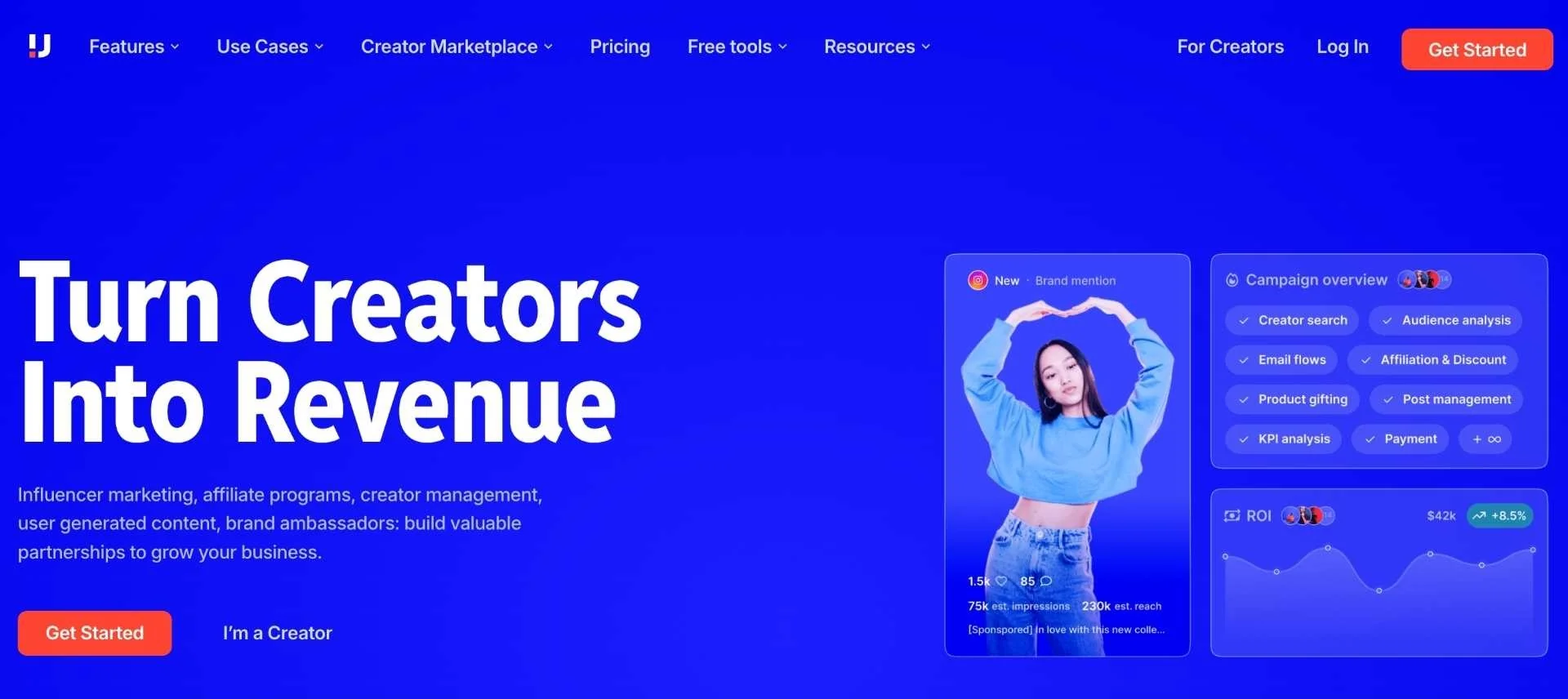
Upfluence is an established influencer marketing platform designed around ecommerce growth, creator discovery, affiliate management, and sales attribution. It is especially popular with online retailers because it combines influencer workflows with store data, allowing brands to identify creators, manage outreach, seed products, and connect creator activity to revenue.
Key Features
- Large influencer database with advanced filters: Upfluence provides access to a large creator dataset with filters for location, niche, engagement, audience demographics, content type, and historical brand activity.
- AI-assisted discovery and setup: Internal materials highlight AI campaign assistance and smarter influencer matching, helping teams move from manual prospecting to more structured creator sourcing.
- Bulk outreach and email automation: Upfluence supports bulk email outreach and follow-up sequences, plus integrations with Gmail and Outlook for centralized communication.
- CRM and campaign management: Brands can organize creators, track conversations, manage deliverables, and monitor campaign progress inside the platform rather than across spreadsheets and inboxes.
- Shopify and Amazon integrations: This is one of Upfluence’s strongest features. It can sync with Shopify and Amazon to identify customers who are influencers, run gifting campaigns, create affiliate programs, and attribute sales to creators.
- Affiliate tracking and payouts: The platform supports affiliate links, custom compensation models, and creator payments, making it a better fit for revenue-led influencer programs than tools focused mostly on awareness.
Platform Coverage
Instagram, TikTok, YouTube, Facebook, Twitch, Pinterest, and blogs.
Pricing
On average plans start around $2,000/month ($24,000 yearly)
Reviews
4.3 / 5.0 (Capterra)
Standout Features
- Customer-to-creator identification: Upfluence’s ability to identify influencers already in your Shopify customer base remains one of its sharpest differentiators for ecommerce brands.
- Amazon plus Shopify attribution: Few platforms lean as hard into both Shopify and Amazon workflows, which makes Upfluence attractive for brands that sell across multiple commerce environments.
- Jace AI and outreach automation: Its AI campaign assistant and email sequencing tools push it beyond simple search-and-contact functionality into more scalable outreach orchestration.
Influential vs Upfluence
Influential is the more enterprise-oriented option, with a stronger emphasis on brand-safe execution, large-scale service support, and enterprise social commerce measurement. Upfluence is the more commerce-native choice, built around Shopify and Amazon integrations, affiliate links, gifting, and ROI attribution for online retailers.
The practical difference is that brands focused on proving direct revenue from creator programs often prefer Upfluence’s ecommerce stack, while larger organizations that want broader enterprise support and a more managed operating model may lean toward Influential.
Aspire
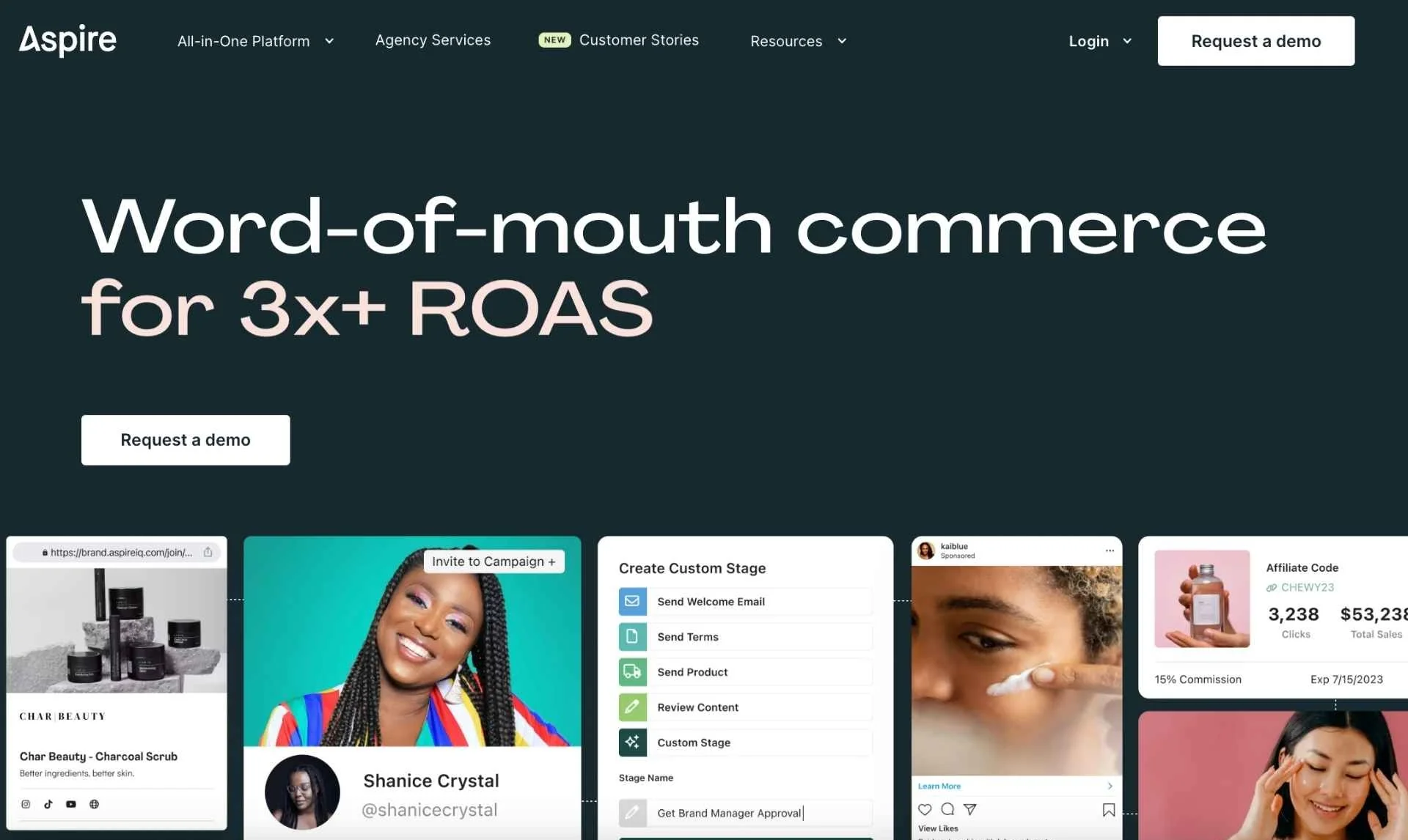
Aspire is an influencer marketing platform built around what it calls word-of-mouth commerce. It combines influencer discovery, creator marketplace workflows, campaign management, affiliate tools, product seeding, and paid media extensions, making it a strong fit for ecommerce brands that want both inbound creator applications and structured outbound campaigns.
Key Features
- Influencer search plus inbound marketplace: Aspire lets brands search millions of creators and also post campaigns to a creator marketplace, which can reduce manual prospecting and help attract creators already interested in the brand.
- First-party platform data: Aspire emphasizes direct partnerships with Meta, TikTok, and Pinterest, which helps improve data reliability for creator insights and campaign performance.
- Workflow automation: The platform supports automated follow-ups, bulk actions, approvals, contracts, and campaign stage management, which helps smaller teams manage larger creator volumes efficiently.
- Shopify-led gifting and fulfillment: Brands can let creators shop from a pre-approved catalog, apply budget or bundle limits, and manage product gifting inside the workflow.
- Affiliate and sales tracking: Aspire supports promo codes, links, creator stores, commission structures, and payout reporting, with strong emphasis on creator-led commerce.
- Content library and repurposing: The platform centralizes creator content and usage rights, supporting both campaign reporting and repurposing for paid social.
Platform Coverage
Instagram, TikTok, Pinterest, YouTube, and Facebook
Pricing
Aspire starts with tiered pricing and can be customized, with a mid-tier quote of about $2,300/month for a use case involving multiple team members and up to 500 creators in CRM.
Reviews
4.0 /5.0 (Capterra)
Standout Features
- Creator Marketplace plus outbound search: Aspire’s blend of active search and inbound creator applications is one of its biggest competitive strengths, especially for brands building ambassador or affiliate programs.
- First-party data partnerships: Its direct ties with Meta, TikTok, and Pinterest give it a strong data-quality advantage over tools that rely more heavily on scraping or weaker connectors.
- Newer affiliate commerce tooling: Aspire’s recent case-study materials highlight newer affiliate features such as stacked discount codes and gift-with-purchase incentives, showing continued investment in revenue-driving creator commerce.
Influential vs Aspire
Influential is the more traditional enterprise platform, with stronger emphasis on enterprise service layers and large-brand campaign orchestration. Aspire is more commerce-focused and more creator-workflow-oriented, with a particularly strong mix of marketplace applications, gifting, affiliate tools, and first-party social data.
If your team wants to scale creator relationships with a combination of inbound demand and automated workflows, Aspire is often the more flexible choice. If you want a more enterprise-managed environment with heavier service support, Influential is the closer fit.
SARAL

SARAL is an influencer marketing operating system built mainly for ecommerce brands that want a simpler, more execution-friendly way to run seeding, affiliate, and ambassador programs. Its positioning is less enterprise and more operator-focused: find creators, automate outreach, manage relationships, track performance, and handle payments from one place.
Key Features
- Discovery engine for untapped creators: SARAL’s discovery product is built around finding creators on public profiles rather than waiting for opt-ins, with search, similar creator recommendations, and filters aimed at brand-fit recruiting.
- Automated outreach: A core part of SARAL’s value proposition is email outreach automation, unlimited connected email accounts, and a simplified workflow for scaling creator prospecting without stitching together multiple tools.
- Relationship management: SARAL includes board-style relationship tracking, lists, and stage management so teams can manage negotiations, gifting, and long-term partnerships more systematically.
- Performance tracking across key creator platforms: It tracks creator performance across Instagram, TikTok, and YouTube in one dashboard and supports exportable reporting for internal teams.
- Affiliate, gifting, and payments: SARAL supports Shopify and WooCommerce integrations for gifting, affiliate tracking, codes, sales monitoring, and creator payments.
- Social listening on higher tiers: Its current pricing page highlights full social listening as part of the Professional plan, which broadens its use beyond basic outreach and seeding.
Platform Coverage
Instagram, TikTok, and YouTube.
Pricing
There are different plans:
- Starter: $3.6k/quarter
- Business: $4.5k/quarter
- Professional: $7.5k/quarter
Reviews
4.7/5.0 (G2)
Standout Features
- Simple, operator-first workflow: SARAL’s biggest differentiator is not enterprise depth but simplicity. It is designed to replace multiple tabs and tools with one operational workflow for creator seeding and affiliate programs.
- Unlimited outreach infrastructure: The pricing page explicitly states SARAL does not charge based on the number of influencers managed and supports unlimited connected email accounts and outreach volume, which is unusually generous in this category.
- Discovery plus commerce integrations: Its combination of creator discovery with Shopify/WooCommerce gifting, affiliate tracking, and payments makes it particularly relevant for DTC brands trying to operationalize creator programs quickly.
Influential vs SARAL
Influential is aimed at larger enterprise brands with bigger budgets, more complex campaign governance, and broader service-led execution. SARAL is a lighter-weight operating system for ecommerce teams that need speed, simplicity, and practical creator workflows without enterprise overhead.
In short, Influential is the more robust enterprise platform, while SARAL is the more approachable option for teams prioritizing creator outreach, relationship management, seeding, and affiliate execution over heavyweight enterprise analytics.
CreatorIQ
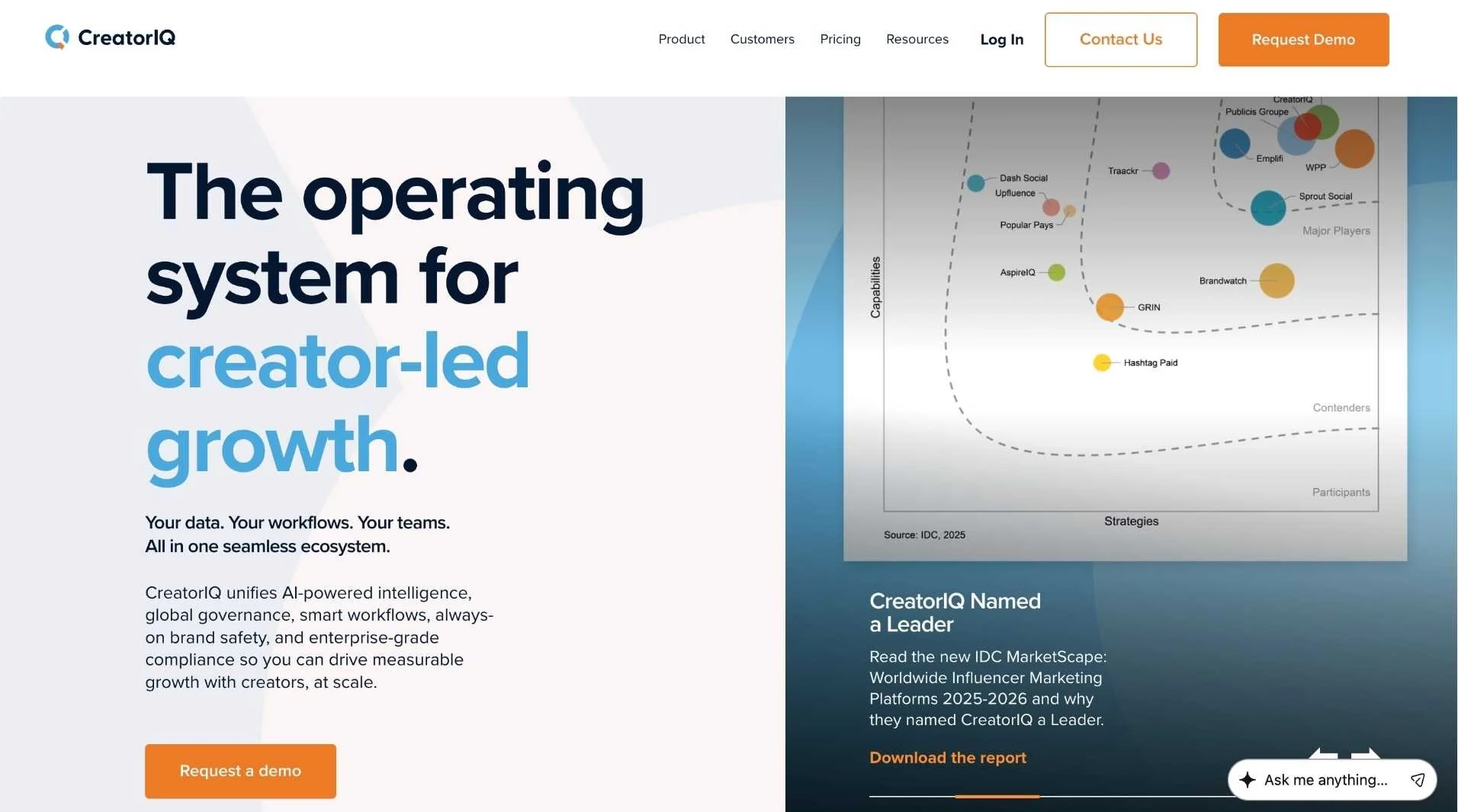
CreatorIQ is one of the best-known enterprise influencer marketing platforms, built for global brands that need scale, governance, brand safety, and structured workflows across large creator programs. Its product positioning is increasingly AI-native, with Creator Graph intelligence, enterprise governance, creator payments, brand safety infrastructure, and measurement built into one ecosystem.
Key Features
- AI-powered creator discovery: CreatorIQ’s discovery stack combines public creator search, semantic filtering, audience intelligence, and recommendation systems to help brands find relevant creators faster and with more control over brand fit.
- Private creator CRM: Teams can build a private creator network with tags, notes, campaign history, questionnaires, contact data, and communication records.
- Campaign execution and approvals: The platform supports campaign templates, creator-specific deliverables, briefs, shareable one-sheet approvals, and content review workflows that suit larger, cross-functional teams.
- Measurement and reporting: CreatorIQ is particularly strong in customizable reporting, live dashboards, and cross-team visibility, which is a major reason large brands choose it over lighter-weight tools.
- Integrated payments and compliance: CreatorIQ Pay streamlines payouts, tax handling, and compliance, helping brands centralize operational and finance workflows.
- Brand safety and benchmarking: Newer product layers like SafeIQ and BenchmarkIQ show CreatorIQ’s continued investment in enterprise controls and performance benchmarking rather than just creator search.
Platform Coverage
Instagram, YouTube, TikTok, Facebook, Twitter, Pinterest, and more.
Pricing
- Basic Plan: Starts at $35,000/year. Includes 1,000 contact creators per month
- Standard Plan: Starts at $50,000/year. Includes 2,500 contact creators per month
- Professional Plan: Starts at $90,000/year. Includes 5,000 contact creators per month
- Enterprise Plan: Starts at $200,000/year. Includes 7,500 contact creators per month
Reviews
4.4 / 5.0 (Capterra)
Standout Features
- SafeIQ brand safety infrastructure: CreatorIQ is actively expanding beyond campaign management into proactive, multimodal brand safety, which is highly relevant for enterprise buyers.
- CreatorIQ + Sprinklr integration: Its newer Sprinklr partnership brings creator, owned, earned, and paid measurement closer together, which is a notable differentiator for brands managing creator alongside broader social operations.
- The Creator Graph and AI-native workflows: CreatorIQ’s AI layer is not just for search; it underpins recommendations, governance, and scaled workflow management across global teams.
Influential vs CreatorIQ
Influential and CreatorIQ both target enterprise buyers, but they differ in emphasis. Influential leans more into managed campaign execution and enterprise social commerce support, while CreatorIQ is especially strong in global governance, reporting structure, compliance, and large-team workflow control.
For brands that need a true operating system for large, multi-market creator programs, CreatorIQ is often the more infrastructure-heavy option. For brands that value enterprise service support and broader creator commerce execution, Influential may feel more campaign-centric.


Sprout Social

Sprout Social Influencer Marketing, which evolved from Tagger, is an enterprise-focused influencer marketing platform built to help brands discover creators, vet fit, manage campaigns, and report on performance inside the broader Sprout ecosystem. Its positioning is strongest for teams that want influencer workflows connected to social intelligence, reporting, and brand governance rather than just outreach automation.
Key Features
- AI-powered creator discovery: Sprout Social uses semantic discovery and AI-assisted search to help teams find creators by topic, audience alignment, and engagement patterns rather than relying only on manual keyword searches.
- Brand Fit Score: Its Brand Fit Score gives marketers a quantified way to assess how closely a creator’s content and audience align with a brand, reducing manual vetting time.
- Brand safety controls: The platform includes brand safety workflows that help teams screen creators for risky content and make more conservative partnership decisions.
- Campaign workflow management: Sprout supports creator lists, approvals, proposals, contracts, and performance tracking in one campaign workflow, which is especially useful for larger teams with review layers.
- Competitive benchmarking and reporting: It is particularly strong in reporting, with campaign analytics, customizable dashboards, benchmarking, and export-ready presentations for internal stakeholders.
- Marketplace and recruiting tools: Newer release notes show Sprout expanding its recruiting layer with creator applications, creator marketplace badges, and verified creator attributes to make qualification faster.
Platform Coverage
Instagram, YouTube, Facebook, TikTok, and X (Twitter)
Pricing
Starts around $1,600/month per user plus $600 per extra user.
Reviews
4.5 / 5.0 (Capterra)
Standout Features
- Brand Fit Score in Creator Lists: Sprout recently added the ability to view, sort, and filter Brand Fit Scores directly inside creator lists, which makes shortlist building much faster for enterprise teams.
- Recruit and creator applications: Its 2026 updates introduced stronger creator recruiting features, including creator marketplace badges and verified creator attributes that go beyond what public profile scraping alone can provide.
- Signals and competitive intelligence: Signals remains one of Sprout’s strongest differentiators because it helps brands pull creators, content, and trends from keyword-based social intelligence, not just profile search.
Influential vs Sprout Social
Influential is more directly positioned as an enterprise creator marketing and commerce platform, while Sprout Social is stronger for brands that want influencer marketing tied into a wider social media management and intelligence stack. Influential leans more into end-to-end creator execution and enterprise creator commerce, while Sprout stands out for analytics, benchmarking, and safer creator vetting.
Another practical difference is operating style. Sprout Social is a better fit when influencer marketing sits inside a broader social team that also values listening, dashboards, and cross-channel reporting. Influential is usually the more campaign-centric choice for brands prioritizing creator operations and commerce at enterprise scale.
GRIN
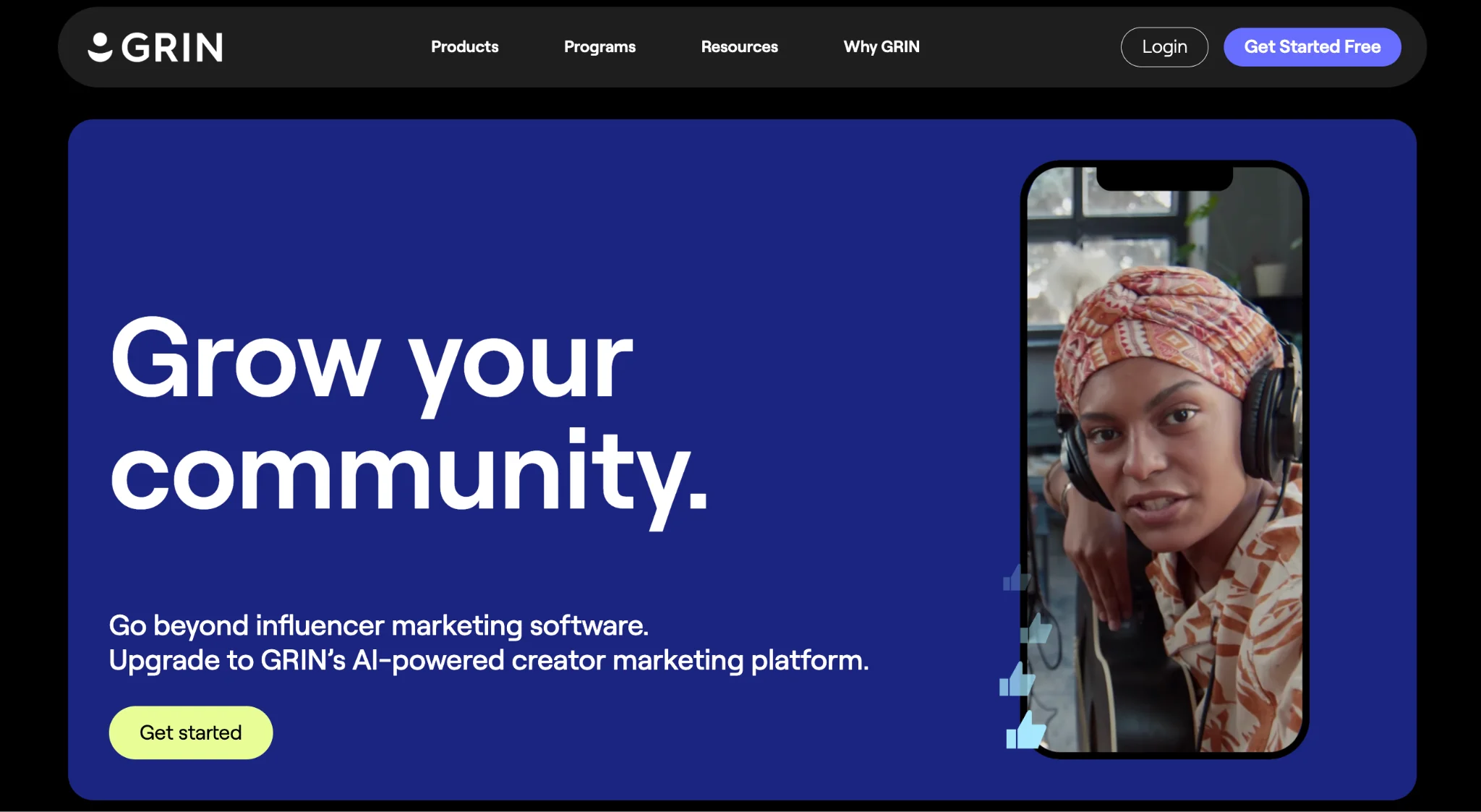
GRIN is a creator management platform built primarily for ecommerce and DTC brands that want to run influencer, affiliate, ambassador, and customer-creator programs in one system. Its messaging has shifted recently from a sales-led enterprise platform to a more accessible, AI-native product with self-serve onboarding and flexible pricing.
Key Features
- Creator discovery and recruitment: GRIN offers creator search, recruitment, and outreach workflows designed for brands that want to build direct relationships instead of relying on marketplaces alone.
- Influencer CRM: The platform centralizes creator relationships with tags, campaign history, comms, deliverables, and performance data in one place.
- Email outreach and automation: GRIN supports templates, email sequences, and tracked outreach so teams can scale creator communications without leaving the platform.
- Ecommerce gifting and product seeding: Product seeding is one of GRIN’s biggest strengths, with storefront and fulfillment workflows that let creators select products while brands track inventory and delivery.
- Affiliate tracking and payouts: GRIN supports commission programs, branded content, creator payments via PayPal, and affiliate-style workflows in the same system.
- UGC and content management: The platform automatically pulls creator content into a searchable library so teams can reuse assets across marketing channels.
- AI layer through Gia: GRIN now heavily emphasizes Gia, its AI creator marketing agent, to help with creator discovery, outreach, gifting, and performance tracking.
Platform Coverage
Facebook, Instagram, TikTok, X, Pinterest, YouTube, and Twitch
Pricing
Annual pricing starts at $25,000/year (approx. $2,050/month)
Reviews
4.5/5.0 (G2)
Standout Features
- Gia, the agentic AI assistant: GRIN’s biggest recent differentiator is Gia, which the company positions as an always-on AI creator marketer that can help find creators, draft outreach, coordinate gifting, and track outcomes.
- Free-to-start, self-serve access: GRIN’s 2026 move to instant self-serve onboarding and month-to-month pricing is a notable market shift for a platform long associated with custom enterprise sales cycles.
- Deep ecommerce workflows: GRIN remains especially strong in ecommerce gifting, storefront-style product selection, affiliate tracking, and creator payments, which is why it continues to resonate with DTC brands.
Influential vs GRIN
Influential is more enterprise-oriented and better known for large-scale creator campaigns, enterprise reporting, and broader managed-service positioning. GRIN is more ecommerce-native, with stronger day-to-day workflows for seeding, affiliate tracking, creator CRM, and product-led partnerships.
The other big difference is accessibility. GRIN is now far easier to start with thanks to self-serve onboarding and flexible pricing, while Influential still feels more like a traditional enterprise buy. For DTC and Shopify-heavy teams, GRIN usually feels more operational; for larger brands wanting enterprise creator infrastructure, Influential often feels broader.
Modash

Modash is an influencer marketing platform built for brands that want a very discovery-heavy, data-driven workflow across creator search, outreach, tracking, influencer gifting, and payments. Its product is intentionally focused: instead of trying to cover every possible enterprise use case, it leans into speed, public-profile coverage, and execution for leaner teams.
Key Features
- Massive public creator database: Modash says it indexes more than 350 million public creators across Instagram, TikTok, and YouTube, making it one of the largest discovery datasets in the category.
- Advanced discovery filters: Teams can search by niche, captions, hashtags, demographics, platform, location, follower count, and engagement, which makes Modash especially strong for niche creator sourcing.
- AI search: Modash now supports AI-based creator search, letting users describe the kind of creator they want and then refine results with traditional filters.
- Influencer email finder and outreach: If a creator has a public email, Modash can surface it, and the platform supports bulk outreach with variables for more personalized large-scale communication.
- Campaign tracking and content monitoring: It tracks content, impressions, reach, engagement, affiliate sales, and creator performance in real time.
- Shopify-linked gifting and affiliate workflows: Modash is tightly aligned to Shopify for gifting, discount codes, affiliate links, and payouts.
Platform Coverage
Modash supports influencer marketing on platforms such as Instagram, YouTube, and TikTok, providing comprehensive campaign tracking and influencer management tools.
Pricing
- Essentials: $199/month (paid annually)
- Performance: $499/month (paid annually)
- Custom Enterprise: Contact for pricing
Reviews
4.9 / 5.0 (Capterra)
Standout Features
- AI search plus precision filters: Modash’s newer AI search is particularly strong because it works as a layer on top of granular filters instead of replacing them.
- Find Your Fans / Influential Fans: This feature identifies creators who already follow or actively engage with your brand, which can raise response rates and improve campaign authenticity.
- Large public-profile coverage: Modash’s biggest structural advantage remains that it is not limited to opt-in creators, which makes it unusually powerful for discovery-led teams.
Influential vs Modash
Influential is the more enterprise-heavy platform, better suited to big-brand governance, broader managed support, and enterprise creator commerce. Modash is the more focused tool for discovery, outreach, and Shopify-linked creator execution.
In practical terms, brands choose Modash when they want speed, huge public creator coverage, and transparent pricing. They choose Influential when they need a more enterprise-grade operating model, wider service support, and a platform built for larger campaign organizations.
Influencity

Influencity is a collaborative influencer marketing platform designed to help brands and agencies run discovery, relationship management, campaign execution, and reporting from one place. Its positioning is notably practical and workflow-oriented, with an emphasis on broad creator data, flexible campaign management, and usability for both brands and agencies.
Key Features
- Large influencer database: Influencity says its software can search across 200+ million influencers, updated in real time, with more than 20 search criteria.
- Public-data discovery: A key advantage is its use of public data, allowing discovery beyond opt-in databases and helping teams search by category, engagement, audience, and lookalikes.
- Influencer relationship management: The platform includes a dedicated IRM layer for storing influencer details, first-party data, custom fields, communications, and activity history.
- Campaign management and tracking: Influencity lets teams launch campaigns, track content, and measure performance from one place, including automated retrieval of tracked content.
- Automated email tracking and outreach support: It supports communication monitoring and email tracking so teams can keep outreach tied to campaign operations.
- Reporting and analytics: The platform is built around exportable reports and practical campaign analysis, which is one reason agencies tend to rate it well.
- Expansion beyond influencer marketing: Public product pages now position Influencity as part of a larger tech suite that also includes social listening and social media management features.
Platform Coverage
Instagram, TikTok, YouTube, and X/Twitter
Pricing
- Professional Plan: $318/month or $3,816/year
- Business Plan: $798/month or $9,576/year
- Enterprise Plan: Custom pricing
- Auto-Tracker Add-On: $660/year (for 50 influencers)
Reviews
4.3 / 5.0 (G2)
Standout Features
- Public-data discovery at scale: Influencity’s strongest differentiator remains the breadth of its public-data-driven discovery model, which helps teams find creators outside closed networks.
- IRM plus first-party data fields: Its IRM is more robust than many lower-cost competitors because it supports custom fields, contact details, performance tracking, and communication history in the same workspace.
- Broader tech-suite expansion: Influencity is increasingly pushing beyond influencer marketing into social listening and social media management, which could matter for teams consolidating tools.
Influential vs Influencity
Influential is more enterprise-led and service-oriented, with a heavier focus on large-brand creator commerce and enterprise recognition. Influencity is more accessible, more transparent on packaging, and often better suited for agencies or mid-market teams that want flexible campaign management without a pure enterprise sales motion.
The other major difference is cost structure and operating complexity. Influential fits organizations that can support enterprise buying and longer ramp-up; Influencity usually appeals to teams that want strong discovery, IRM, and campaign tools at a lower barrier to entry.
IZEA

IZEA is one of the longest-standing names in influencer marketing, with roots going back to 2006. Today its offering spans managed services, IZEA Flex for campaign management, The Creator Marketplace for self-serve collaboration, and FormAI for AI-assisted creative work, making it more of an ecosystem than a single-point discovery tool.
Key Features
- Creator Marketplace: IZEA’s marketplace allows brands to search creator listings, post casting calls, review pitches, and transact directly with creators.
- IZEA Flex campaign management: Flex is positioned as the central campaign platform for finding influencers, managing contracts, negotiating, paying creators, and tracking performance.
- Contacts and relationship management: Flex Contacts lets teams maintain creator records, smart lists, and relationship data that update from creators’ social handles.
- Tracking and measurement: IZEA highlights tracking links, ShareMonitor social listening, ContentMine monitoring, and campaign KPI analysis, including revenue and product-level tracking.
- Creator payments: Flex supports creator compensation with a flat per-payment fee model rather than a percentage-based payout structure.
- FormAI: IZEA’s AI suite supports image generation, editing, copy generation, prompt tools, and creative assistants tailored to creator marketing use cases.
Platform Coverage
Instagram, TikTok, YouTube, Facebook, Pinterest, Snapchat, Twitch, and X (Twitter).
Pricing
IZEA does not publicly list fixed pricing tiers for all products, but it offers two main approaches:
- IZEA Flex (self-serve SaaS): Typically offered via custom pricing based on usage, features, and scale.
- Managed Services: Fully customized pricing depending on campaign scope, creator volume, and level of service.
In practice, this means pricing is quote-based, often structured as annual contracts for software access or campaign-based pricing for managed services.
Reviews
3.9/ 5.0 (G2)
Standout Features
- BrandGraph: IZEA is currently promoting BrandGraph as an upcoming addition to Flex, aimed at expanding creator and brand intelligence inside the platform.
- FormAI: Its AI suite is unusually broad for this category, covering image generation, editing, assistants, and marketing copy workflows tailored to creators and brands.
- Dual model of marketplace plus Flex: IZEA stands out because brands can work through both a self-serve creator marketplace and a more structured campaign-management environment, rather than being forced into only one route.
Influential vs IZEA
Influential is more concentrated on enterprise creator marketing and commerce execution, whereas IZEA offers a broader stack that spans managed services, a self-serve marketplace, campaign software, and AI tooling. That makes IZEA more modular, but also a little less singular in positioning.
For brands that want multiple entry points, including lower-cost marketplace access and lighter-weight software starts, IZEA can be easier to test. Influential is the stronger fit for brands that want a more unified enterprise creator platform with heavier enterprise momentum and recognition.
Final Thoughts on Influential Alternatives
Influential stands out as a strong enterprise-level platform, particularly for brands seeking large-scale campaign execution and integrated creator commerce. However, the alternatives highlighted show that the market offers a wide range of solutions tailored to different needs—from ecommerce-focused platforms like GRIN and Upfluence, to data-driven tools like Modash and CreatorIQ, and more accessible, workflow-oriented options like Influencity or SARAL. Ultimately, the right choice depends on factors such as budget, team size, desired level of automation, and whether the priority is discovery, relationship management, or revenue attribution, as each platform brings its own strengths and trade-offs.