

Kofluence Alternatives: Best Influencer Marketing Platforms
Managing influencer partnerships at scale requires more than manual outreach—modern influencer marketing software helps teams streamline creator discovery, automate communication, manage campaigns, and track performance across channels like Instagram, TikTok, and YouTube. Kofluence positions itself as a performance-driven platform with strong campaign execution capabilities, particularly for brands operating in the Indian market, but it comes with trade-offs that lead many users to explore Kofluence alternatives. Common concerns include a lack of transparent pricing that makes it difficult to benchmark costs, a limited global focus for brands running multi-region campaigns, inconsistent experiences around support and influencer payouts, and less visibility into advanced integrations for eCommerce, CRM, and automation workflows. For marketers evaluating influencer marketing software, these limitations often push them toward platforms that offer clearer pricing, stronger global reach, or deeper operational capabilities.
In this guide, we compare the best Kofluence alternatives—including Influencer Hero, Upfluence, Aspire, SARAL, CreatorIQ, Sprout Social, GRIN, Modash, Influencity, and IZEA—to help you find the right fit for your campaign goals and team structure.
Criteria for Suggesting Platform Alternatives
Core Features
Evaluation of each platform’s essential capabilities, including influencer discovery, outreach, CRM, campaign reporting, gifting, UGC and content collection, affiliate tracking and payments, storefronts, application pages, and AI-powered tools.
Supported Social Media Platforms
Assessment of how well each platform integrates with major social networks such as Instagram, YouTube, TikTok, Facebook, Pinterest, and many more
Pricing & Contract Flexibility
Comparison of pricing models, subscription costs, and contract requirements to help brands choose solutions that match their budget and scalability needs.
Standout & Differentiating Features
Highlighting unique or innovative functionalities that set each platform apart, such as real-time tracking dashboards, creator benchmarking, TikTok email discovery, or advanced automation tools.
Customer Reviews & User Satisfaction
Analysis of verified user feedback from credible platforms like G2, TrustRadius, Capterra, focusing on usability, reliability, value for money, customer support, and real-world performance.
Kofluence Overview
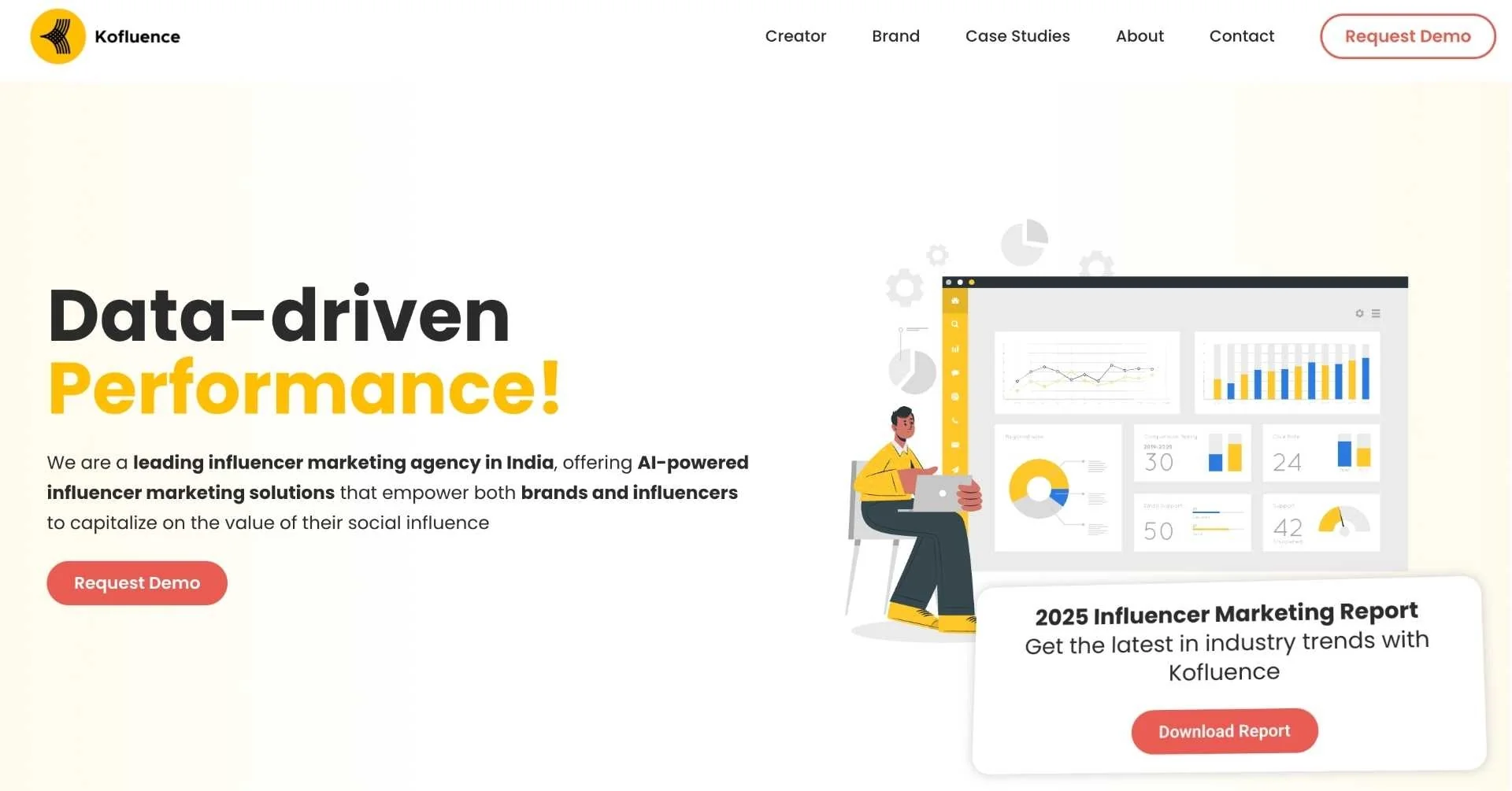
Kofluence is an AI-powered influencer marketing platform designed to help brands discover creators, run campaigns, and measure performance at scale. Positioned strongly in the Indian market, the platform combines a large creator network with performance-driven campaign capabilities—allowing brands to move beyond awareness campaigns into measurable outcomes like installs, leads, and sales. It offers an end-to-end workflow, from influencer discovery and outreach to campaign execution, tracking, and payments.
Key Features
- AI-Powered Influencer Discovery:
Kofluence uses audience data, engagement metrics, and content signals to match brands with relevant creators, helping marketers identify influencers based on performance potential—not just follower count. - End-to-End Campaign Management:
The platform enables brands to create briefs, shortlist influencers, manage approvals, and execute campaigns within a centralized dashboard, reducing reliance on manual processes. - Performance-Based Campaign Models:
Unlike many influencer platforms focused on awareness, Kofluence supports campaigns optimized for measurable outcomes such as clicks, installs, conversions, and ROI. - Real-Time Analytics & Reporting:
Provides dashboards that track both upper-funnel (reach, engagement) and lower-funnel (CPC, CPA, conversions) metrics, allowing marketers to optimize campaigns mid-flight. - Integrated Influencer Payments:
Includes built-in payment workflows and pricing mechanisms based on campaign deliverables, helping streamline negotiations and payouts. - Creator App Ecosystem:
Influencers can apply to campaigns, submit content, track performance, and receive payments via a dedicated mobile app, improving collaboration and execution speed.
Platform Coverage
Instagram, YouTube, Facebook, LinkedIn, and X (Twitter).
Pricing
Kofluence does not publicly disclose detailed pricing for brands. Instead, pricing appears to be custom-based, depending on campaign scope, usage, and service requirements.
Reviews
Not available
Kofluence Standout Features
- Performance-Driven “Brandformance” Campaigns:
Kofluence stands out for combining brand awareness with performance marketing, allowing campaigns to be optimized for conversions, installs, and ROI—not just impressions. - Hyperlocal Influencer Targeting:
Features like location-based (pincode-level) creator shortlisting enable highly targeted regional campaigns—especially valuable for brands running city-specific or offline-to-online activations. - Enhanced Creator Workflow & Campaign Types:
Recent updates include features like store-visit campaigns, multi-product reviews, milestone-based payouts, and in-app chat—making it easier to manage complex campaigns and creator collaboration.
Limitations (Why Users Look for Kofluence Alternatives)
Lack of Transparent Pricing
Brands cannot easily evaluate costs upfront, making it harder to compare against competitors with clear monthly or annual pricing tiers.
Limited Global Focus
The platform is heavily optimized for the Indian market, which can be a limitation for brands looking to run global or multi-region influencer campaigns.
Inconsistent Support & Payment Experience
Some users report delays in payouts, account issues, or slow customer support, which can impact campaign execution and trust.
Less Advanced Integrations & Enterprise Features
Compared to leading global platforms, Kofluence provides less visibility into integrations (eCommerce, CRM, automation), making it less suitable for complex enterprise workflows.
10 Best Influencer Marketing Platform Alternatives
| TOOL | REVIEWS | BEST FOR | TRIAL INFO | PRICING | ||
|---|---|---|---|---|---|---|
1 |

|
⭐ | Influencer CRM & automation | Book Demo | Pricing | Website |
2 |

|
⭐ | Influencer discovery | Book Demo | Pricing | Website |
3 |

|
⭐ | Influencer partnerships | Book Demo | Pricing | Website |
4 |

|
⭐ | Influencer outreach | Book Demo | Pricing | Website |
5 |

|
⭐ | Enterprise influencer marketing | Book Demo | Pricing | Website |
6 |
|
⭐ | Influencer marketing & Social media analytics | Book Demo | Pricing | Website |
7 |

|
⭐ | DTC creator management | Book Demo | Pricing | Website |
8 |

|
⭐ | Influencer discovery | Book Demo | Pricing | Website |
9 |

|
⭐ | Campaign management | Book Demo | Pricing | Website |
10 |

|
⭐ | Influencer marketplace | Book Demo | Pricing | Website |
Influencer Hero

Influencer Hero is an all-in-one influencer marketing platform built for brands that want to manage discovery, outreach, influencer gifting, affiliate tracking, UGC collection, and reporting in one system. Its positioning leans heavily toward ROI-focused eCommerce teams, with automation and CRM workflows as the core of the product.
Key Features
- Influencer discovery: Search creators across major platforms with advanced audience, engagement, location, and niche filters, plus fraud detection and lookalike recommendations
- Outreach & automation: Run personalized outreach at scale with AI-assisted messaging, automated follow-ups, and multi-step email sequences
- Influencer CRM: Centralize creator relationships with pipeline management for conversations, campaign stages, and deliverables
- Gifting workflows: Manage product seeding end-to-end with automated order creation, shipment tracking, and delivery monitoring
- Affiliate tracking & payouts: Create trackable links and discount codes, measure performance, and manage commissions and payments in one workflow
- Campaign analytics & ROI tracking: Track engagement, clicks, conversions, and revenue through real-time dashboards tied to campaign performance
- UGC library: Automatically capture and organize creator content in the content library for reuse across paid ads, social media, and eCommerce channels
- Application pages & storefronts: Build branded creator application pages and enable influencers to promote products through personalized storefronts
- eCommerce integrations: Connect directly with platforms like Shopify and WooCommerce to link influencer activity to sales and attribution
- API & integrations: Expand capabilities with API access and integrations such as Klaviyo, Slack, Zapier, and email platforms
Platform Coverage
Instagram, TikTok, YouTube, Facebook, Pinterest, Snapchat, X, and Twitch
Pricing
Influencer Hero offers flexible pricing based on outreach volume, and you can have unlimited creators in your CRM with Influencer Hero:
- Standard — $649/month (up to 1,000 reachouts/month)
- Pro — $1,049/month (up to 5,000 reachouts/month)
- Business — $2,490/month (up to 10,000 reachouts/month)
- Custom / Agency — Tailored pricing
Reviews
5.0/5.0 (Capterra)
Standout Features
- Chrome extension with live creator analytics: Influencer Hero’s extension surfaces engagement rate, fake follower percentage, audience demographics, EMV, and AI-personalized intro lines directly while browsing creator profiles, which makes sourcing and outreach faster.
- Campaign-centric CRM automation: The product is notably workflow-heavy, with stage-based boards, drip outreach, automated follow-ups, and centralized creator management built for brands running large creator pipelines.
- AI-Powered UGC Search: With AI and UGC search, brands can quickly find influencer-generated content based on keywords, visuals, captions, or campaign context. This helps teams reuse high-performing UGC, identify top creators, and streamline content discovery for paid ads, social media, and ecommerce use cases
Kofluence vs Influencer Hero
Kofluence is more visibly positioned around India-focused creator campaigns, AI matchmaking, and performance-led influencer activations, while Influencer Hero is more transparent on pricing and more tailored to brands that want structured CRM, automated outreach, and eCommerce-heavy execution. Kofluence emphasizes its large Indian creator network and campaign management depth, whereas Influencer Hero is the clearer fit for teams that prioritize predictable SaaS pricing and an all-in-one outbound workflow.
Upfluence
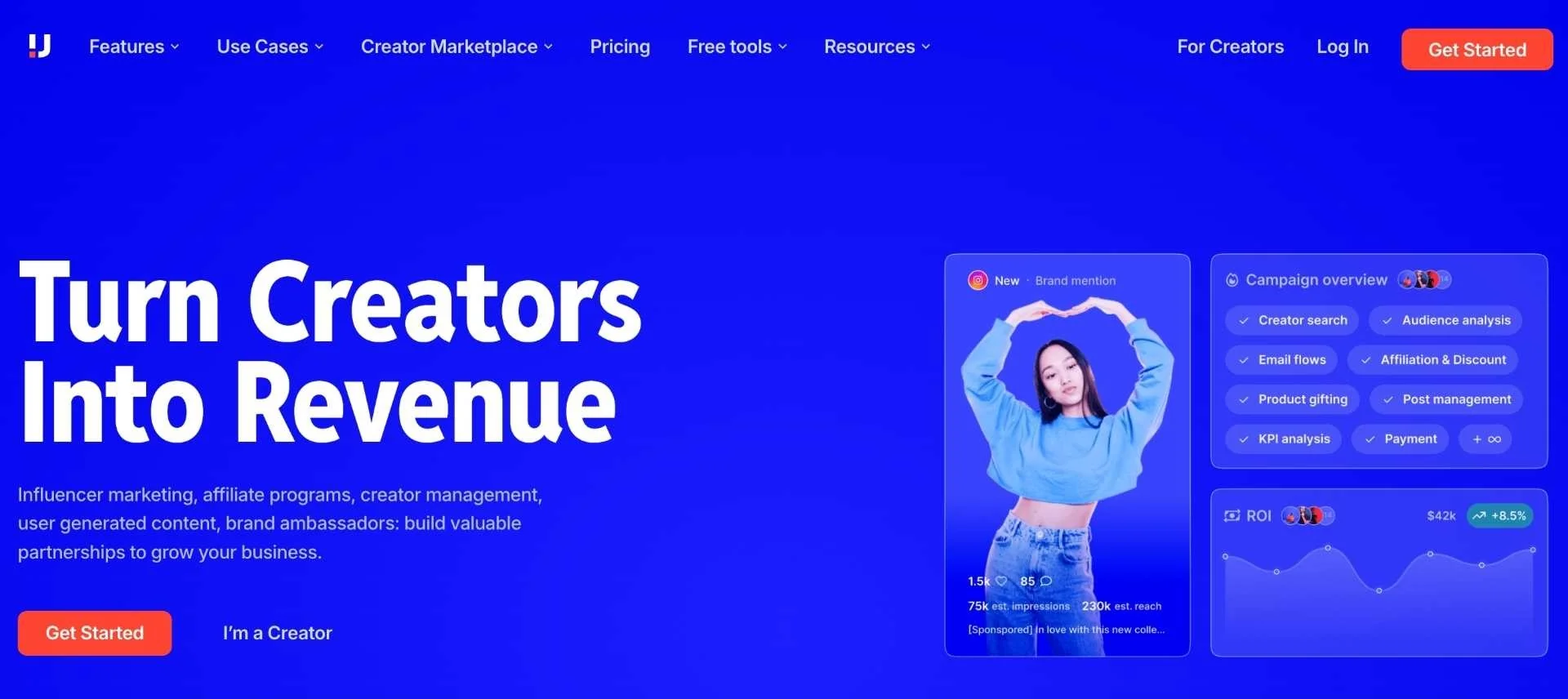
Upfluence is an influencer and affiliate marketing platform designed for brands that want to connect creator discovery with commerce data, outreach, gifting, affiliate sales, and payments. It is especially well known for its eCommerce integrations and for helping brands identify creators within their own customer base.
Key Features
- Large creator database with AI search: Upfluence supports creator discovery across major social channels and uses Jaice AI to help brands find better-fit influencers by audience, niche, and campaign goals.
- Integrated outreach and campaign workflows: Brands can manage contracts, outreach, campaign operations, approvals, and performance from one place rather than stitching together separate CRM and email tools.
- Strong eCommerce integrations: Upfluence’s biggest strength is its integration layer, especially with Shopify, WooCommerce, Magento, BigCommerce, Amazon, and Klaviyo for promo codes, sales attribution, gifting, and affiliate execution.
- Influencer Matching from customer data: Upfluence can capture or enrich customer profiles to identify customers who are already creators, making it easier to convert existing buyers into affiliates or ambassadors.
- Payments and affiliate management: The platform includes influencer payments, commission-based workflows, and promotion code generation for performance-driven programs.
Platform Coverage
Instagram, TikTok, YouTube, Facebook, Twitch, Pinterest, and blogs.
Pricing
On average plans start around $2,000/month ($24,000 yearly)
Reviews
4.3 / 5.0 (Capterra)
Standout Features
- Jaice AI: Upfluence has leaned hard into Jaice as an AI campaign copilot and AI creator finder, positioning it as a faster way to build creator lists and move from brief to launch.
- Customer-to-creator matching: Its Influencer Matching feature is one of the product’s most differentiated capabilities, letting brands spot influential customers through checkout, site capture, or commerce integrations.
- Deep commerce integrations: Upfluence is unusually strong for Shopify, WooCommerce, Magento, BigCommerce, and Amazon-driven influencer programs, especially when affiliate tracking and promo code attribution matter.
Kofluence vs Upfluence
Kofluence is stronger if your priority is India-led creator campaigns and performance-style brand activations, while Upfluence is the more commerce-centric platform for brands that want Shopify, Amazon, and customer-data integrations at the center of their workflow. Kofluence focuses more on creator matchmaking, campaign management, and measurable outcomes in the Indian market, whereas Upfluence is better suited to international eCommerce teams that want affiliate, CRM, and customer-to-creator discovery in one stack.
Aspire
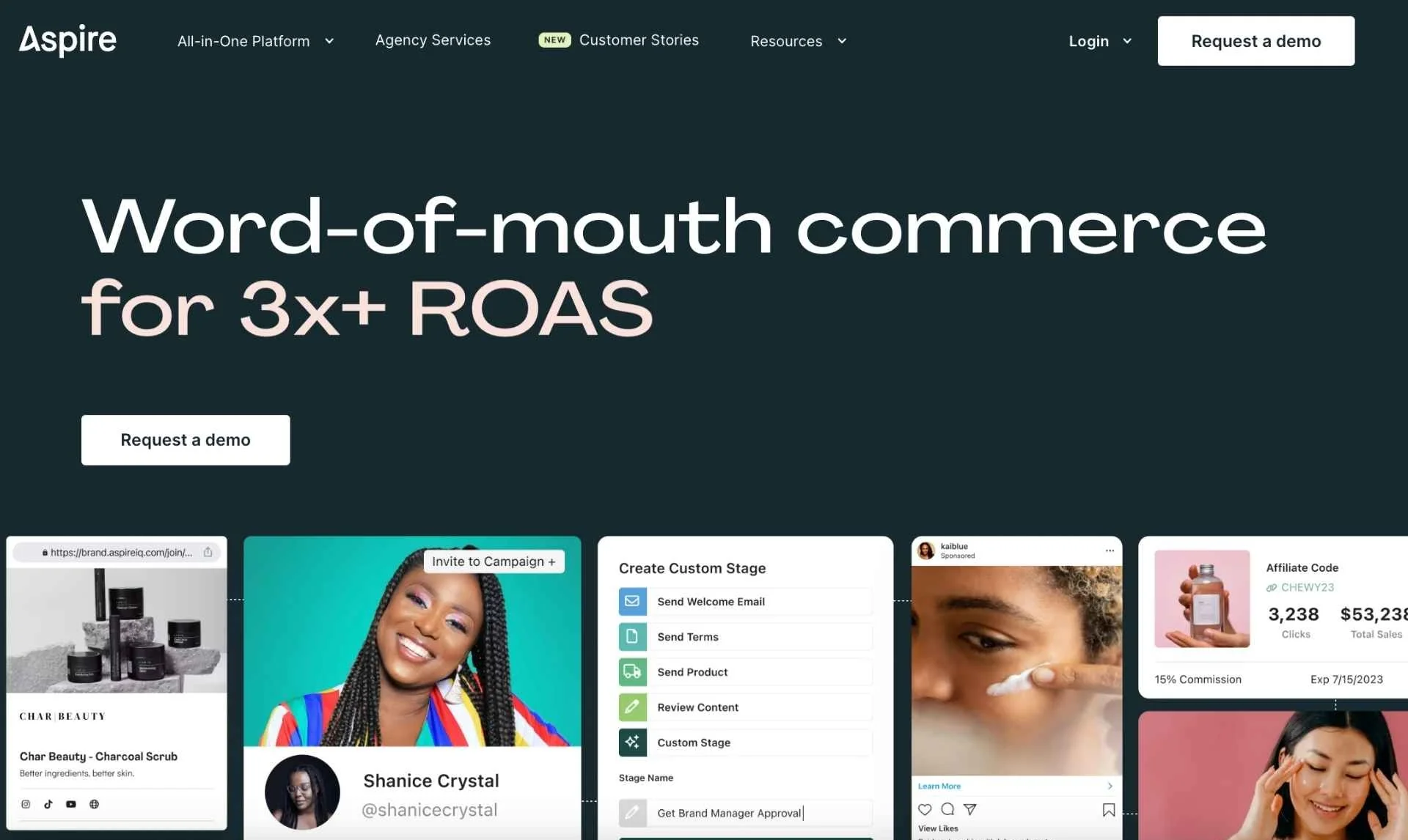
Aspire is an influencer marketing platform built around what it calls “word-of-mouth commerce,” combining creator discovery, campaign execution, affiliate workflows, UGC management, and commerce integrations. It is particularly appealing to eCommerce brands that want both outbound influencer sourcing and inbound creator applications through a marketplace model.
Key Features
- Dual discovery model: Aspire combines a searchable creator database with a large Creator Marketplace, giving brands both outbound sourcing and inbound applications.
- Content approvals and workflow automation: Brands can manage creators, briefs, communication, approvals, and campaign milestones inside Aspire, helping teams scale without losing control over deliverables.
- Shopify and commerce integrations: Aspire integrates tightly with Shopify for gifting, product sync, order tracking, and commerce attribution.
- Affiliate and sales tracking: The platform supports links, codes, commissions, PayPal payouts, and conversion reporting, making it suitable for both awareness and revenue-led creator programs.
- UGC and content library: Aspire collects creator content into a central library and supports approval, reuse, and content-led optimization workflows.
Platform Coverage
Instagram, TikTok, Pinterest, YouTube, and Facebook
Pricing
Aspire starts with tiered pricing and can be customized, with a mid-tier quote of about $2,300/month for a use case involving multiple team members and up to 500 creators in CRM.
Reviews
4.0 /5.0 (Capterra)
Standout Features
- Creator Marketplace: Aspire’s marketplace gives brands access to inbound applications from over 1M creators, which reduces the amount of purely outbound recruiting needed.
- AI Reverse Image Search: This feature helps brands find creators whose content visually matches a desired aesthetic, which is especially useful for visual-first and lifestyle categories.
- CreatorStores: Aspire’s newer commerce push includes co-branded microstores hosted on Shopify, designed to help creators drive higher-converting social commerce journeys.
Kofluence vs Aspire
Kofluence is more tightly associated with India-first influencer campaigns and performance-led matching, while Aspire is more mature for DTC and Shopify-connected brands that want UGC workflows, affiliate programs, and creator commerce. If Kofluence is a better fit for regional creator execution and marketplace-style scale in India, Aspire is stronger for brands that want inbound creator applications, first-party platform partnerships, and commerce-led creator infrastructure.
SARAL

SARAL is an influencer marketing platform built mainly for eCommerce and consumer brands that want a simpler operating system for finding creators, automating outreach, managing relationships, tracking performance, and paying influencers. Its positioning is notably SMB- and DTC-friendly, with transparent pricing and a lighter operational feel than many enterprise tools.
Key Features
- Search engine-style discovery: SARAL says brands can search hundreds of millions of creator profiles without waiting for creators to opt in, helping teams source niche influencers faster.
- Outreach automation: The platform supports personalized outreach, inbox management, follow-ups, and relationship management so influencer programs can run without heavy spreadsheet work.
- Influencer CRM and campaign management: SARAL centralizes creator stages, campaign tracking, application flows, and relationship data in one dashboard.
- Performance and affiliate tracking: Brands can track sales, ROAS, codes, and influencer-level performance, which makes SARAL more useful for conversion-driven programs than discovery-only tools.
- Payments: SARAL includes payout automation support and payment operations, including PayPal workflows and commission tracking.
Platform Coverage
Instagram, TikTok, and YouTube.
Pricing
There are different plans:
- Starter: $3.6k/quarter
- Business: $4.5k/quarter
- Professional: $7.5k/quarter
Reviews
4.7/5.0 (G2)
Standout Features
- SIA AI assistant: SARAL’s built-in AI assistant helps with creator discovery, personalized replies, follow-ups, and workflow automation, which is a strong differentiator at its price point.
- Chrome extension with fair fee and audience insights: The SARAL extension lets teams save creators while browsing and surfaces metrics such as engagement, predicted likes, fee guidance, and audience data.
- Transparent pricing with no contract lock-in: Unlike many enterprise tools, SARAL openly pushes free trial access, cancel-anytime positioning, and unlimited influencer management across plans.
Kofluence vs SARAL
Kofluence is more marketplace- and campaign-oriented for India-based influencer programs, while SARAL is more appealing to DTC brands that want transparent pricing, quick onboarding, and a simpler Instagram/TikTok/YouTube operating system. Kofluence leans into scale, AI matchmaking, and performance marketing in India; SARAL leans into ease of use, outreach automation, and lightweight influencer operations for consumer brands.
CreatorIQ
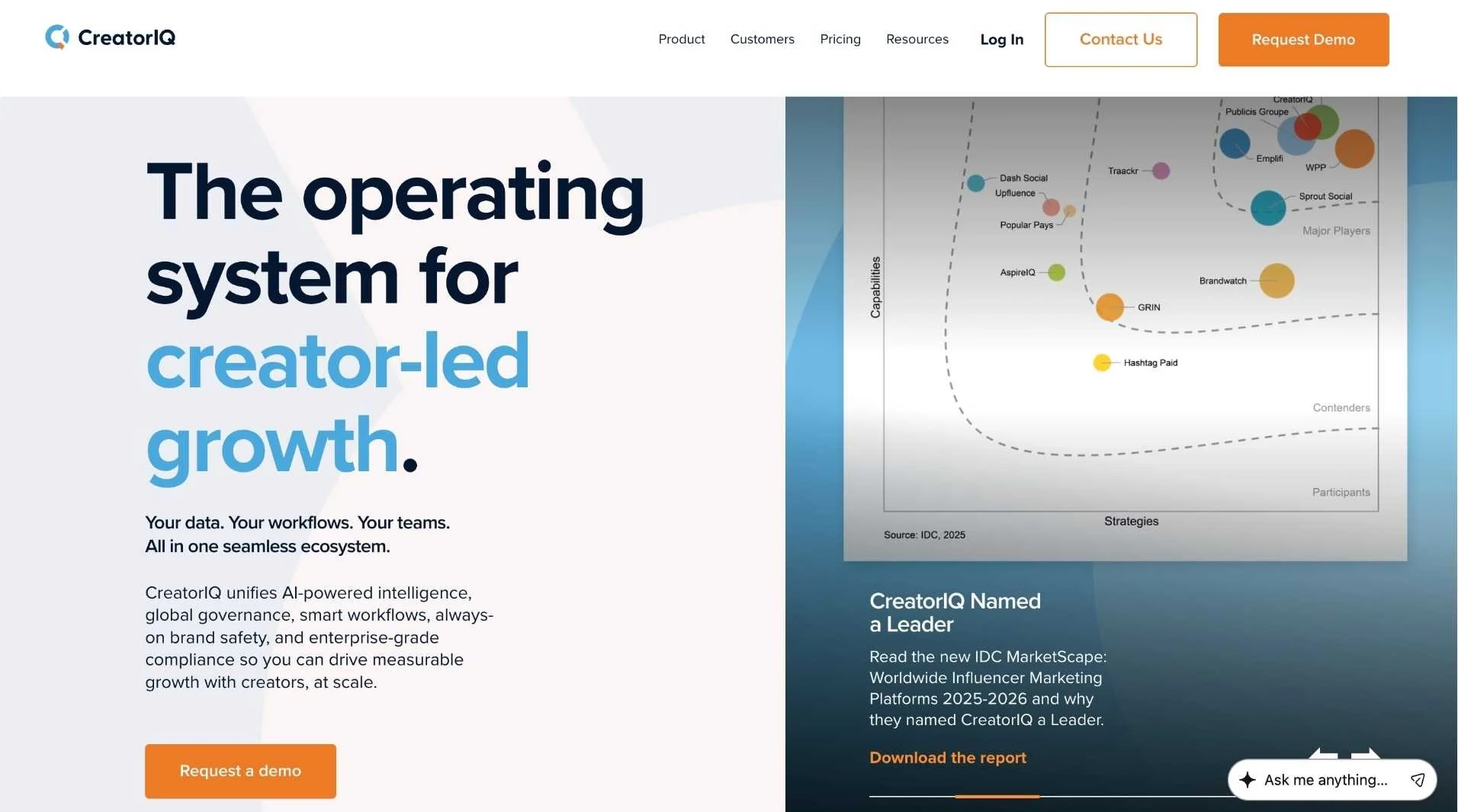
CreatorIQ is an enterprise creator marketing platform built for large brands and agencies that need governance, brand safety, analytics, and workflow infrastructure at scale. The company now positions itself as an AI-native operating system for creator-led growth, with a strong emphasis on intelligence, compliance, and enterprise-grade control.
Key Features
- Enterprise creator discovery: CreatorIQ supports large-scale creator search and evaluation, with coverage across major social channels and tools for audience authenticity, creator vetting, and brand-fit analysis.
- Unified workflows and governance: Its core strength is not just discovery, but centralizing creator operations, governance, compliance, and reporting for larger marketing organizations.
- Brand safety and suitability: Brand safety has become a major differentiator through SafeIQ, which applies multimodal AI analysis to help teams monitor risk across creator content.
- Integrations and data connectivity: CreatorIQ emphasizes API integrations and enterprise data exchange so creator marketing performance can connect with the rest of the martech stack.
- Measurement and enterprise reporting: The platform is designed to help large teams prove creator impact through structured workflows, business metrics, and centralized reporting rather than only campaign-level dashboards.
Platform Coverage
Instagram, YouTube, TikTok, Facebook, Twitter, Pinterest, and more.
Pricing
- Basic Plan: Starts at $35,000/year. Includes 1,000 contact creators per month
- Standard Plan: Starts at $50,000/year. Includes 2,500 contact creators per month
- Professional Plan: Starts at $90,000/year. Includes 5,000 contact creators per month
- Enterprise Plan: Starts at $200,000/year. Includes 7,500 contact creators per month
Reviews
4.4 / 5.0 (Capterra)
Standout Features
- SafeIQ: CreatorIQ’s recent SafeIQ launch is one of the clearest enterprise differentiators in this category, adding AI-native brand safety and suitability controls across creator content.
- AI-native operating system positioning: The platform’s recent product refresh leans into AI-driven intelligence, governance, workflows, and enterprise control rather than just campaign management.
- Expanded YouTube first-party integration: CreatorIQ has recently deepened its YouTube integration, improving access to sharper audience insights and campaign planning data for brands running YouTube-heavy programs.
Kofluence vs CreatorIQ
Kofluence is the more practical fit for brands prioritizing Indian creator access and performance-led influencer execution, while CreatorIQ is built for global enterprise teams that need governance, advanced brand safety, and large-scale infrastructure. Kofluence is more campaign- and marketplace-oriented; CreatorIQ is more enterprise, compliance-heavy, and analytics-driven.


Sprout Social

Sprout Social’s influencer marketing product—built from its Tagger acquisition and now branded as Sprout Social Influencer Marketing—is designed for brands and agencies that want creator discovery, vetting, campaign execution, reporting, and social intelligence in one enterprise workflow. Its strongest positioning is around data-driven creator selection, brand safety, and presentation-ready reporting for larger teams.
Key Features
- AI-powered creator discovery: Sprout combines semantic search with topic-based discovery so teams can find creators based on what they actually talk about, not just hashtags or follower counts. It also layers in audience and engagement data for faster vetting.
- Brand Fit Score: Its Brand Fit Score gives brands a fast alignment signal based on creator content, audience interests, and location, which helps standardize shortlisting across teams.
- Brand safety controls: Sprout lets teams apply custom brand safety parameters and keyword-based risk checks before creators are activated, which is especially useful for regulated or reputation-sensitive brands.
- Campaign workflow management: The platform supports structured workflows for outreach, contracts, content approvals, deliverables, spend, and reporting, making it easier for distributed teams to manage multi-stage creator programs.
- Competitive benchmarking and reporting: Sprout is particularly strong on analytics, with EMV, platform-level performance trends, custom reports, and downloadable stakeholder-friendly exports. The uploaded product notes also highlight competitive benchmarking and export formats such as PDF, PNG, and JPEG.
- Commerce-friendly integrations: The platform supports Shopify gifting, PayPal-linked payouts, and creator sales attribution in supported workflows, giving brands a path from creator discovery to measurable commerce outcomes.
Platform Coverage
Instagram, YouTube, Facebook, TikTok, and X (Twitter)
Pricing
Starts around $1,600/month per user plus $600 per extra user.
Reviews
4.5 / 5.0 (Capterra)
Standout Features
- Brand Fit Score: One of Sprout’s clearest differentiators is its AI-driven Brand Fit Score, which turns creator-brand alignment into a faster, more repeatable decision signal.
- Brand Safety Reports: The reimagined platform emphasizes customizable brand safety checks that flag risky content before activation, which is especially valuable for enterprise teams and regulated categories.
- Reimagined workflow and workspace model: Since the Tagger transition, Sprout has pushed a more modular workflow with creator lists, workspaces, semantic discovery, and end-to-end reporting built for multi-brand or multi-client programs.
Kofluence vs Sprout Social
Kofluence is more focused on creator campaigns and performance-led activations in the Indian market, while Sprout Social is better suited to larger teams that care most about governance, brand safety, competitive intelligence, and executive reporting. Kofluence is also less publicly structured around seat-based enterprise pricing, whereas Sprout’s evaluated setup is significantly more expensive and more clearly built for teams with multiple stakeholders and formal approval workflows.
GRIN
GRIN is a creator management platform aimed primarily at eCommerce and DTC brands that want discovery, relationship management, gifting, affiliate tracking, payments, and reporting in one operating system. It positions itself less as a marketplace and more as a creator CRM built around repeatable revenue-focused programs.
Key Features
- Creator CRM and relationship management: GRIN’s core strength is organizing creator relationships at scale, with tags, notes, pipelines, portals, and structured workflows for long-term creator programs.
- Integrated outreach: GRIN supports outreach through built-in email workflows and integrations with Gmail, Outlook, and Klaviyo, helping teams manage creator communication without jumping between systems.
- Gifting and product seeding: GRIN is especially strong for product-centric brands, with integrations for Shopify and WooCommerce that support discount codes, shipping, and fulfillment tracking inside the campaign workflow.
- Affiliate tracking and creator payments: The platform supports commission-based programs and PayPal payments, making it useful for brands that want creator relationships tied directly to sales outcomes.
- UGC collection and creator portals: Brands can collect creator content through personalized portals and keep assets organized for reuse and review, although some users have reported occasional upload issues in practice.
- AI support through Gia: GRIN introduced Gia, its AI assistant, to help creator marketers work faster across discovery, planning, and execution workflows.
Platform Coverage
Facebook, Instagram, TikTok, X, Pinterest, YouTube, and Twitch
Pricing
Annual pricing starts at $25,000/year (approx. $2,050/month)
Reviews
4.5/5.0 (G2)
Standout Features
- Gia AI assistant: GRIN’s launch of Gia is one of its biggest recent differentiators, giving the platform a more explicit AI layer for creator marketers.
- eCommerce-native infrastructure: GRIN stands out for deep gifting, seeding, discount code, and payout workflows tied to commerce platforms rather than just discovery and reporting.
- Creator-friendly portals: GRIN’s creator portals centralize briefs, deliverables, uploads, payment status, and collaboration details, which helps brands run repeatable programs without forcing creators into fragmented workflows.
Kofluence vs GRIN
Kofluence is more marketplace-driven and more clearly oriented around India-based creator campaigns and performance activations, while GRIN is stronger for DTC brands that want gifting, affiliate tracking, and creator relationship management tightly linked to eCommerce. GRIN is also more commerce-operational in its DNA, whereas Kofluence leans more toward campaign discovery, execution, and regional creator access.
Modash

Modash is an influencer marketing platform built around creator discovery, outreach, tracking, and payments, with a particularly strong reputation for public-profile search and Shopify-connected execution. It is designed for teams that want a focused, modern workflow rather than a sprawling enterprise suite.
Key Features
- Large public creator database: Modash says it gives access to 350M+ public profiles, which is one of its biggest selling points for brands that do not want discovery limited to opt-in creators.
- Advanced discovery filters and AI search: Brands can search by niche topics, hashtags, captions, audience demographics, engagement, and lookalikes, and Modash also supports prompt- or image-led discovery for visually aligned creator sourcing.
- Outreach and lightweight CRM: The platform supports email outreach, Gmail/Outlook syncing, conversation tracking, and status-based creator management in a simplified CRM flow.
- Shopify gifting and affiliate workflows: Modash ties gifting, discount codes, affiliate links, and commission-based payouts closely to Shopify, which makes it especially attractive for lean eCommerce teams.
- Real-time campaign tracking: It tracks content, engagement, reach, code usage, affiliate sales, and campaign assets as they come in, helping brands connect creator content to revenue outcomes.
- Creator payments: Modash includes payouts and commission tracking, with an annual free threshold for Payments + Affiliates before fees apply.
Platform Coverage
Modash supports influencer marketing on platforms such as Instagram, YouTube, and TikTok, providing comprehensive campaign tracking and influencer management tools.
Pricing
- Essentials: $199/month (paid annually)
- Performance: $499/month (paid annually)
- Custom Enterprise: Contact for pricing
Reviews
4.9 / 5.0 (Capterra)
Standout Features
- AI creator discovery by prompt or image: Modash’s ability to describe a creator profile or upload an aesthetic reference image remains one of the most distinctive search workflows in this category.
- Find Your Fans: Modash can identify influencers who already follow or engage with your brand, which can improve response rates and partnership fit.
- Focused Shopify-connected workflow: Modash is especially strong when a brand wants discovery, gifting, affiliate tracking, and payouts connected in one streamlined system without enterprise overhead.
Kofluence vs Modash
Kofluence is better aligned to brands prioritizing India-first creator access and campaign activation, while Modash is better for lean, global teams that want transparent pricing, broad public-profile discovery, and Shopify-based gifting or affiliate execution. Modash is also more self-serve and discovery-centric, whereas Kofluence is more campaign- and marketplace-oriented.
Influencity

Influencity is an all-in-one influencer marketing platform that combines discovery, outreach, CRM, campaign management, reporting, and broader social media management tools. It is positioned as a flexible system for brands and agencies that want strong data depth and campaign control without being limited to opt-in creators.
Key Features
- Public-data creator discovery: Influencity uses public profiles rather than requiring opt-in creators, giving brands broader discovery potential across core social networks.
- Smart search and profile analysis: It includes AI keyword matching, hashtags, lookalikes, follower-quality checks, engagement metrics, audience demographics, and affinity data for deeper vetting.
- Visual CRM and campaign boards: The platform uses structured lists and a board-style workflow for managing deadlines, approvals, tasks, and creator progress across multiple campaigns.
- Automated outreach tools: Influencity supports email outreach and performance tracking for opens, clicks, and replies, with an AI email assistant available on higher plans.
- Shopify gifting and affiliate tracking: It supports influencer seeding, discount codes, sales attribution, and gifting through Shopify integrations.
- Manual and automated reporting: Teams can choose manual reporting or auto-tracking based on campaign rules, then export reports in multiple formats for internal use.
Platform Coverage
Instagram, TikTok, YouTube, and X/Twitter
Pricing
- Professional Plan: $318/month or $3,816/year
- Business Plan: $798/month or $9,576/year
- Enterprise Plan: Custom pricing
- Auto-Tracker Add-On: $660/year (for 50 influencers)
Reviews
4.3 / 5.0 (G2)
Standout Features
- Public-data discovery model: Influencity’s non-opt-in discovery remains a key differentiator for teams that want broader sourcing coverage rather than a closed marketplace.
- AI email assistant: The current knowledge base highlights an AI assistant for generating outreach emails, which adds more automation to the platform’s outreach stack.
- Social Hub expansion: Influencity has continued broadening into social media management and listening through Social Hub, making it more multi-purpose than many influencer-only tools.
Kofluence vs Influencity
Kofluence is more centered on marketplace-style creator activations and India-focused campaign execution, while Influencity is a more tool-driven platform for global discovery, CRM, reporting, and Shopify-linked workflows. Influencity also gives brands more explicit control over public-data sourcing and board-style campaign management, whereas Kofluence is more closely associated with managed campaign flow and regional creator access.
IZEA

IZEA is one of the longest-standing influencer marketing platforms in the market, offering a full suite of tools for influencer discovery, campaign management, content creation, and performance tracking. Known for its combination of influencer marketing and content marketplace capabilities, IZEA positions itself as both a technology platform and a managed services provider, supporting brands that want either self-serve tools or hands-on campaign execution.
Key Features
- IZEA Flex platform:
IZEA Flex is the core software offering, enabling brands to discover influencers, manage campaigns, negotiate rates, track deliverables, and measure performance in a centralized dashboard. - Creator Marketplace (IZEA Marketplace):
Brands can post campaign opportunities that creators can apply to directly, reducing the need for outbound outreach and helping fill campaigns faster. - Influencer discovery and vetting:
Provides search filters for niche, audience demographics, engagement metrics, and historical performance, allowing marketers to identify creators that align with campaign goals. - Content workflow and approvals:
Includes tools for briefing, content submission, approvals, and collaboration, ensuring campaigns stay organized and compliant with brand guidelines. - Payments and contract management:
IZEA handles influencer payments, contracts, and compliance within the platform, streamlining financial workflows and reducing administrative overhead. - Reporting and performance analytics:
Tracks campaign metrics such as reach, engagement, impressions, and ROI, with customizable reporting dashboards for stakeholders. - Managed services option:
In addition to software, IZEA offers fully managed influencer campaigns, where its team handles strategy, execution, and optimization.
Platform Coverage
Instagram, TikTok, YouTube, Facebook, Pinterest, Snapchat, Twitch, and X (Twitter).
Pricing
IZEA does not publicly list fixed pricing tiers for all products, but it offers two main approaches:
- IZEA Flex (self-serve SaaS): Typically offered via custom pricing based on usage, features, and scale.
- Managed Services: Fully customized pricing depending on campaign scope, creator volume, and level of service.
In practice, this means pricing is quote-based, often structured as annual contracts for software access or campaign-based pricing for managed services.
Reviews
3.9/ 5.0 (G2)
Standout Features
- Dual marketplace + SaaS model:
IZEA combines a creator marketplace with a full campaign management platform, allowing brands to choose between inbound applications or structured campaign workflows. - Managed services offering:
Unlike many platforms, IZEA provides a hands-on service layer, making it suitable for teams that want to outsource campaign execution entirely. - Content-first campaign approach:
IZEA emphasizes content creation alongside influencer marketing, supporting branded content production beyond traditional influencer posts.
Kofluence vs IZEA
Kofluence is more focused on performance-driven campaigns and marketplace-style influencer activation, particularly within the Indian market, while IZEA offers a more mature combination of software and managed services for brands that want flexibility between self-serve and fully managed campaigns. IZEA also has broader global platform coverage and a stronger emphasis on content production, whereas Kofluence is more centered on campaign execution and performance outcomes.
Final Thoughts on Kofluence Alternatives
Kofluence offers a strong foundation for influencer marketing, particularly for brands focused on performance-driven campaigns and regional execution, but its limitations around pricing transparency, global scalability, and advanced integrations often lead teams to explore alternatives. Platforms like Influencer Hero, Upfluence, and Aspire stand out for their eCommerce and automation capabilities, while tools such as CreatorIQ and Sprout Social cater more to enterprise needs with advanced analytics and governance. Meanwhile, solutions like Modash, SARAL, and Influencity provide more flexible, discovery-driven, and cost-transparent options. Ultimately, the best choice depends on a brand’s priorities—whether that’s global reach, ROI tracking, workflow automation, or ease of use.