

Modash vs Aspire vs Influencer Hero: Pricing, Features, and Platform Comparison
E-commerce brands and agencies now need influencer marketing platforms to do more than just find creators—they need systems that centralize outreach, gifting, affiliate tracking, content approvals, and revenue reporting in one workflow.
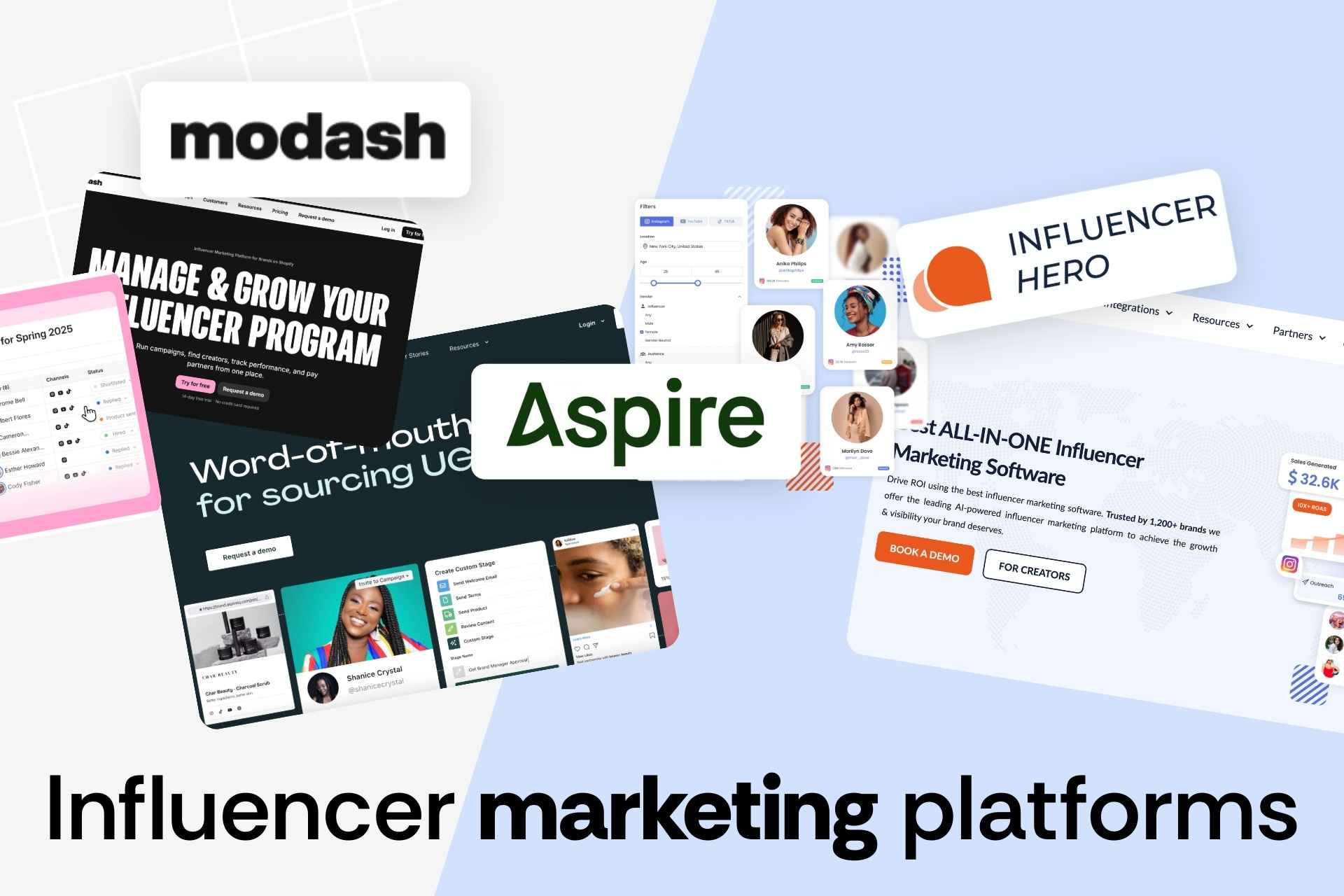
The main difference between Modash, Aspire, and Influencer Hero is where each platform is strongest: Modash leans heavily into large-scale public creator discovery, AI search, and Shopify-based tracking; Aspire stands out for its first-party data partnerships, large inbound creator marketplace, and structured approval workflows; Influencer Hero is more centered on campaign execution, CRM automation, and broader e-commerce support, including both Shopify and WooCommerce. That makes this comparison especially relevant for teams deciding whether they need stronger discovery, better inbound creator sourcing, or a more automation-heavy system for managing campaigns at scale.
In this article, we’ll dive deep into the comparison between Modash vs Aspire vs Influencer Hero, exploring their features, pricing, and overall platform fit to help you decide which is best for your brand.
Modash vs Aspire vs Influencer Hero
Influencer Discovery and Database
Modash is the strongest of the three when sheer database scale and search flexibility are the priority. It gives brands access to 350M+ public profiles and stands out for its deep filtering, lookalike search, fake follower analysis, and AI discovery tools that let teams search by creator style or even image aesthetic, which is especially useful for e-commerce brands with a strong visual identity.
Aspire takes a different approach by leaning on first-party data partnerships with Meta, TikTok, and Pinterest, plus a large inbound creator marketplace where around 1M–1.2M creators actively apply to brands. Influencer Hero is broader in platform coverage, supporting 8 social channels and combining discovery filters with lookalike suggestions and a Chrome extension, but its positioning is more tied to campaign execution than to pure database depth.
Suggestion: Choose Modash if your team values the largest searchable creator pool and advanced discovery filters, Aspire if first-party data accuracy and inbound creator applications matter most, and Influencer Hero if you want discovery to connect more directly with campaign execution.
Influencer Outreach
All three platforms cover core outreach needs, but they prioritize different strengths. Modash keeps outreach practical and streamlined with bulk email, templates, Gmail/Outlook integrations, and conversation tracking, while Aspire adds more structure through Gmail sync, custom templates, and automated follow-ups tied directly to campaign stages.
Influencer Hero is the most automation-focused here, with AI-personalized templates, multi-step drip sequences, reply tracking, and workflow-based automation designed for teams running outreach at scale. That makes the choice less about whether a platform can send outreach and more about how much automation and workflow control your team actually needs.
Suggestion: Pick Modash for straightforward outreach, Aspire for more structured follow-up workflows, and Influencer Hero if your team wants to automate large parts of outreach without losing personalization.
CRM and Campaign Management
This is where the clearest separation appears. Modash includes a usable CRM and campaign workflow, but it is more lightweight, centered on organizing creators, tracking statuses, and moving campaigns from outreach to affiliate tracking without going especially deep on internal process management.
Aspire offers a more structured end-to-end workflow with contracts, briefs, approvals, post tracking, tagging, creator lists, and bulk actions, making it a strong fit for teams that want process consistency. Influencer Hero goes further in campaign orchestration, with structured boards, bulk actions, automated email flows, relationship tracking, and dashboards designed for high-volume programs, which makes it particularly appealing for brands and agencies managing more complex creator operations.
Suggestion: Use Modash if you only need a lighter CRM layer, Aspire if your campaigns depend on structured approvals and workflow control, and Influencer Hero if campaign management is the center of your influencer program.
Reporting and Analytics
Modash does a strong job on campaign visibility, giving users real-time reporting on impressions, reach, engagement, tracked content, code usage, affiliate sales, audience insights, and fake follower benchmarks. Aspire goes further into structured campaign reporting with creator-, channel-, and campaign-level views, plus detailed reporting on clicks, conversions, sales, commissions, and exportable summaries that are well suited for performance-focused teams.
Influencer Hero is more ROI-oriented in how it frames reporting, with dashboards focused on influencer-level ROI, affiliate sales, clicks, content performance, and exports for internal stakeholders. Each platform covers core campaign metrics, but Aspire and Influencer Hero are stronger if your team needs reporting that supports ongoing optimization and executive review.
Suggestion: Go with Modash for strong core analytics tied to discovery and tracking, Aspire for more detailed performance and sales reporting, and Influencer Hero if ROI visibility is a top priority for internal decision-making.
Product Gifting
Modash and Aspire are both strong in gifting, but they execute it differently. Modash uses Shopify-powered gifting links that let creators choose products while brands automate fulfillment, code creation, and attribution, which works well for e-commerce teams that want a smooth workflow with minimal manual coordination.
Aspire’s gifting setup feels more controlled operationally, with Shopify-based catalog selection, approval rules, bundle limits, and fulfillment tracking directly inside the platform. Influencer Hero stands out for broader e-commerce compatibility by supporting both Shopify and WooCommerce, which gives it an edge for brands that are not fully standardized on Shopify.
Suggestion: Choose Modash for streamlined Shopify gifting, Aspire for more controlled product selection and fulfillment workflows, and Influencer Hero if you need gifting support across both Shopify and WooCommerce.
UGC Collection
Modash supports automatic content collection and lets brands download assets for reuse, but usage rights and licensing need to be handled outside the platform through creator contracts. Aspire is stronger on governance here, with a content library plus built-in handling of usage rights and ad permissions inside briefs and contracts, giving teams more structure around how creator content is collected and reused.
Influencer Hero also performs well in this category by automatically gathering influencer posts, centralizing content, and letting teams tag top-performing assets for repurposing. The practical difference is that Modash is more about collection, Aspire is stronger on rights and approval structure, and Influencer Hero is especially useful for teams that want to operationalize UGC inside broader campaign workflows.
Suggestion: Pick Modash if simple content collection is enough, Aspire if rights management and approval structure matter more, and Influencer Hero if you want collected content to feed directly into campaign and ad workflows.
Pricing
Pricing is one of the biggest practical differences between these platforms. Modash is the most accessible entry point, with public pricing starting at $199/month for Essentials and $499/month for Performance on annual billing, while Aspire is positioned much higher, with the shared mid-tier example landing around $2,300/month for a brand managing 20–40 creators per month.
Influencer Hero sits between them in a more transparent way, starting at $649/month, then scaling to $1,049/month and $2,490/month before custom plans, which makes it easier to match platform cost to campaign size. This gives readers a clearer tradeoff: Modash is the most budget-accessible, Aspire is the premium option in this comparison, and Influencer Hero fills the middle with broader execution capabilities and more flexible scaling.
Suggestion: Start with Modash if budget is the main constraint, consider Aspire if you are comfortable paying more for first-party data and inbound marketplace access, and look at Influencer Hero if you want a more scalable all-in-one platform without jumping straight to Aspire-level pricing.


Modash Overview
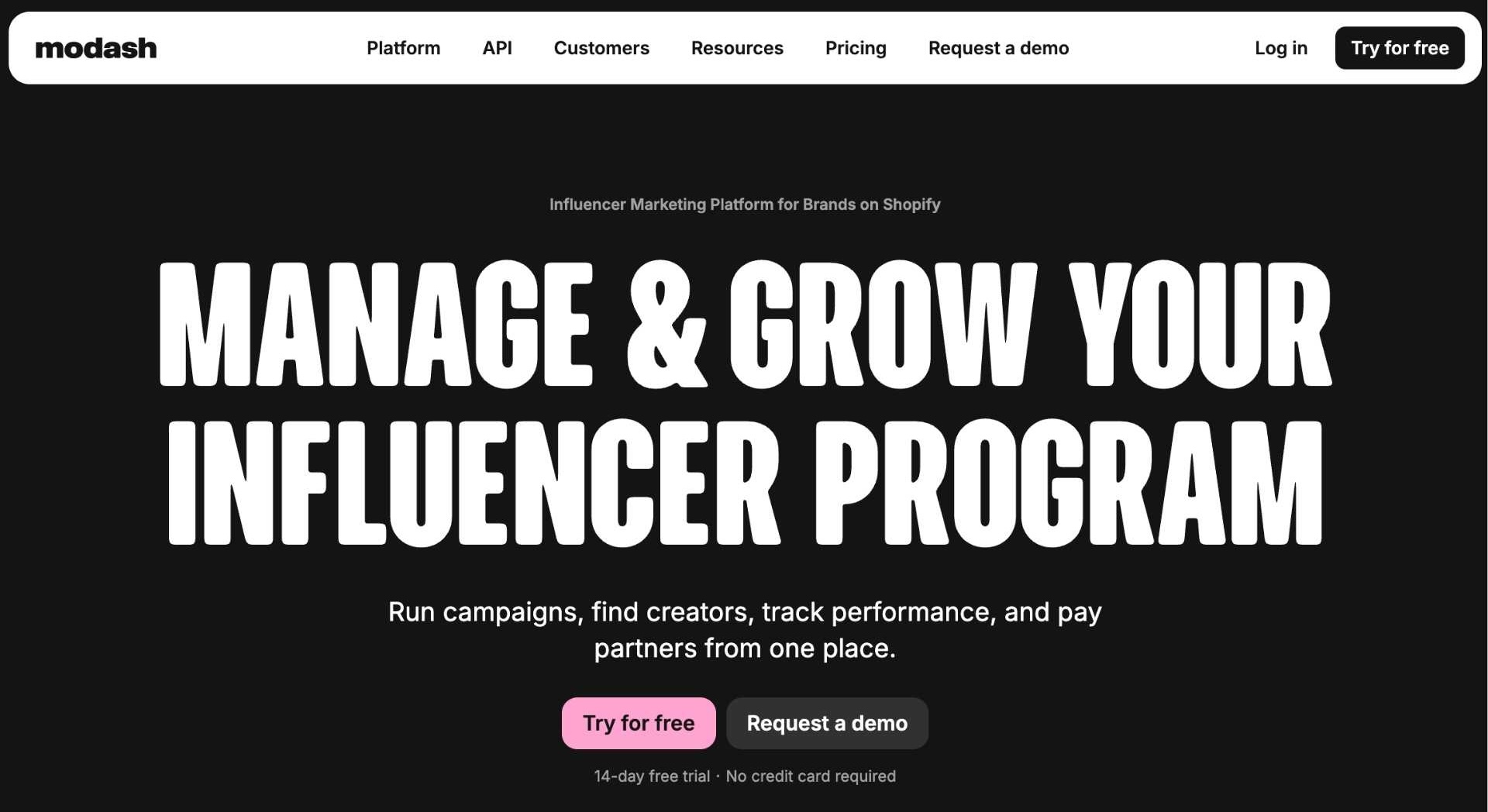
Modash is an influencer marketing platform built for brands that want to find creators, manage outreach, track campaign content, and connect influencer activity to e-commerce results in one place. Its strongest use case is influencer discovery: Modash indexes a very large pool of public creator profiles and gives teams detailed filters, lookalike search, audience analysis, and AI-assisted search tools to narrow that pool into a workable shortlist.
Key features
- Large public creator database — Modash gives brands access to 350M+ public creator profiles, making it easier to source creators beyond closed or opt-in marketplaces.
- Advanced discovery filters — Teams can filter creators by niche, hashtags, captions, audience location, gender, age, platform, and engagement rate to build highly specific lists.
- Lookalike search — Brands can find creators similar to top-performing partners or target profiles already known to convert well.
- AI discovery tools — Users can describe the type of creator they want or upload an aesthetic image to find creators with a similar visual style.
- Influencer CRM — Creators can be organized into lists and tracked by status, helping teams manage discovery, negotiation, and active collaborations in one workflow.
- Email outreach — Modash supports one-to-one and bulk outreach with templates plus Gmail and Outlook sync for conversation tracking.
- Campaign tracking — The platform tracks live content, campaign performance, code usage, and affiliate sales through a central dashboard.
- Product gifting — Shopify-based gifting lets creators choose products through unique links while brands automate fulfillment and tie gifting back to campaign performance.
- Affiliate and payout workflows — Brands can assign commission tiers, generate codes and links, and automate creator payouts inside the platform.
Platform coverage
Modash primarily supports Instagram, TikTok, and YouTube, while also identifying creator presence on some additional channels with more limited functionality.
Standout Features
- Discovery at scale — Modash’s biggest differentiator is the size of its public creator database, which is especially valuable for brands searching across niches, countries, or creator tiers.
- AI search by content style — The ability to search by natural-language prompt or visual aesthetic is one of the more distinctive discovery features in this category.
- Shopify-native campaign workflow — Product gifting, discount codes, affiliate tracking, and payouts are tightly connected, which makes Modash particularly practical for e-commerce teams.
Limitations
- Limited e-commerce flexibility outside Shopify — Modash’s strongest commerce workflows are centered on Shopify rather than broader native support for platforms like WooCommerce or Magento.
- No built-in content licensing workflow — Teams can collect and download creator content, but licensing and reuse rights still need to be handled manually in contracts.
- No native whitelisting or paid social workflow — It is less suited for teams that want creator content boosting or paid amplification tools directly inside the platform.
- Some users report occasional speed or workflow friction — Public user feedback is generally strong, but some reviewers mention loading delays or wanting deeper campaign operations in certain workflows.
Integrations
- Shopify — Connect your store to run gifting campaigns, generate discount codes, track affiliate sales, and tie influencer activity to revenue.
- Gmail — Sync outreach conversations with Modash so email history stays connected to each creator record.
- Outlook — Outlook users can manage influencer communication and reply tracking inside the same workflow.
- API — Modash offers API access for teams that want to build custom reporting, creator data workflows, or internal integrations.
Pricing
Modash offers a 14-day free trial with no credit card required. Public pricing starts at $199/month when paid annually or $299/month billed monthly, with higher-tier plans scaling by usage limits such as profile views, email unlocks, and creators tracked; enterprise pricing is available for larger teams.
Reviews
4.9/5.0 (Capterra)
Aspire Overview
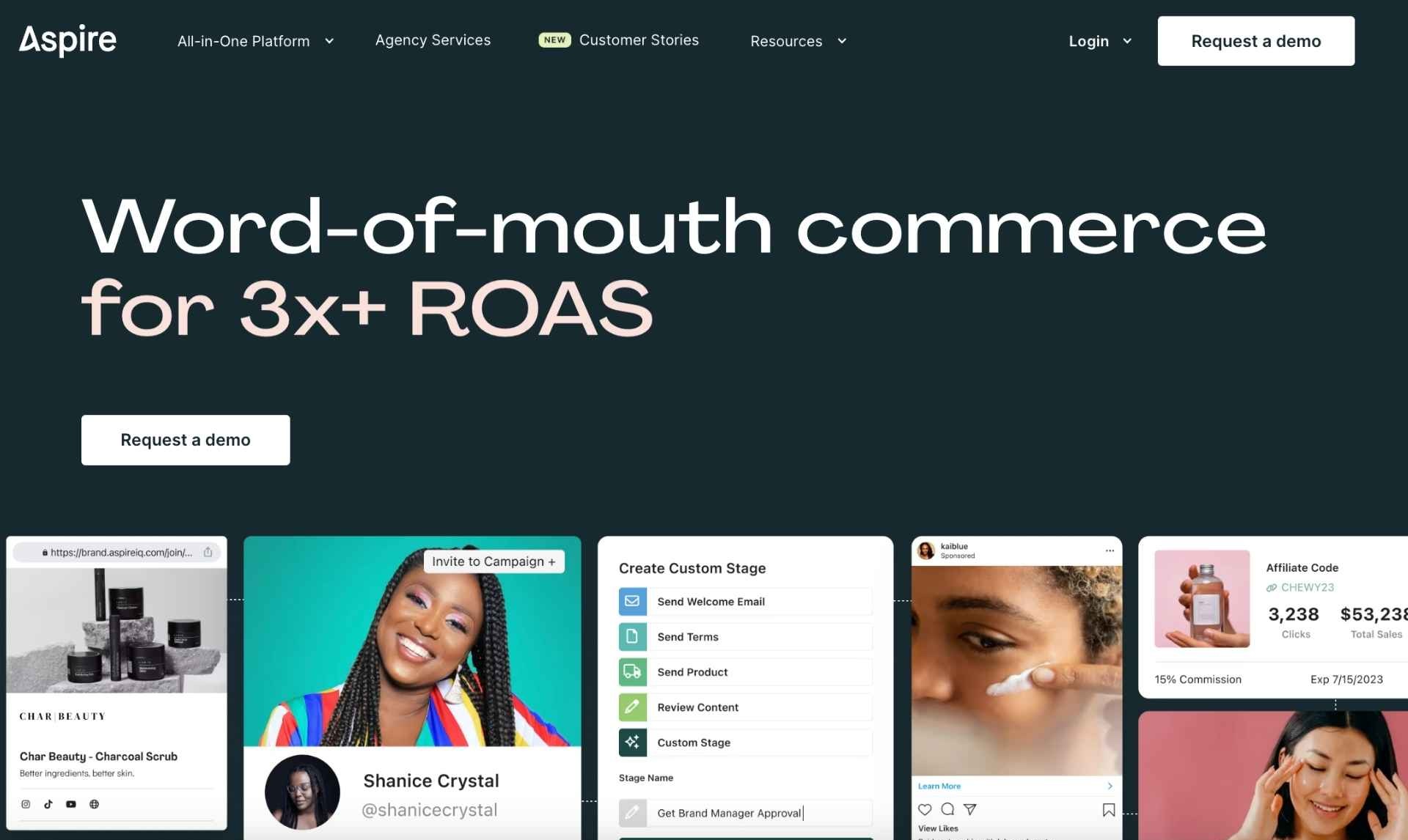
Aspire is an influencer marketing platform designed to help brands discover creators, recruit them through inbound applications, manage campaigns, and track sales and content performance in one system. In influencer discovery specifically, Aspire stands out by combining outbound search with an inbound creator marketplace and first-party data partnerships, which gives brands a different workflow than tools that rely mainly on scraped public data.
Key features
- Creator search — Aspire lets teams search creators by channel, keyword, engagement, audience demographics, and lookalike recommendations to build targeted creator lists.
- First-party social data — The platform uses first-party partnerships with Meta, TikTok, and Pinterest, which helps improve the reliability of audience and performance data.
- Inbound creator marketplace — Brands can post campaign opportunities and receive applications from creators through Aspire’s marketplace, reducing dependence on cold outreach alone.
- Application pages — Custom landing pages make it easy to collect creator details, ideas, and product fit information before moving creators into a campaign workflow.
- Workflow automation — Aspire supports automated follow-ups, bulk actions, and structured campaign stages for contracts, briefs, approvals, and live posts.
- Content approval tools — Teams can manage post approvals and campaign deliverables inside the platform rather than handling that process manually over email.
- Sales tracking — Aspire supports unique links, discount codes, creator stores, and commission tracking so teams can tie influencer activity back to conversions.
- Content library — Campaign assets and creator content are stored in a central library for reuse, reporting, and team access.
- Email communication — Gmail-synced outreach, templates, and conversation history help teams manage creator communication in the same workflow as campaign execution.
- Reporting and analytics — Aspire gives brands exportable campaign, creator, and channel-level reporting with sales and performance views.
Platform coverage
Aspire’s discovery and campaign workflows are centered on Instagram, TikTok, YouTube, Pinterest, and Facebook, with its strongest emphasis typically on the major commerce-focused channels rather than broad long-tail platform coverage.
Standout Features
- Inbound creator marketplace — Aspire’s marketplace is one of its clearest differentiators because it gives brands an additional sourcing channel beyond standard outbound search.
- First-party data partnerships — Its partnerships with Meta, TikTok, and Pinterest are a major selling point for teams that care about cleaner, more reliable creator data.
- Structured workflow automation — Aspire is especially strong for brands that need campaign approvals, automated follow-ups, and operational control across larger creator programs.
Limitations
- Higher entry pricing — Aspire is positioned above many self-serve tools, which can make it harder to justify for smaller teams or lighter influencer programs.
- Less pricing transparency than lower-cost tools — While Aspire provides tailored packages, buyers usually need to go through sales to understand the exact fit and total cost.
- Primary strength is structured workflows, not the broadest platform coverage — Compared with some competitors, Aspire is less centered on supporting a wide range of secondary social platforms.
- Direct payment processing is less emphasized in the core pitch — Its strongest positioning is around workflows, gifting, and sales attribution rather than being known first for creator payout infrastructure.
Integrations
- Shopify — Aspire’s Shopify integration supports product seeding, promo codes, influential customer matching, shipping workflows, and conversion tracking.
- WooCommerce — Aspire lists WooCommerce among its commerce integrations, giving brands another route for connecting store and campaign data.
- Gmail — Gmail sync helps teams manage outreach, replies, and creator communication inside Aspire rather than splitting work across tools.
- Microsoft Outlook — Outlook integration supports brand-email outreach and shared inbox workflows for influencer communication.
- CJ — The CJ integration helps centralize conversion data and affiliate performance reporting alongside influencer campaign activity.
Pricing
Aspire’s pricing is customized, starting from $2,000/month for a brand managing roughly 20–40 creators per month with multiple team members and up to 500 creators in CRM. Aspire is typically sold through tailored packages rather than simple self-serve plans, and the material provided does not indicate a standard free trial.
Reviews
4.0 /5.0 (Capterra)
Influencer Hero Overview
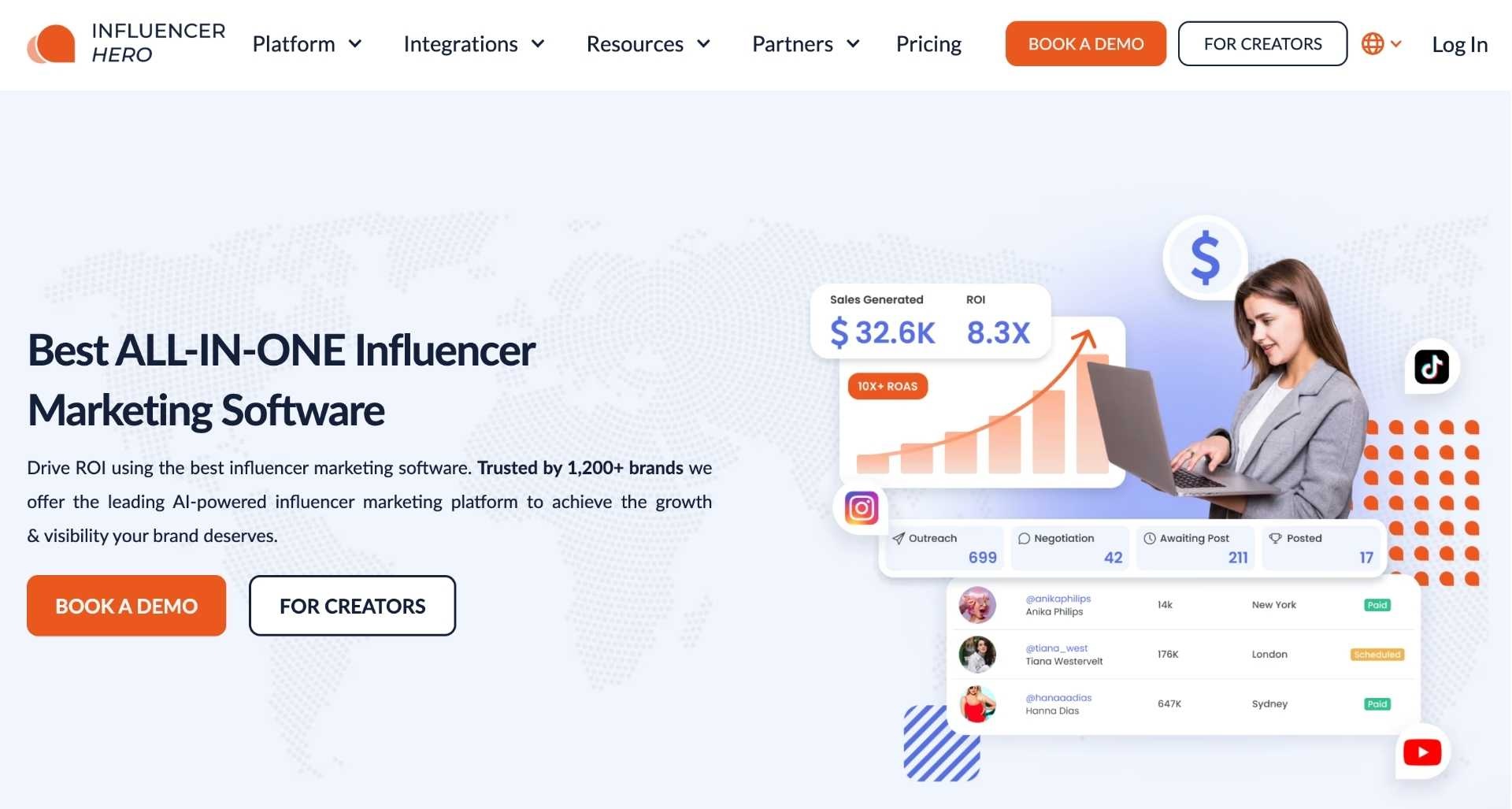
Influencer Hero is an all-in-one influencer marketing platform built to help brands find creators, run outreach, manage campaigns, handle gifting, and track ROI in one workflow. On the discovery side, it combines advanced filters, lookalike suggestions, brand-follower detection, and a Chrome extension that lets teams pull creator data while browsing social platforms, making it more operational than a simple influencer database.
Key features
- Influencer discovery — Search creators using filters such as location, audience demographics, interests, engagement rate, follower quality, and fake follower detection.
- Lookalike recommendations — Find creators similar to top-performing influencers to speed up shortlist building.
- Brand-follower detection — Identify creators who already follow or engage with your brand, which can improve outreach relevance and response rates.
- Chrome extension — View creator stats in real time on Instagram, TikTok, or YouTube and import profiles into campaigns with one click.
- AI-assisted discovery — Use AI-powered matching and creator suggestions to narrow down candidates faster based on campaign goals.
- Bulk and 1:1 outreach — Run automated bulk outreach or individual emails from the same platform.
- AI-personalized email templates — Generate outreach copy with personalization and use drip sequences plus reply tracking to manage conversations at scale.
- CRM and campaign boards — Track communication, campaign stages, deliverables, and creator status through visual relationship boards.
- Reporting and ROI tracking — Measure clicks, affiliate sales, UGC downloads, content performance, and ROI per influencer in real time.
- Product gifting and seeding — Automate gifting through e-commerce integrations and monitor shipping, delivery, and confirmations inside the workflow.
- UGC collection — Automatically collect influencer posts, store them centrally, and tag top-performing assets for reuse.
- Affiliate management and payouts — Create custom links and discount codes, track commissions and conversions, and automate payments.
- Application pages and storefronts — Build branded landing pages for inbound creator applications and customizable storefronts for affiliate-driven product sales.
Platform coverage
Influencer Hero supports Instagram, TikTok, YouTube, Facebook, Pinterest, Snapchat, X, and Twitch, giving it broader platform coverage than many influencer tools focused only on the three largest creator channels.
Standout Features
- Campaign-centric CRM automation — Influencer Hero’s strongest differentiator is its CRM structure, with visual boards, bulk actions, and automation designed for brands managing high-volume outreach and seeding programs.
- Multi-platform e-commerce support — It supports Shopify, WooCommerce, and additional custom or script-based commerce setups, which makes it more flexible than platforms built mainly around Shopify.
- AI-powered workflow optimization — From creator recommendations to personalized outreach and predictive campaign suggestions, the platform is built to reduce manual work across the full campaign lifecycle.
- Influencer Brand Followers — Identify creators who already follow or engage with your brand to boost campaign authenticity and improve outreach success.
Limitations
- No free trial — There is no free trial available, which can make it harder to test the platform before committing.
- Initial learning curve — The broad feature set may require onboarding time for new users to fully utilize the platform.
- Higher starting price — Plans start at $649/month, which may be a barrier for smaller brands or early-stage teams.
Integrations
- Shopify — Connect your store to automate gifting, track affiliate revenue, and measure creator-driven sales.
- WooCommerce — Run gifting and affiliate workflows for WooCommerce stores without relying only on Shopify.
- Klaviyo — Sync influencer activity with email marketing workflows and customer data for more connected lifecycle campaigns.
- Zapier — Connect Influencer Hero with a wide range of external apps to automate tasks such as reporting, store events, shipping, and internal workflows.
- DocuSign — Streamline contract collection and signature workflows as part of influencer deal management.
- API access — Access influencer data and campaign workflows programmatically to build custom integrations or internal tools.
Pricing
Influencer Hero offers flexible pricing based on outreach volume:
- Standard: $649/month (up to 1,000 outreaches/month)
- Pro: $1,049/month (up to 5,000 outreaches/month)
- Business: $2,490/month (up to 10,000 outreaches/month)
- Custom / Agency: Custom pricing available
All plans include core features and allow unlimited creators in the CRM.
Reviews
5.0/5.0 (Capterra)
Final Thoughts
Modash, Aspire, and Influencer Hero each solve the same core problem—helping brands and agencies find creators, manage campaigns, and measure performance—but they do it with different strengths. Modash stands out for large-scale creator discovery and a strong Shopify workflow, Aspire is strongest for brands that want first-party data, inbound creator applications, and more structured campaign processes, while Influencer Hero offers a broader all-in-one approach with strong CRM automation, multi-platform coverage, and flexible e-commerce support.
The right choice comes down to how your team runs influencer marketing today. Teams focused primarily on sourcing creators may lean toward Modash, those running larger approval-heavy or inbound-led programs may prefer Aspire, and brands or agencies looking for a more execution-focused platform with outreach, gifting, CRM, and reporting in one place should take a close look at Influencer Hero.