

.jpg)
TRIBE Alternatives: Best Influencer Marketing Platforms
Managing creator partnerships at scale requires more than spreadsheets—modern influencer marketing software helps brands handle discovery, outreach, campaign workflows, and performance tracking in one place. Tribe has become a popular option thanks to its content-first marketplace model, where creators pitch campaign ideas and brands can quickly source UGC-ready content. This approach works well for fast campaign execution, but it may not suit teams looking for deeper control over influencer sourcing and long-term program management.
Common feedback highlights a few limitations that lead users to explore Tribe alternatives, including limited proactive discovery capabilities, a more transactional campaign structure that makes relationship-building harder, and fewer advanced CRM or analytics features compared to other platforms. As brands mature their influencer strategies, they often need tools that offer stronger automation, eCommerce integrations, and ROI tracking. In this guide, we compare the 10 best Tribe alternatives—GRIN, Influencer Hero, Aspire, SARAL, Influencity, NeoReach, Heepsy, Skeepers, Upfluence, and Traackr—to help you find the right influencer marketing platform for your needs.
Criteria for Suggesting Platform Alternatives:
• Core Features
Evaluation of each platform’s essential capabilities, including influencer discovery, outreach, CRM, campaign reporting, gifting, UGC and content collection, affiliate tracking and payments, storefronts, application pages, and AI-powered tools.
• Supported Social Media Platforms
Assessment of how well each platform integrates with major social networks such as Instagram, YouTube, TikTok, Facebook, Pinterest, and many more
• Pricing & Contract Flexibility
Comparison of pricing models, subscription costs, and contract requirements to help brands choose solutions that match their budget and scalability needs.
• Standout & Differentiating Features
Highlighting unique or innovative functionalities that set each platform apart, such as real-time tracking dashboards, creator benchmarking, TikTok email discovery, or advanced automation tools.
• Customer Reviews & User Satisfaction
Analysis of verified user feedback from credible platforms like G2, TrustRadius, Capterra, focusing on usability, reliability, value for money, customer support, and real-world performance.
Tribe Overview

Tribe is an influencer marketing platform that focuses on connecting brands with creators through a content-first marketplace model. Founded in Australia, Tribe positions itself as a self-serve platform where brands can launch campaigns and receive content submissions directly from creators, rather than relying heavily on outbound outreach. This approach makes it particularly attractive for brands looking to scale user-generated content (UGC) and streamline influencer collaborations without extensive manual sourcing.
Unlike traditional influencer platforms that prioritize database search and outreach workflows, Tribe flips the model—allowing creators to pitch content ideas upfront. This results in faster campaign turnaround times and a strong emphasis on performance-driven, ready-to-publish content.
Key Features
• Content Marketplace (Creator Pitches): Brands can publish campaign briefs and receive content submissions directly from creators. Each submission includes draft content, pricing, and audience insights, allowing brands to review before approving.
• End-to-End Campaign Management: Manage the full lifecycle—from brief creation and creator selection to approvals, publishing, and reporting—all within a centralized dashboard.
• Pre-Vetted Creator Network: Tribe maintains a curated network of creators, ensuring a baseline level of quality, brand safety, and audience authenticity.
• Content Approval Workflow: Built-in approval systems allow brands to review, request edits, and approve content before it goes live, reducing risk and ensuring alignment.
• Usage Rights & Licensing: Brands typically gain rights to reuse approved content across paid ads, social media, and other marketing channels—making it a strong UGC engine.
• Performance Tracking & Reporting: Track campaign metrics such as reach, engagement, and conversions, with insights tied to individual creators and content pieces.
• Paid Media Amplification: Tribe integrates content amplification, allowing brands to boost high-performing creator content through paid social campaigns.
Platform Coverage
Instagram, TikTok, and Facebook, with strong support for mobile-first, content-driven campaigns.
Pricing
Tribe does not publicly list fixed pricing tiers. Instead, pricing is typically customized based on campaign scope, creator volume, and brand needs.
Reviews
4.3 / 5.0 (G2)
Tribe Standout Features
• Content-First Creator Marketplace: Instead of searching and pitching to influencers, brands receive ready-made content proposals from creators—complete with creative direction, captions, and pricing. This significantly reduces campaign ideation time.
• Pre-Approved UGC Before Payment: Brands can review and approve content before committing budget, ensuring they only pay for assets that meet their standards—something not commonly offered in traditional outreach-driven platforms.
• Integrated Paid Amplification: Tribe allows brands to seamlessly turn influencer content into paid ads, bridging the gap between influencer marketing and performance marketing in one workflow.
Limitations (Why Users Look for Tribe Alternatives)
Limited Control Over Creator Discovery
Since the platform is largely inbound (creators apply to campaigns), brands have less control compared to tools with large searchable databases and proactive outreach capabilities.
Not Ideal for Relationship Building at Scale
The transactional nature of campaigns can make it harder to build long-term influencer partnerships or manage ongoing ambassador programs.
Pricing Can Be High for Frequent Campaigns
Costs can add up quickly, especially for brands running multiple campaigns or requiring high volumes of content.
Limited Advanced CRM & Automation Features
Compared to more robust platforms, Tribe lacks deeper CRM functionalities, automation workflows, and integrations needed for complex, large-scale influencer programs.
10 Best Influencer Marketing Platform Alternatives
| TOOL | REVIEWS | BEST FOR | TRIAL INFO | PRICING | ||
|---|---|---|---|---|---|---|
1 |

|
⭐ | DTC creator management | Book Demo | Pricing | Website |
2 |

|
⭐ | Influencer CRM & automation | Book Demo | Pricing | Website |
3 |

|
⭐ | Influencer partnerships | Book Demo | Pricing | Website |
4 |

|
⭐ | Influencer outreach | Book Demo | Pricing | Website |
5 |

|
⭐ | Campaign management | Book Demo | Pricing | Website |
6 |
|
⭐ | Influencer campaigns & data analytics | Book Demo | Pricing | Website |
7 |

|
⭐ | Influencer discovery | Book Demo | Pricing | Website |
8 |

|
⭐ | Influencer gifting & UGC campaigns with micro-influencers | Book Demo | Pricing | Website |
9 |
|
⭐ | Ecommerce influencer discovery | Book Demo | Pricing | Website |
10 |

|
⭐ | Enterprise influencer analytics | Book Demo | Pricing | Website |
GRIN
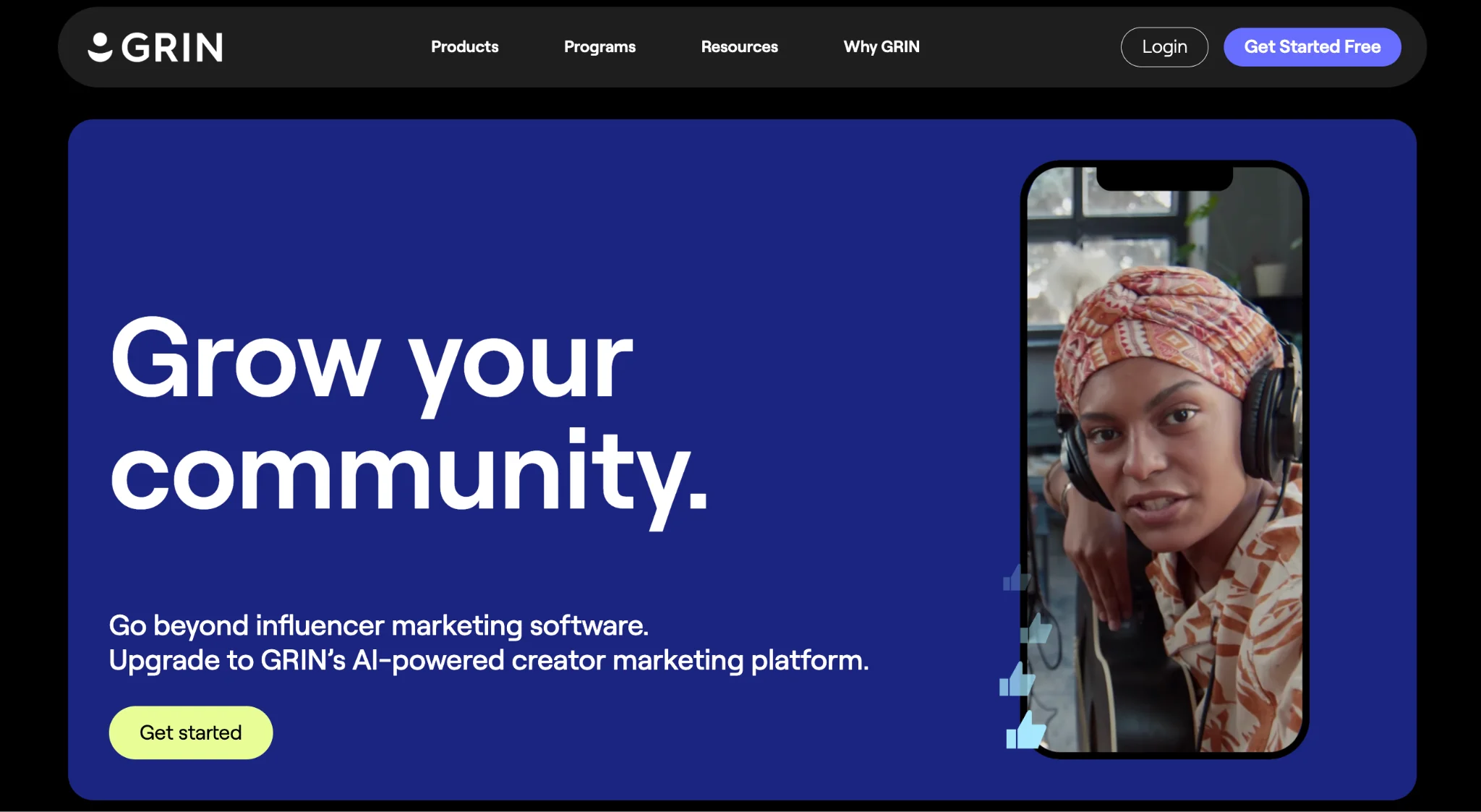
GRIN is a creator management platform built primarily for eCommerce and DTC brands that want to run influencer programs with tighter operational control over outreach, gifting, affiliate tracking, content collection, and revenue attribution. Its positioning is less about a pitch-based marketplace and more about helping brands build repeatable creator workflows tied to sales outcomes.
Key Features
• Creator discovery and lookalike search: GRIN lets brands search large creator pools and filter by audience and performance criteria, then expand shortlists with creator and audience lookalikes. It is designed for teams that want to source creators proactively rather than wait for inbound pitches.
• Integrated outreach and CRM: Brands can manage email outreach, creator status tracking, briefs, contracts, and relationship stages in one system. This is useful for teams handling ongoing partnerships rather than one-off campaign transactions.
• Gifting and eCommerce workflows: GRIN is especially strong for product seeding. It connects gifting, affiliate links, codes, and order tracking so brands can tie creator activity back to commerce performance more directly.
• Payments and compliance tools: Higher tiers include automated creator payments and 1099 processing, which reduces finance admin for brands running larger creator programs.
• Content library and approvals: GRIN centralizes creator assets and supports content approvals, helping teams manage UGC and repurposing more systematically.
• Reporting and attribution: The platform includes report builders, deep links, advanced affiliate attribution, and broader creator performance reporting as brands move up tiers.
Platform Coverage
Facebook, Instagram, TikTok, X, Pinterest, YouTube, and Twitch
Pricing
Annual pricing starts at $25,000/year (approx. $2,050/month)
Reviews
4.5/5.0 (G2)
Standout Features
• eCommerce-native creator operations: GRIN’s strongest differentiator is how tightly it connects creator management with gifting, affiliate tracking, payments, and commerce attribution, making it especially appealing for Shopify-led brands.
• Automated payments and tax workflows: Unlike more marketplace-style platforms, GRIN bakes creator payouts and 1099 handling directly into higher tiers, which is valuable for brands scaling many long-term partnerships.
• Flexible self-serve pricing rollout: One notable recent change is GRIN’s move toward instant self-serve access and month-to-month pricing, which makes the platform more accessible than older enterprise-style contract models.
Tribe vs GRIN
Tribe is built around an opt-in creator community and a pitch-first workflow, where brands publish briefs and creators submit ideas and content proposals. GRIN is better suited to brands that want to source creators proactively, run structured CRM-style workflows, and connect influencer activity directly to gifting, affiliate sales, and repeatable eCommerce operations. In practice, Tribe is more content-marketplace-led, while GRIN is more relationship- and revenue-operations-led.
Influencer Hero

Influencer Hero is an all-in-one influencer marketing platform aimed at DTC brands, eCommerce teams, and agencies that want discovery, outreach, gifting, affiliate tracking, UGC collection, and influencer payouts inside a single operating system. Its positioning is especially strong for brands that care about performance visibility and scalable outreach rather than just campaign matchmaking.
Key Features
• Influencer discovery: Search creators across major platforms with advanced audience, engagement, location, and niche filters, plus fraud detection and lookalike recommendations
• Outreach & automation: Run personalized outreach at scale with AI-assisted messaging, automated follow-ups, and multi-step email sequences
• Influencer CRM: Centralize creator relationships with pipeline management for conversations, campaign stages, and deliverables
• Gifting workflows: Manage product seeding end-to-end with automated order creation, shipment tracking, and delivery monitoring
• Affiliate tracking & payouts: Create trackable links and discount codes, measure performance, and manage commissions and payments in one workflow
• Campaign analytics & ROI tracking: Track engagement, clicks, conversions, and revenue through real-time dashboards tied to campaign performance
• UGC library: Automatically capture and organize creator content for reuse across paid ads, social media, and eCommerce channels
• Application pages & storefronts: Build branded creator application pages and enable influencers to promote products through personalized storefronts
• eCommerce integrations: Connect directly with platforms like Shopify and WooCommerce to link influencer activity to sales and attribution
• API & integrations: Expand capabilities with API access and integrations such as Klaviyo, Slack, Zapier, and email platforms
Platform Coverage
Instagram, TikTok, YouTube, Facebook, Pinterest, Snapchat, X, and Twitch
Pricing
Influencer Hero offers flexible pricing based on outreach volume, and you can have unlimited creators in your CRM with Influencer Hero:
• Standard — $649/month (up to 1,000 reachouts/month)
• Pro — $1,049/month (up to 5,000 reachouts/month)
• Business — $2,490/month (up to 10,000 reachouts/month)
• Custom / Agency — Tailored pricing
Reviews
5.0/5.0 (Capterra)
Standout Features
• Campaign-first CRM automation: Influencer Hero’s strongest differentiator is its board-style campaign management, with bulk actions and automated follow-up logic built for higher-volume creator programs.
• AI-enhanced outreach workflows: It stands out for combining scalable outreach with personalization, helping teams send more emails without making them feel fully templated.
• Broad eCommerce support: Compared with tools that center mainly on Shopify, Influencer Hero emphasizes support for Shopify, WooCommerce, and custom setups, which is useful for brands with more varied commerce stacks.
Tribe vs Influencer Hero
Tribe is stronger if a brand wants creators to come in through a brief-and-pitch workflow and prioritize ad-ready content generation from its opt-in community. Influencer Hero is the better fit for brands that want active prospecting, structured outreach automation, a deeper influencer CRM, and stronger gifting, affiliate, and payout workflows tied to ROI. Tribe leans more into creator submissions; Influencer Hero leans more into program orchestration.
Aspire
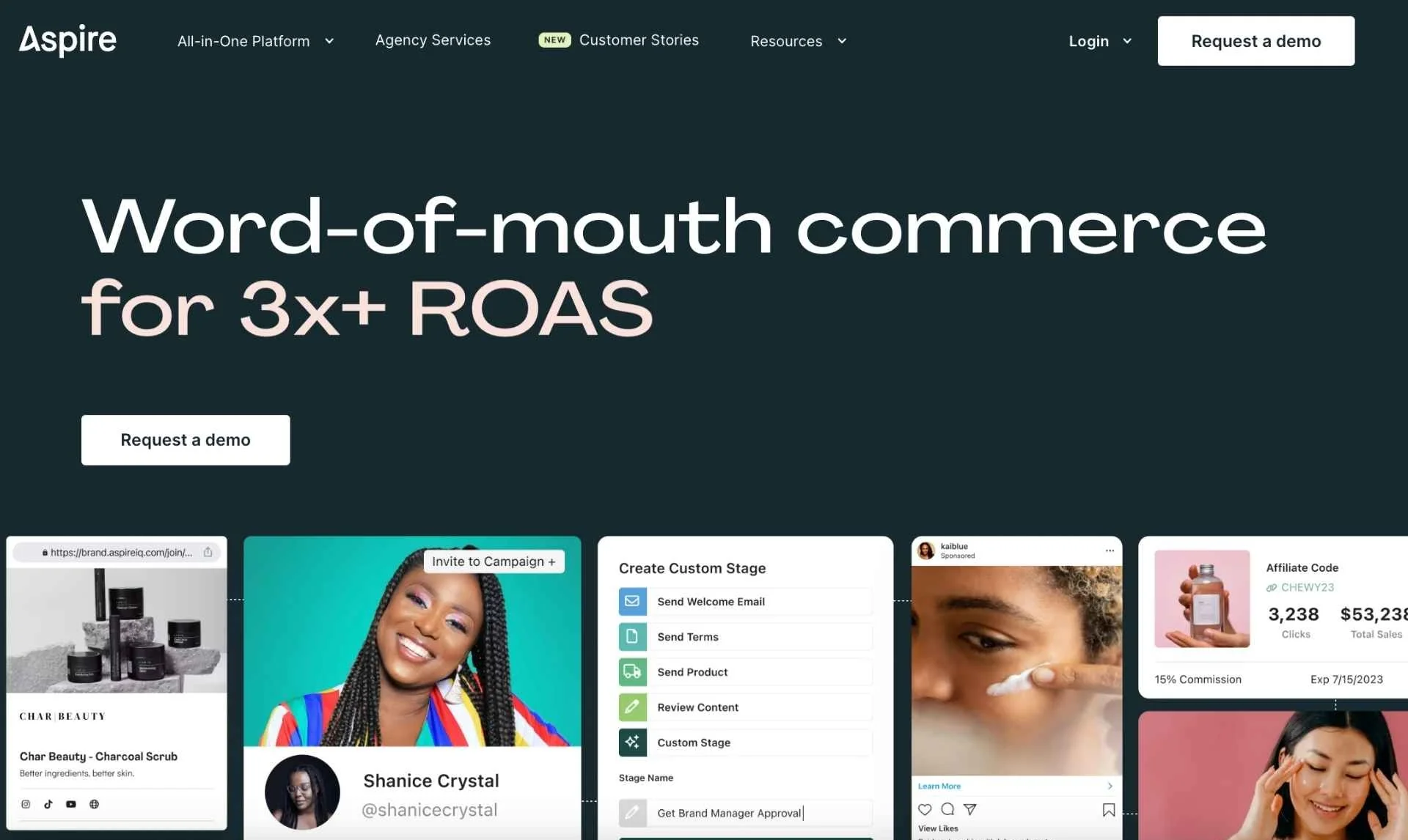
Aspire is an influencer marketing platform built for eCommerce brands that want to combine creator discovery, inbound applications, gifting, affiliate programs, content approvals, and sales tracking in one system. It is particularly well known for pairing a creator marketplace with workflow tools that help brands build more structured, ROI-focused creator programs.
Key Features
• Dual discovery model: Aspire combines searchable creator discovery with a large inbound creator marketplace, giving brands both outbound sourcing and inbound applications. This gives teams more flexibility than tools that rely on only one discovery model.
• First-party platform data: Aspire highlights direct platform partnerships and first-party integrations, which can improve confidence in creator and campaign metrics. This matters for brands that want cleaner reporting and less dependence on scraped data.
• Campaign workflow and approvals: Brands can manage outreach, briefs, contracts, approvals, and creator milestones from a central dashboard, which supports more controlled, repeatable campaign execution.
• Gifting and creator commerce: Aspire integrates product gifting, creator stores, discount links, and sales tracking, making it particularly attractive for brands that want creators to function as both content partners and commerce partners.
• Content and licensing support: Aspire supports UGC collection, usage rights workflows, and content approvals before posts go live, which is especially useful for brands with tighter brand governance needs.
• Support and onboarding: Aspire is also frequently noted for its implementation and success support, which can reduce friction for teams launching more mature influencer operations.
Platform Coverage
Instagram, TikTok, Pinterest, YouTube, and Facebook
Pricing
Aspire starts with tiered pricing and can be customized, with a mid-tier quote of about $2,300/month for a use case involving multiple team members and up to 500 creators in CRM.
Reviews
4.0 /5.0 (Capterra)
Standout Features
• Large inbound creator marketplace: Aspire’s marketplace is one of its clearest differentiators, helping brands fill campaigns with creators who proactively apply instead of relying entirely on cold outreach.
• Direct platform partnerships: Aspire emphasizes direct relationships with Meta, TikTok, and Pinterest, which helps strengthen first-party reporting and campaign insights.
• Creator commerce workflows: Its combination of gifting, creator stores, affiliate tracking, and content approvals makes Aspire especially attractive for brands blending influencer marketing with conversion-focused commerce.
Tribe vs Aspire
Both platforms are strong for creator content, but they approach it differently. Tribe is more centered on creators pitching campaign ideas into a marketplace-style brief, while Aspire adds a fuller CRM, stronger workflow automation, gifting, creator commerce, and a broader inbound-plus-outbound discovery model. For brands prioritizing long-term creator infrastructure and sales tracking, Aspire usually goes further; for brands prioritizing pitch-led content sourcing, Tribe stays simpler.
SARAL

SARAL is an influencer marketing platform built mainly for emerging eCommerce and DTC brands that want a simpler operating system for creator discovery, outreach, relationship management, gifting, affiliate workflows, and performance tracking. Its value proposition is ease of use: replacing spreadsheets and fragmented tools with a more streamlined workflow for lean teams.
Key Features
• Influencer discovery: SARAL helps brands find creators from public profiles and shortlist them based on relevance, making it useful for teams building programs from scratch. It is designed to reduce manual sourcing work.
• Automated outreach: The platform includes outreach automation so brands can scale emails without managing everything manually in inboxes and spreadsheets. This is one of the recurring reasons smaller teams adopt it.
• Relationship management: SARAL organizes creator relationships, stages, and performance inside a dedicated influencer OS, helping brands track where every creator sits in the workflow.
• Affiliate and gifting workflows: The platform supports gifting, affiliate tracking, customer-to-ambassador workflows, and payment processes, making it useful for commerce-led creator programs.
• Application forms and ambassador recruitment: SARAL also supports application forms for brands that want to collect inbound interest and turn customers or fans into creators and ambassadors.
• Chrome extension and rate guidance: Market feedback frequently highlights the Chrome extension and suggested rate calculator as practical tools for speeding up sourcing and outreach decisions.
Platform Coverage
Instagram, TikTok, and YouTube.
Pricing
There are different plans:
• Starter: $3.6k/quarter
• Business: $4.5k/quarter
• Professional: $7.5k/quarter
Reviews
4.7/5.0 (G2)
Standout Features
• Simplicity for lean teams: SARAL’s clearest differentiator is how strongly it focuses on replacing spreadsheets and disconnected workflows for smaller eCommerce teams.
• Influencer OS with relationship tracking: Rather than acting only as a search tool, SARAL positions itself as an end-to-end operating layer for creator relationships, campaign progress, and performance.
• Practical workflow tools like the Chrome extension and rate calculator: These are not flashy enterprise features, but they are the kind of high-utility tools that matter a lot for smaller teams running day-to-day sourcing and outreach.
Tribe vs SARAL
Tribe is better known for its opt-in creator community and creator pitch workflow, which makes it attractive for content-led campaign briefs. SARAL is more operational and outreach-led, giving brands tools to find creators, manage relationships, automate emails, and connect influencer activity to gifting and affiliate workflows. Put simply, Tribe is stronger as a creator marketplace; SARAL is stronger as a lightweight influencer operating system for DTC teams.
Influencity

Influencity is an end-to-end influencer marketing platform designed for brands and agencies that want discovery, campaign execution, influencer relationship management, outreach, and reporting in one place. It is positioned as a flexible, workflow-heavy system with a large creator database and a stronger agency-friendly orientation than many DTC-only tools.
Key Features
• Large influencer database and analytics: Influencity provides access to a very large creator database with detailed filters, profile analytics, audience insights, and follower-quality analysis. This is one of its biggest strengths for teams doing upfront vetting.
• Outreach and workflow management: The platform includes outreach tools, email templates, follow-up support, and campaign boards that help teams organize creator communication and progress visually.
• Campaign management: Influencity is built to run campaigns from planning through tracking, making it suitable for brands and agencies coordinating multiple creators and deliverables at once.
• Performance measurement and reporting: It offers campaign analytics, reporting exports, and a broad set of influencer marketing features intended to reduce reliance on external reporting tools.
• Influencer payments and seeding: Its official product positioning includes influencer payments and seeding features, helping brands move beyond discovery into actual execution.
• Agency-friendly flexibility: Influencity’s workflow customization and broad feature set make it especially relevant for agencies or multi-market teams managing more than one program at a time.
Platform Coverage
Instagram, TikTok, YouTube, and X/Twitter
Pricing
• Professional Plan: $318/month or $3,816/year
• Business Plan: $798/month or $9,576/year
• Enterprise Plan: Custom pricing
• Auto-Tracker Add-On: $660/year (for 50 influencers)
Reviews
4.3 / 5.0 (G2)
Standout Features
• Strong analytics and filtering depth: Influencity stands out for giving teams a lot of control over creator filtering, analysis, and shortlist building, which is a major advantage for research-heavy teams.
• Agency-friendly end-to-end workflow: It is built not just for discovery but for managing multiple campaigns, approvals, outreach flows, and reports inside one platform.
• Balanced pricing structure: Compared with more enterprise-only tools, Influencity sits in a more accessible middle ground, with a public entry point and modular structure for brands that want more than basic discovery but less than a fully bespoke enterprise stack.
Tribe vs Influencity
Tribe is more creator-community-driven and content-pitch-led, which is useful when a brand wants creators to respond directly to briefs with ideas and pre-approved content concepts. Influencity is more database-, workflow-, and analytics-driven, making it a better fit for brands or agencies that want proactive discovery, detailed filtering, structured outreach, and broader campaign management. Tribe is simpler for content sourcing; Influencity is broader for operational control and analysis.


NeoReach

NeoReach is an enterprise influencer marketing platform focused on data-driven campaign execution, influencer discovery, and ROI measurement. It is particularly known for combining influencer marketing with performance marketing capabilities, offering deep analytics, audience insights, and paid media integrations for large-scale brand campaigns.
Key Features
• Advanced influencer discovery: NeoReach offers access to a large global creator database with detailed filters including audience demographics, engagement metrics, brand affinity, and past collaborations.
• Predictive analytics and campaign forecasting: The platform uses historical data to estimate campaign performance, helping brands allocate budgets more effectively.
• End-to-end campaign management: Manage workflows from creator sourcing and outreach to contracts, approvals, and reporting within a centralized dashboard.
• Paid media amplification: NeoReach integrates influencer content into paid media strategies, allowing brands to scale top-performing content through ads.
• Custom reporting and dashboards: Provides highly customizable reporting with metrics such as ROI, conversions, impressions, and engagement.
• API and integrations: Offers robust API access and integrations with enterprise tools for brands that require custom workflows and data pipelines.
Platform Coverage
Instagram, TikTok, YouTube, Facebook, Twitter (X), Pinterest, and Snapchat.
Pricing
NeoReach uses custom enterprise pricing, typically based on campaign scale, number of users, and feature requirements. Contracts are generally annual, with pricing often positioned in the higher tier of the market.
Reviews
4.5 / 5.0 (G2)
Standout Features
• Predictive campaign forecasting: Helps brands estimate ROI and performance before launching campaigns.
• Enterprise-grade API and data access: Allows deep integrations for large teams needing custom workflows.
• Paid media + influencer integration: Strong focus on turning influencer content into scalable paid ads.
Tribe vs NeoReach
Tribe focuses on a content marketplace where creators pitch ideas, making it faster for UGC production. NeoReach, on the other hand, is built for enterprise teams needing deep analytics, forecasting, and paid media integration. While Tribe is more agile and content-driven, NeoReach is more data-heavy and suited for large-scale, performance-focused campaigns.
Heepsy

Heepsy is an influencer marketing platform designed for brands and agencies looking for strong discovery and outreach capabilities at a more accessible price point. It is particularly popular among small to mid-sized businesses for its intuitive interface and powerful search filters.
Key Features
• Massive influencer database: Access to around 50 million influencers globally with detailed filtering by niche, location, audience demographics, and engagement.
• Advanced search filters: Filter by follower count, engagement rate, authenticity score, and audience data to find relevant creators.
• Fake follower detection: Built-in tools to assess audience authenticity and reduce influencer fraud risk.
• Outreach automation: Send bulk emails with templates and follow-ups to scale outreach efforts.
• Campaign tracking and CRM: Visual pipeline to track influencer status across campaigns (contacted, approved, paid, etc.).
• Shopify integration (Advanced plan): Enables affiliate tracking, discount codes, and sales attribution.
Platform Coverage
Instagram, TikTok, YouTube, and Twitch
Pricing
There are different plans:
• Free Plan: You can simply discover creators and see how the discovery feature works.
• Starter Plan: Starts at $89/month. You get up to 15k results, 50 profiles and 50 outreach emails.
• Plus Plan: Starts at $249/month. Offers 40K results, 1,000 advanced profiles, and 1,000 outreach emails. Adds bulk email outreach, contact exports, media gallery, and campaign reporting.
• Advanced Plan: Starts at $369/month. Includes 60K results, 3,000 profiles, and 3,000 outreach emails. Adds advanced filters, automated sales tracking, Shopify/WooCommerce integrations, product catalogs, and promo code tracking.
Reviews
4.5 / 5.0 (G2)
Standout Features
• Highly granular search filters: One of the strongest filtering systems for finding niche influencers quickly.
• Affordable entry point: Lower cost compared to enterprise platforms while still offering strong discovery tools.
• Visual CRM pipeline: Simple but effective campaign tracking interface for managing influencer relationships.
Tribe vs Heepsy
Tribe is focused on inbound creator pitches and content production, while Heepsy emphasizes outbound discovery and outreach. Heepsy gives brands more control over influencer selection and prospecting, whereas Tribe simplifies content sourcing. Brands needing hands-on sourcing and filtering often prefer Heepsy, while Tribe suits those prioritizing UGC speed.
Skeepers
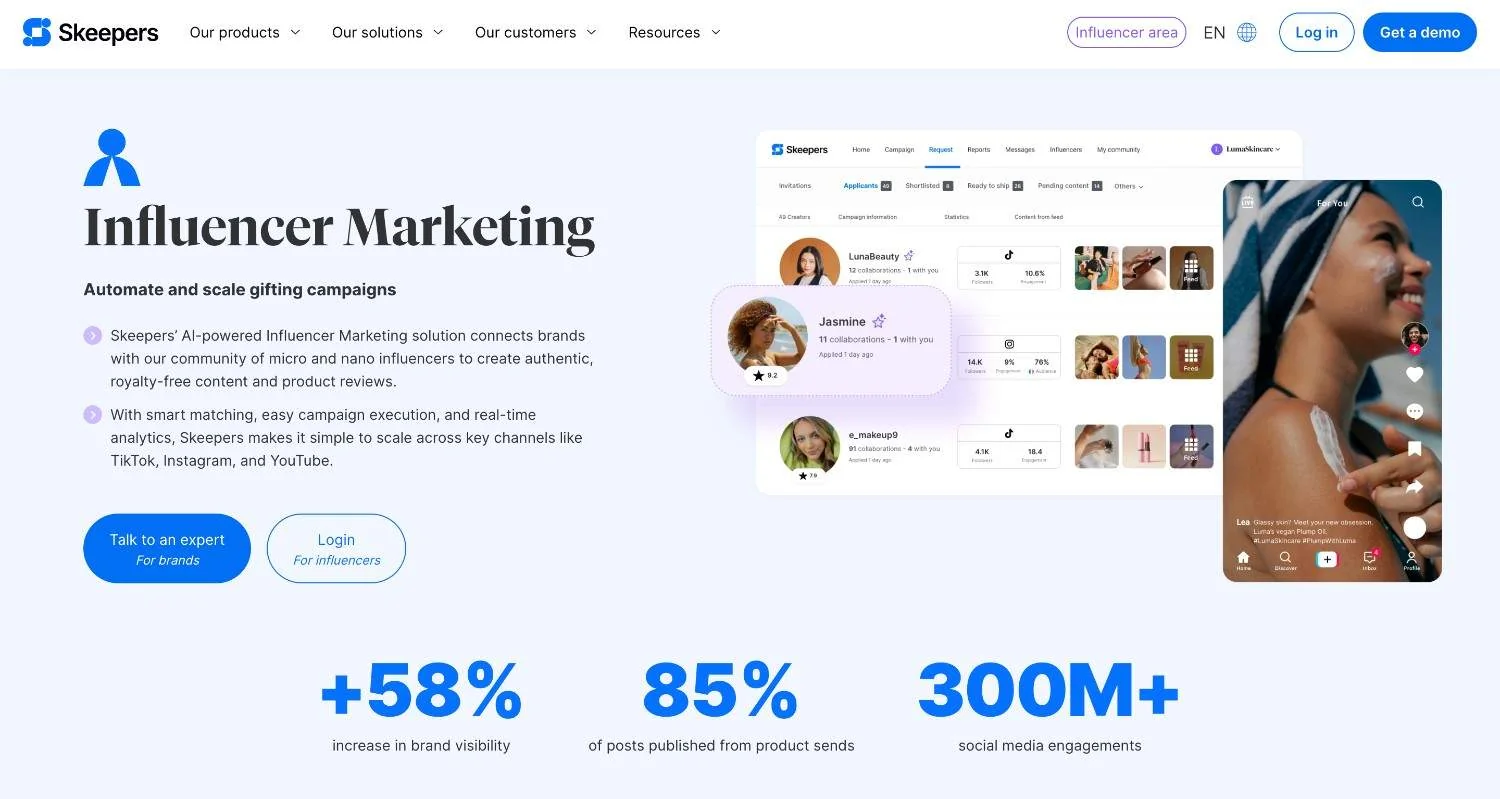
Skeepers is a unified platform that combines influencer marketing, user-generated content (UGC), customer reviews, and ratings into one ecosystem. It is particularly popular in Europe and among brands looking to integrate influencer campaigns with broader customer engagement strategies.
Key Features
• Influencer marketing platform: Connect with creators and manage campaigns from discovery to reporting.
• UGC and content collection: Gather and manage user-generated content for reuse across marketing channels.
• Ratings and reviews integration: Combine influencer marketing with customer feedback to build trust and social proof.
• Campaign management tools: Manage collaborations, approvals, and deliverables in one place.
• Data and performance insights: Track engagement, conversions, and ROI across campaigns.
• Community-driven approach: Focuses on building communities of creators and customers rather than one-off campaigns.
Platform Coverage
Instagram, TikTok, YouTube
Pricing
Skeepers uses custom pricing, typically based on modules (UGC, influencer marketing, reviews) and campaign scale. Contracts are usually annual.
Reviews
4.7/5.0 (G2)
Standout Features
• All-in-one UGC + reviews ecosystem: Combines influencer content with verified customer reviews in one platform.
• Community-first approach: Focuses on long-term engagement with creators and customers.
• Content repurposing capabilities: Strong tools for turning influencer content into broader marketing assets.
Tribe vs Skeepers
Tribe is focused on influencer-generated content through a marketplace model, while Skeepers expands beyond influencers into reviews and customer-generated content. Skeepers is better suited for brands wanting a full UGC ecosystem, whereas Tribe is more specialized in influencer campaigns and content sourcing.
Upfluence
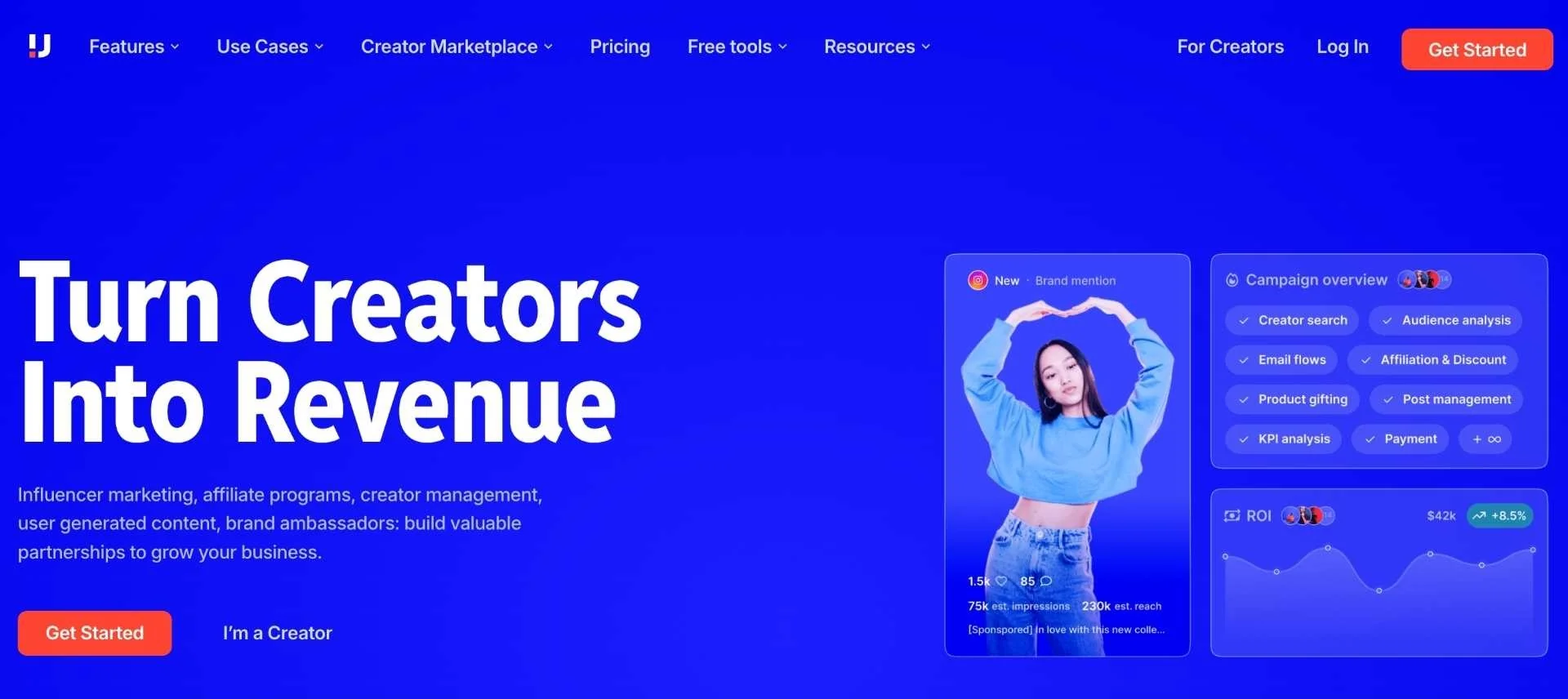
Upfluence is a comprehensive influencer marketing platform designed for eCommerce brands and agencies that want to manage influencer discovery, outreach, affiliate marketing, and sales tracking in one place. It stands out for its deep integrations with Shopify and Amazon.
Key Features
• Large influencer database: Access to over 12 million influencers with advanced filtering options.
• AI-powered outreach (Jace AI): Automates email campaigns and follow-ups to streamline communication.
• CRM and campaign management: Track influencer relationships, campaigns, and performance in one system.
• Affiliate and eCommerce integrations: Strong Shopify and Amazon integrations for tracking sales and ROI.
• Customer-to-influencer identification: Identify existing customers who are influencers and convert them into brand advocates.
• Payment processing: Secure bulk payments to influencers directly within the platform.
Platform Coverage
Instagram, TikTok, YouTube, Facebook, Twitch, Pinterest, and blogs.
Pricing
On average plans start around $2,000/month ($24,000 yearly)
Reviews
4.3 / 5.0 (Capterra)
Standout Features
• Shopify and Amazon integrations: One of the strongest eCommerce integrations for tracking influencer-driven sales.
• Customer-to-creator identification: Unique ability to turn existing customers into influencers.
• End-to-end influencer + affiliate management: Combines influencer marketing with affiliate tracking seamlessly.
Tribe vs Upfluence
Tribe simplifies influencer campaigns through a creator marketplace, while Upfluence offers a full-stack solution focused on discovery, outreach, and eCommerce ROI tracking. Upfluence is better for brands needing deep integrations and sales attribution, whereas Tribe is more streamlined for content-driven campaigns.
Traackr

Traackr is an enterprise influencer marketing platform focused on performance benchmarking, budget optimization, and ROI tracking. It is widely used by global brands that need advanced analytics and strategic insights across large influencer programs.
Key Features
• Influencer discovery: Access to over 6 million influencers with advanced filtering options.
• CRM and relationship management: Track influencer relationships, notes, and campaign progress.
• Advanced reporting and analytics: Detailed metrics including CPC, CPE, CPV, and ROI tracking.
• Budget optimization tools: Helps allocate spend across influencers based on expected performance.
• UGC tracking and content management: Collect and repurpose influencer-generated content.
• Affiliate and payment tools: Manage commissions and payouts within the platform.
Platform Coverage
Instagram, TikTok, YouTube, Facebook, Pinterest, and Twitter (X).
Pricing
Plans usually start at $32,500/year
Reviews
4.3/5.0 (G2)
Standout Features
• Brand Vitality Score (BVS): Proprietary metric combining visibility, influence, and trust.
• Budget optimization calculator: Helps determine optimal spend per influencer.
• Cost-per metrics dashboard: Tracks CPC, CPE, CPV, and other efficiency metrics.
Tribe vs Traackr
Tribe is designed for fast, content-driven influencer campaigns with a marketplace approach, while Traackr is built for enterprise teams focused on analytics, benchmarking, and budget optimization. Traackr provides deeper insights and performance metrics, whereas Tribe prioritizes speed and simplicity in content sourcing.
Final Thoughts on Tribe Alternatives
Tribe stands out for its content-first, creator marketplace approach, making it ideal for brands focused on fast UGC production and streamlined campaign execution. However, as explored across these alternatives, many platforms offer deeper capabilities in areas like influencer discovery, CRM workflows, eCommerce integrations, and advanced analytics. Solutions like GRIN, Upfluence, and Influencer Hero cater to brands seeking scalable, ROI-driven programs, while platforms like Aspire and Traackr provide more structured campaign management and performance insights. Ultimately, the right alternative depends on whether a brand prioritizes simplicity and content generation (like Tribe) or more robust control, automation, and data-driven influencer marketing operations.