

Upfluence vs GRIN vs Modash: Pricing, Features, and Platform Comparison
Choosing an influencer marketing platform now has a direct impact on how efficiently teams find creators, manage outreach, send products, track sales, and report ROI. For e-commerce brands and agencies, the right platform can reduce manual work and connect influencer activity more closely to revenue.
The main difference between Upfluence, GRIN, and Modash is that Upfluence stands out for Shopify and Amazon attribution plus customer-to-creator discovery, GRIN is built more deeply for e-commerce workflow management with creator portals, gifting, payments, and built-in media rights handling, while Modash is strongest on creator discovery with its huge non-opt-in database, visual AI search, and simpler pricing entry point.
In this article, we’ll dive into Upfluence vs GRIN vs Modash across pricing, features, and overall fit to help you decide which platform is best for your brand or agency.
Upfluence vs GRIN vs Modash
Influencer Discovery and Database
Upfluence, GRIN, and Modash take very different approaches to discovery. Upfluence gives brands access to a 12M+ database and stands out for combining creator search with audience data, suggested pricing, and customer-to-creator identification through Shopify, which is especially useful for e-commerce brands that want to activate existing customers as creators. GRIN positions discovery as part of a broader e-commerce workflow and offers AI-powered search, but its discovery layer is more closely tied to its CRM and opt-in ecosystem, while Modash is the strongest pure discovery option here with 350M+ public profiles, no opt-in requirement, lookalike search, “Find Your Fans,” and AI visual search based on aesthetic or content style.
Suggestion: Choose Modash if discovery depth is your top priority, Upfluence if you want discovery tied to e-commerce attribution, and GRIN if discovery is only one part of a larger creator operations stack.
Influencer Outreach
Upfluence is built for scaled outreach with bulk emails, automated drip flows, and Jace AI to speed up campaign setup and messaging. GRIN also offers strong outreach, but its advantage is tighter integration with Gmail, Outlook, and Klaviyo, making it better suited for teams that want outreach connected directly to broader lifecycle marketing workflows. Modash keeps outreach more streamlined, with bulk email, templates, and Gmail/Outlook syncing, but it feels more lightweight and practical than deeply automated compared with the other two.
Suggestion: Upfluence is the better fit for teams focused on outreach automation, GRIN for teams that want outreach embedded into a broader CRM process, and Modash for simpler, efficient outreach without extra complexity.
CRM and Campaign Management
GRIN is the most operationally mature platform in this group for campaign management. It goes beyond standard CRM features with creator portals, DocuSign contracts, discount codes, task automation, gifting workflows, and a structure built for ongoing creator programs. Upfluence covers the essentials well, including influencer relationship management, in-platform communication, affiliate setup, and campaign tracking, while Modash offers a lighter CRM experience that is effective for organizing partnerships and campaign statuses but is less built out for large-scale workflow management than GRIN.
Suggestion: GRIN is the strongest choice for brands running complex or high-volume programs, Upfluence works well for teams that want solid all-in-one campaign execution, and Modash is best for leaner teams that do not need a heavy workflow layer.
Reporting and Analytics
Upfluence is especially strong when reporting needs to connect influencer activity to commerce outcomes, particularly for Shopify and Amazon sellers tracking sales, clicks, conversions, and affiliate performance. GRIN also performs well here, with real-time ROI, conversion, gifting, and affiliate reporting designed for DTC teams, though some report customization is more limited. Modash offers a very usable reporting setup with campaign tracking, affiliate sales, fake follower analysis, and benchmarking, but it is more focused on campaign visibility and creator performance than enterprise-style reporting depth.
Suggestion: Pick Upfluence if sales attribution is the key KPI, GRIN if you want reporting tightly tied to your e-commerce workflow, and Modash if you want strong day-to-day analytics without paying for a more enterprise-heavy reporting layer.
Product Gifting
Product gifting is a major strength for GRIN and one of the clearest reasons e-commerce brands consider it. GRIN supports product seeding through Shopify, WooCommerce, BigCommerce, and Magento, which gives it the widest commerce flexibility in this comparison. Upfluence also performs well for gifting, especially for Shopify users and brands that want to combine seeding with affiliate and customer advocacy programs, while Modash offers a very efficient Shopify gifting flow where creators choose products through a unique link, but it is more limited because Shopify is its only e-commerce integration.
Suggestion: GRIN is the best fit for brands with more advanced gifting workflows or non-Shopify stores, Upfluence is a strong option for Shopify and Amazon-focused programs, and Modash is a great fit for Shopify brands that want simplicity.
UGC Collection
GRIN is the strongest platform here by a clear margin. It includes a searchable UGC library, stores creator content including Instagram Stories, and adds automatic media rights handling when creators are booked, which solves both storage and reuse issues in one workflow. Modash can automatically collect and surface content for download, but rights management has to be handled separately in contracts, while Upfluence tracks creator content and performance but does not appear to make UGC collection and rights management as central a strength as GRIN does.
Suggestion: GRIN is the best choice if UGC reuse is a major part of your program, Modash works if you are comfortable handling rights manually, and Upfluence is better viewed as a broader campaign platform than a UGC-first system.
Pricing
Modash is easily the most accessible option on pricing, with public entry-level plans starting at $199 per month and a Performance plan at $499 per month, both billed annually. Upfluence sits in the middle, with quoted pricing around $1,276 per month on an annual plan and optional removal of its payments module in some cases, while GRIN is clearly the highest-commitment option, with custom pricing typically starting around $2,500 per month and often increasing significantly based on scale and features.
Suggestion: Modash is the strongest value option for cost-conscious teams, Upfluence makes sense for brands that want stronger commerce features without jumping to GRIN’s price tier, and GRIN is best justified when you need a more complete e-commerce influencer operating system.


Upfluence Overview
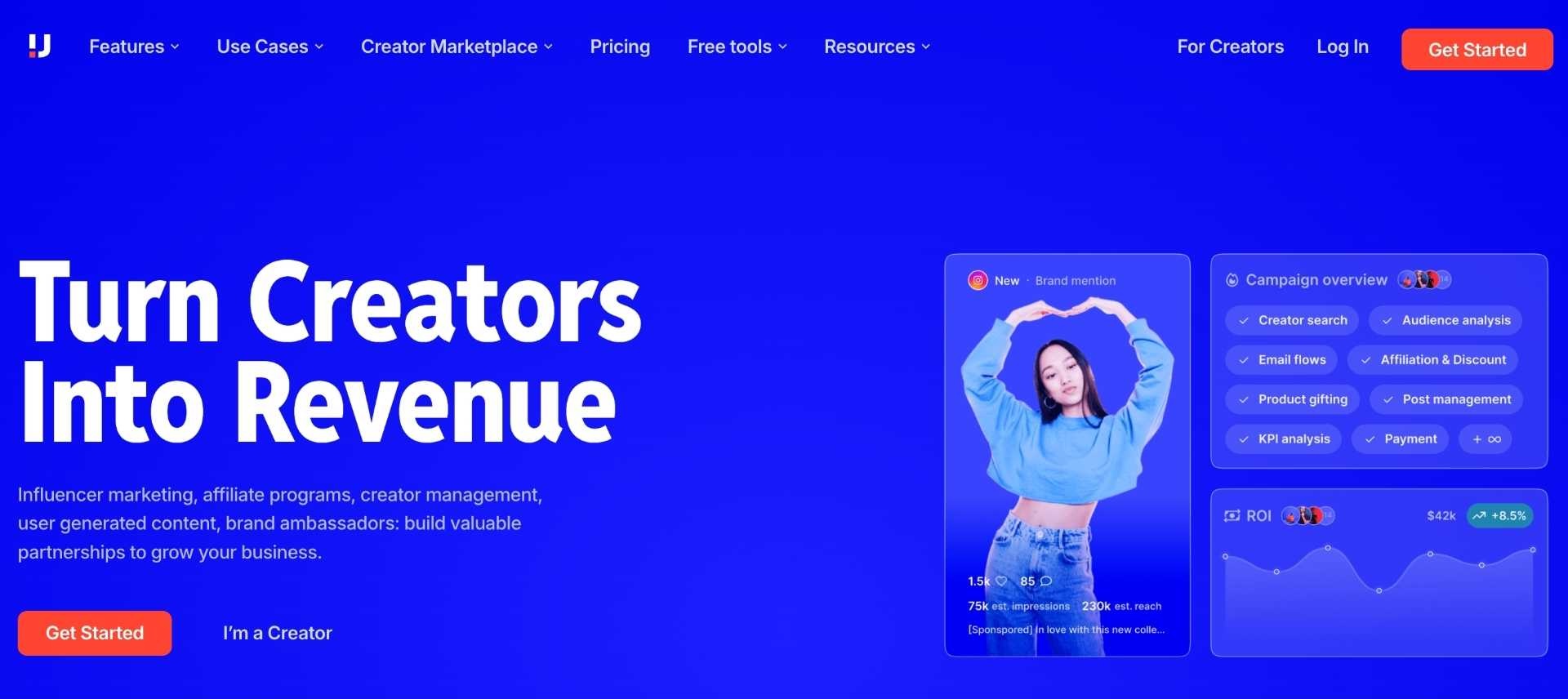
Upfluence is an end-to-end influencer marketing platform built mainly for e-commerce brands that want discovery, outreach, gifting, affiliate tracking, and sales attribution in one system. On the discovery side, it lets teams search a 12M+ creator database using filters like niche, engagement rate, location, audience demographics, and interests, while also surfacing pricing guidance, recent content, and customer-to-creator matches through its commerce integrations.
Key features
- Influencer discovery database: Access 12M+ creators and filter by location, niche, follower size, engagement rate, interests, and audience demographics to find relevant partners faster.
- AI campaign assistant: Jaice AI helps teams speed up creator search and campaign setup, reducing manual work during discovery and outreach.
- Bulk outreach and follow-up flows: Send emails at scale and automate parts of follow-up from within the platform.
- Influencer CRM: Manage communication, performance, imported creator lists, and campaign activity without switching between tools.
- Affiliate tracking: Create affiliate codes, track links, and run performance-based creator programs tied to commerce data.
- Shopify customer-to-creator matching: Identify existing customers who are also creators and turn them into affiliates or influencer partners.
- Amazon attribution support: Track influencer-driven Amazon sales and affiliate performance, which is still a differentiator in this category.
- Product gifting workflows: Send products, manage gifting, and connect seeding activity to downstream campaign performance
- Campaign analytics: Measure sales, reach, impressions, engagement, clicks, and conversions inside campaign reporting.
- Creator payments: Pay influencers in bulk and automate commission calculations through its payment tools.
- Social listening: Monitor brand and market conversations to spot relevant creators and high-performing posts.
Platform coverage
Upfluence supports influencer discovery across Instagram, TikTok, YouTube, X, Twitch, Pinterest, and WordPress blogs, with broader site messaging also positioning it around major creator channels for e-commerce programs.
Standout Features
- Shopify customer discovery: Upfluence’s strongest differentiator is its ability to identify customers who are already creators, which gives brands a warmer, often more conversion-ready influencer pool than cold prospecting alone.
- Amazon integration and attribution: It is one of the few influencer platforms positioned around both Shopify and Amazon, making it especially relevant for sellers that need clearer revenue attribution beyond social metrics.
- Commerce-first workflow: Discovery, outreach, gifting, affiliate tracking, payments, and ROI measurement are all tied back to e-commerce performance rather than just creator management.
Limitations
- High commitment for smaller teams: Pricing is on the expensive side for many smaller brands, and contracts are typically annual rather than month-to-month.
- Learning curve and clunky workflows: Several reviewers describe the platform as powerful but less intuitive than expected, especially when setting up and organizing campaigns.
- Editing rigidity in campaign setup: Some users report that once parts of a campaign are configured, editing flexibility is limited and progress can be easy to lose mid-setup.
- Mixed support experiences: While some customers praise onboarding and support, others describe slower issue resolution than expected, so the experience appears uneven across accounts.
Integrations
- Shopify: Identify influential customers, manage gifting, generate codes, and track creator-driven sales directly from your store.
- Amazon Attribution: Track influencer-linked Amazon performance and connect creator activity to marketplace sales more accurately.
- Klaviyo: Enrich existing email lists with creator data and build more targeted creator or affiliate flows from your CRM stack.
- Gmail / Outlook: Run creator outreach from your own mailbox while keeping conversations synchronized inside Upfluence.
- Stripe / Upfluence Pay: Automate creator payments, stay compliant across currencies, and handle payout workflows more efficiently.
Pricing
Starts from $1,276-$2,000/month on an annual term billed monthly
Reviews
4.3 / 5.0 (Capterra)
GRIN Overview
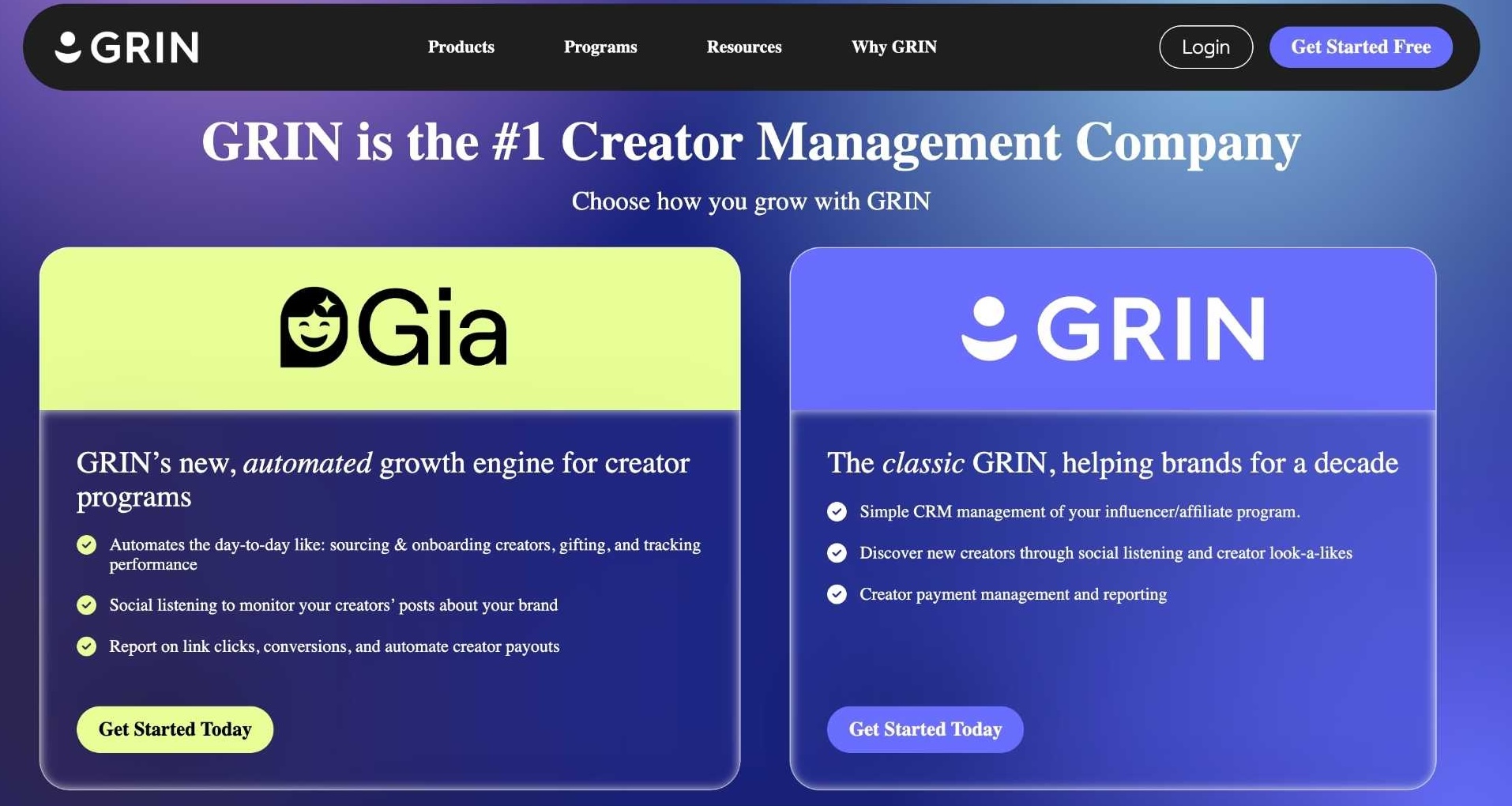
GRIN is an influencer marketing platform built mainly for e-commerce and DTC teams that want discovery, outreach, gifting, affiliate tracking, content collection, and payments in one workflow. For influencer discovery, it combines a large creator database, keyword and lookalike search, audience filters, and its AI assistant Gia, while keeping discovery closely tied to campaign execution and creator relationship management rather than treating it as a standalone search tool.
Key features
- Creator discovery suite: Search for creators by niche, audience data, engagement rate, brand affinity, keywords, and lookalikes to build targeted shortlists faster.
- Gia AI assistant: GRIN’s AI layer helps surface creator recommendations, scoring, and workflow support so teams can move faster through discovery and campaign setup.
- Built-in outreach: Send personalized outreach from your own email environment and track opens, clicks, and replies inside the platform.
- Influencer CRM: Manage creators with tags, notes, statuses, tasks, and custom pipelines so relationship data stays centralized.
- Creator portals: Give creators a dedicated place to receive briefs, contracts, discount codes, submission links, and payment updates without a messy back-and-forth process.
- Product gifting workflows: Automate seeding, discount code creation, order tracking, and fulfillment directly through connected e-commerce systems.
- Affiliate tracking: Assign links and codes, measure conversions and revenue, and manage commission-based partnerships from the same platform.
- In-platform payments: Pay creators through PayPal and streamline commission payouts without relying on separate finance tools.
- UGC library: Store creator content, including Stories, in a searchable content hub for easier reuse across marketing channels.
- Media rights management: Include creator content rights within the workflow so reuse is easier to manage operationally.
- Application pages: Build branded landing pages to attract inbound creator applications and keep your pipeline stocked with warmer leads.
- Reporting and ROI analytics: Track campaign performance, conversions, affiliate revenue, gifting effectiveness, and creator-level ROI in real time.
Platform coverage
Instagram, TikTok, YouTube, X, Twitch, and Snapchat, with core operational strength centered on Instagram, TikTok, and YouTube for creator programs.
Standout Features
- E-commerce-native workflow: GRIN’s biggest differentiator is how tightly it connects discovery, gifting, affiliate tracking, and ROI measurement to e-commerce operations, especially for product-heavy brands.
- Creator portals plus UGC management: The platform gives creators structured portals for submissions, contracts, and payments while also storing approved content in a searchable UGC library, which makes it stronger operationally than discovery-first tools.
- Gia and workflow automation: GRIN is pushing AI beyond search by using Gia to assist with creator recommendations and campaign execution, which is especially useful for teams managing ongoing creator programs at scale.
Limitations
- High price and annual commitment: GRIN is frequently described as expensive for smaller teams, with custom pricing that commonly starts around $2,500 per month and often requires a 12-month commitment.
- Discovery is not its strongest edge for every team: Some users report duplicates, weaker curated lists, and less reliable discovery results than they expected from a premium platform.
- Limited paid media tooling: GRIN does not natively focus on creator whitelisting or paid social boosting in the same way some adjacent creator platforms do.
- Support consistency can vary: While many teams value the strategic support model, some buyers report slower follow-through on unresolved issues than expected.
Integrations
- Shopify: Sync products, automate gifting, generate discount codes, and attribute creator-driven sales back to your store.
- WooCommerce: Run gifting and sales tracking workflows for WooCommerce stores without handling product fulfillment manually in spreadsheets.
- PayPal: Pay creators and affiliates directly inside GRIN, including commission-based payouts.
- Klaviyo: Connect creator outreach and lifecycle marketing more closely by linking influencer activity with your email marketing stack.
- DocuSign: Send and manage creator contracts as part of the campaign workflow instead of relying on disconnected legal processes.
Pricing
GRIN pricing is custom and sales-led rather than fully transparent. Pricing typically starts around $2,500/month and can go much higher depending on scale and features, with a 12-month commitment commonly required; however, GRIN also announced a newer self-serve option with a 30-day free trial, month-to-month billing, and no annual contract in January 2026, so buyers should confirm which model applies to the package they are considering.
Reviews
4.5/5.0 (G2)
Modash Overview
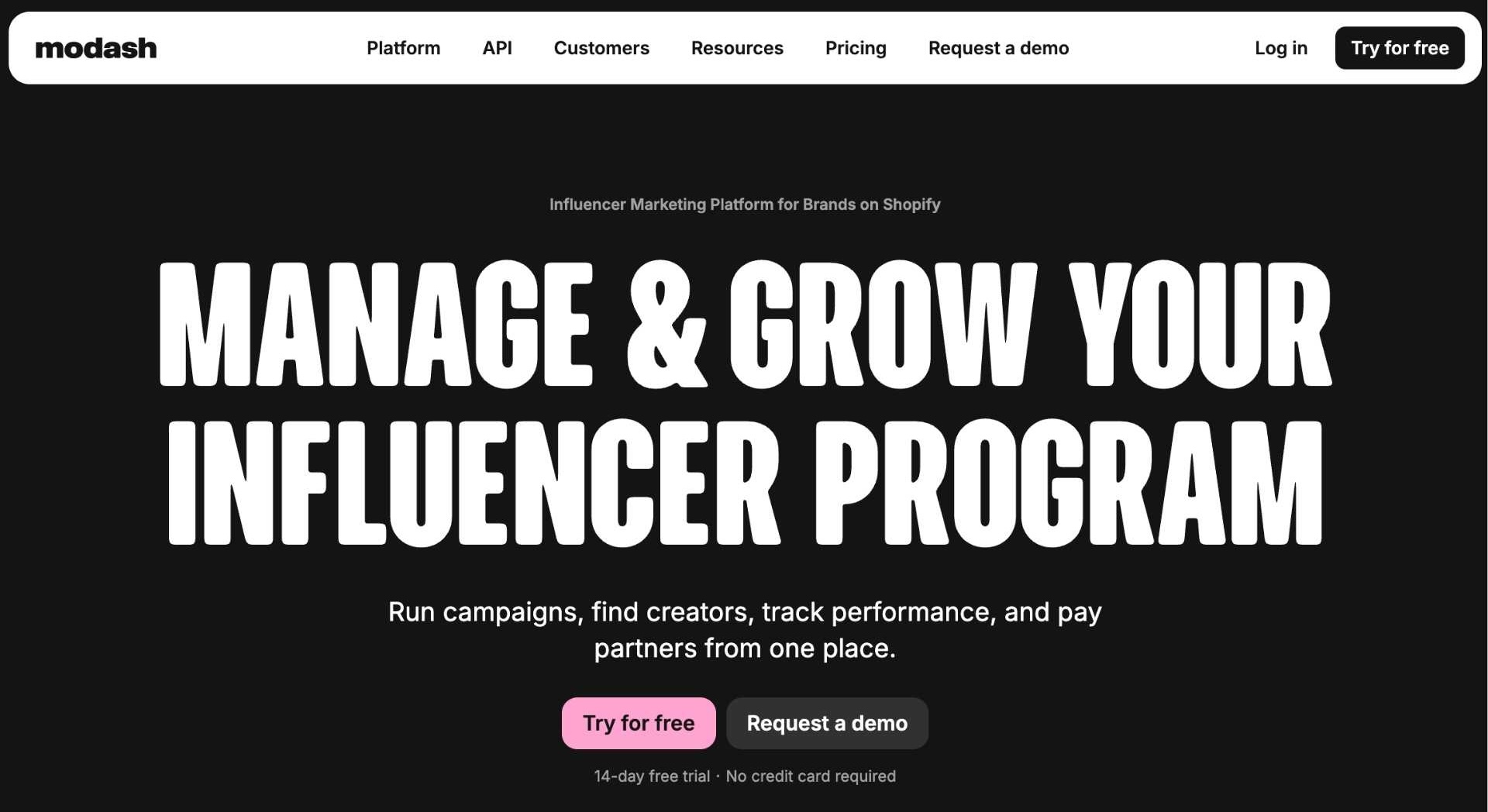
Modash is an end-to-end influencer marketing platform designed for teams that want to discover creators, run outreach, manage campaigns, and track performance without paying for a heavier enterprise stack. For discovery specifically, its biggest strength is a large non-opt-in database of 350M+ public creator profiles across Instagram, TikTok, and YouTube, paired with detailed filters. Modash is especially popular with Shopify brands because it connects discovery directly to gifting, affiliate tracking, and payouts in the same workflow.
Key features
- Influencer discovery database: Access 350M+ public creator profiles without relying on an opt-in network, which gives teams broader coverage when searching niche creators.
- Advanced discovery filters: Filter creators by niche, hashtags, captions, audience location, gender, age, engagement rate, language, and platform to narrow lists quickly.
- AI discovery search: Describe the kind of creator you want or upload an image to find profiles with a similar aesthetic or content style.
- Lookalike search: Find creators similar to your best-performing partners or shortlisted profiles to scale prospecting faster.
- Find Your Fans: Identify creators who already follow or engage with your brand, which can improve reply rates and partnership fit.
- Outreach and inbox sync: Run creator outreach with templates, bulk email, and two-way Gmail or Outlook sync so conversations stay inside your workflow.
- CRM and pipeline tracking: Organize creators with statuses like contacted, negotiating, and confirmed, plus notes and documents tied to each profile.
- Campaign tracking: Track content by hashtags and mentions, automatically collect campaign posts, and monitor performance in real time.
- Audience and profile vetting: Review fake follower percentages, benchmark engagement, historical sponsored content, and cross-platform profile data before outreach.
- Shopify gifting: Let creators pick products through a unique link, auto-tag orders, and connect gifting activity to campaign reporting.
- Affiliate tracking and payouts: Set commission tiers, track code usage and sales, and automate monthly payouts after creators add their banking details.
- Reporting dashboard: Measure impressions, reach, engagement, code usage, affiliate revenue, and collected content from one dashboard.
Platform coverage
Modash focuses mainly on Instagram, TikTok, and YouTube, while also identifying linked profiles on channels like X and Snapchat with more limited functionality there.
Standout Features
- Largest public creator database: Modash’s non-opt-in model is one of its clearest advantages, since teams can search a far broader pool of public creators instead of being limited to opted-in talent only.
- AI visual discovery: The ability to describe a creator vibe or upload an image and find visually similar creators is one of the more distinctive discovery tools in this category.
- Shopify-first workflow: Modash does a strong job of connecting discovery, gifting, discount codes, affiliate tracking, and payouts in one streamlined Shopify workflow without a lot of enterprise overhead.
Limitations
- Limited e-commerce integrations: Modash’s core commerce integration is Shopify, so brands on WooCommerce, Magento, or other commerce stacks may find it less flexible than GRIN or some enterprise alternatives.
- No built-in content licensing workflow: UGC reuse rights need to be handled manually in creator contracts rather than through a dedicated in-platform licensing module.
- No native whitelisting or paid social boosting tools: It is less suited to teams that want to run creator content as paid media directly from the platform.
- Usage caps on lower plans: Entry plans can be limiting for teams doing high-volume gifting, tracking, or outreach, and some users mention needing to upgrade sooner than expected.
Integrations
- Shopify: Connect gifting, discount codes, affiliate links, sales tracking, and creator product selection directly to your store workflow.
- Gmail: Sync your inbox two ways so outreach, replies, and creator communication stay visible inside Modash while still using your existing email setup.
- Outlook: Run outreach from your Microsoft email environment with the same two-way synchronization and status tracking inside Modash.
- API: Use Modash’s API products for creator discovery, analytics, and monitoring if you want to build internal workflows or custom tooling on top of its data layer.
- Shopify Collabs / store workflows via Shopify app layer: Extend creator gifting and store-connected tracking through its Shopify app ecosystem, which is where a lot of Modash’s operational value sits for e-commerce teams.
Pricing
Modash offers a 14-day free trial with no credit card required. Paid plans start at $199/month when billed annually or $299/month when billed monthly on its official pricing page.
Reviews
4.9/5.0 (Capterra)
Final Thoughts
Upfluence, GRIN, and Modash each solve a different part of the influencer marketing workflow best. Upfluence stands out for Shopify and Amazon attribution, affiliate workflows, and customer-to-creator discovery, making it a strong fit for e-commerce brands that want to connect influencer activity more directly to revenue. GRIN is the most operationally complete option for brands running larger or more complex programs, with deeper CRM, gifting, creator management, payments, and UGC workflows. Modash is the most discovery-focused and accessible of the three, with a large non-opt-in database, strong search tools, and simpler pricing that appeals to leaner teams.
The right choice depends less on which platform has the most features and more on which one matches your team’s workflow and budget. Brands that want a commerce-first platform with strong attribution may lean toward Upfluence, teams needing a more robust creator operations system may prefer GRIN, and companies prioritizing creator discovery, ease of use, and lower entry cost may find Modash the better fit. The best way to evaluate them is to map each platform against your actual campaign process, reporting needs, and e-commerce stack before making a decision.