

Upfluence vs Modash vs Influencer Hero: Pricing, Features, and Platform Comparison
Choosing an influencer marketing platform now has a direct impact on how efficiently teams find creators, manage outreach, track sales, and report ROI. For e-commerce brands and agencies, the right platform can reduce manual work across gifting, affiliate tracking, content collection, and creator relationship management while giving clearer visibility into performance.
The main difference between Upfluence, Modash, and Influencer Hero is where each platform puts its strength: Upfluence stands out for its Shopify and Amazon integrations plus customer-to-creator identification, Modash stands out for its very large public creator database, AI-style discovery, and streamlined Shopify workflows, while Influencer Hero stands out for campaign-centric CRM automation, multi-platform coverage, and flexible plans built to support both scaling and enterprise teams. Pricing also differs meaningfully, with Modash starting lower, Upfluence positioned around an annual contract with e-commerce-focused infrastructure, and Influencer Hero offering more flexible tiers tied to creator volume.
In this article, we’ll dive deep into the comparison between Upfluence vs Modash vs Influencer Hero, exploring their features, pricing, and overall fit to help you decide which is best for your brand.
Upfluence vs Modash vs Influencer Hero
Influencer Discovery and Database
Upfluence is the most commerce-oriented in discovery, with a 12M+ influencer database and useful filters for audience demographics, engagement, interests, pricing estimates, and past content, plus the ability to identify existing customers who may already be creators. Modash goes wider on discovery scale, with 350M+ public profiles and standout tools like lookalike search, fake follower analysis, “Find Your Fans,” and AI search based on text or image prompts, making it especially strong for brands that want broad top-of-funnel creator sourcing. Influencer Hero is less positioned around the biggest public database claim and more around practical discovery tied to execution, with advanced filters, fake follower detection, lookalikes, and a Chrome extension that helps teams quickly move creators into campaigns.
Suggestion: Choose Modash if discovery depth and scale are your top priority, Upfluence if you want discovery connected closely to e-commerce data, and Influencer Hero if you want discovery that feeds directly into a more operational campaign workflow.
Influencer Outreach
Upfluence offers bulk email outreach, automated follow-up flows, and AI assistance through Jace AI, which makes it a strong option for teams that want outreach tied to affiliate and sales tracking. Modash covers both email and DM outreach, includes bulk sending and templates, and keeps communication inside the platform, but its value is strongest when paired with its discovery engine and Shopify workflows rather than advanced outreach automation alone. Influencer Hero stands out most on outreach automation, with bulk and one-to-one emails, AI-personalized templates, reply tracking, and multi-step drip sequences designed to support higher-volume programs.
Suggestion: Pick Influencer Hero if your team needs the most structured outreach automation, Upfluence if outreach is part of a broader e-commerce workflow, and Modash if you want capable outreach paired with strong creator sourcing.
CRM and Campaign Management
Upfluence provides a solid all-in-one setup for managing outreach, creator communication, affiliate codes, compensation models, and imported creator relationships. Modash has a more streamlined CRM-style workflow with status tracking like contacted, negotiating, and confirmed, which works well for leaner teams that want a simpler pipeline. Influencer Hero is the strongest of the three in this category, with structured campaign boards, bulk actions, automated follow-ups, deliverables tracking, and ROI monitoring built specifically for teams running large or multi-layered influencer programs.
Suggestion: Go with Influencer Hero if campaign operations are the center of your workflow, Modash if you want a lighter and easier CRM structure, and Upfluence if you want broad functionality and can accept a more involved setup.
Reporting and Analytics
Upfluence is strong on performance tracking tied to commerce outcomes, covering sales, clicks, conversions, reach, impressions, and engagement, with added social listening for market research. Modash gives teams a practical real-time dashboard for campaign content, code usage, affiliate sales, audience quality, and performance metrics, which makes it very useful for fast-moving e-commerce campaigns. Influencer Hero focuses reporting around campaign execution and ROI visibility, with dashboards for influencer-level ROI, affiliate sales, clicks, content performance, and exports for internal stakeholders, making it particularly appealing for teams that need operational clarity as much as raw metrics.
Suggestion: Choose Upfluence if sales attribution and social listening matter most, Modash if you want clean day-to-day campaign reporting, and Influencer Hero if you want reporting tied closely to workflow management and ROI tracking.
Product Gifting
Upfluence is one of the strongest options here for brands selling through Shopify and Amazon, since it supports gifting, referrals, commissions, and customer-to-creator identification in one system. Modash also performs very well for gifting, but its workflow is more Shopify-centric, with creators receiving product links, automatic order tagging, and direct linkage between gifting activity and campaign performance. Influencer Hero supports gifting across both Shopify and WooCommerce, which gives it an advantage for brands that do not want to be locked into Shopify alone.
Suggestion: Upfluence is a strong fit for Shopify and Amazon sellers, Modash is ideal for Shopify-first gifting campaigns, and Influencer Hero is the better fit for teams that want more e-commerce platform flexibility.
UGC Collection
UGC is not the clearest strength for Upfluence, which position it more around end-to-end campaign execution, affiliate management, and payments than around a dedicated content repurposing workflow. Modash automatically collects campaign content and allows teams to download assets, but it does not include built-in licensing tools, so reuse rights need to be handled in creator contracts. Influencer Hero is the most explicit here about auto-collecting influencer posts for repurposing and helping teams identify top-performing content for ads, giving it a more developed UGC workflow for brands that want to extend creator content value.
Suggestion: Choose Influencer Hero if content repurposing is a major priority, Modash if you are comfortable managing rights outside the platform, and Upfluence if UGC is secondary to sales tracking and campaign execution.
Pricing
Upfluence is positioned higher than Modash and requires an annual commitment, with pricing around $1,276 - $2,000 per month billed monthly on an annual term, although the payments module can be removed in some cases. Modash has the lowest published entry point of the three, starting at $199 per month for Essentials and $499 per month for Performance, both billed yearly, making it more accessible for teams prioritizing discovery and core campaign workflows. Influencer Hero sits in the middle to upper-middle range with clearer packaged tiers, starting at $649 per month and scaling to $2,490 per month before custom plans, which gives buyers more visible room to grow without jumping immediately into enterprise-only pricing.
Suggestion: Modash is the best fit for cost-conscious teams that still want serious discovery capability, Upfluence makes sense when its commerce integrations justify the annual spend, and Influencer Hero is a strong option for brands that want scalable pricing tied to more advanced campaign operations.


Upfluence Overview
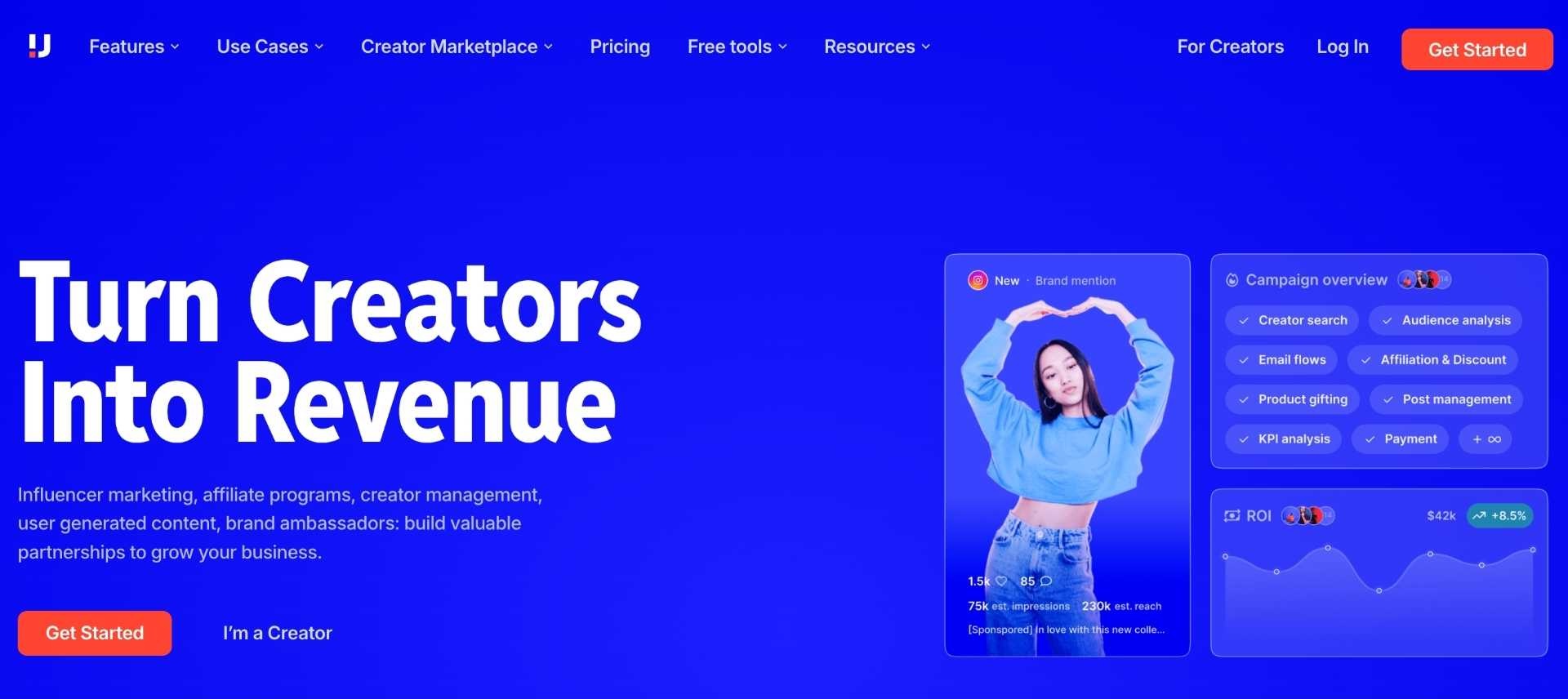
Upfluence is an end-to-end influencer marketing platform built for brands that want discovery, outreach, campaign execution, affiliate tracking, gifting, and payments in one system. On the discovery side, it combines a 12M+ influencer database with filters for niche, audience demographics, engagement, location, and estimated pricing, and it is especially strong for e-commerce brands because it can also identify creators who are already customers through its Shopify connection.
Key features
- Influencer discovery: Upfluence gives teams access to 12M+ global influencers with filters for location, niche, follower size, engagement rate, interests, and audience demographics.
- AI campaign assistant: Its AI assistant, Jaice AI, helps streamline campaign setup and outreach workflows.
- Bulk outreach and follow-ups: The platform supports bulk email outreach plus automated drip follow-up flows to reduce manual back-and-forth.
- CRM and campaign management: Brands can manage creator communication, campaign activity, affiliate links, compensation models, and influencer imports in one place.
- Customer-to-creator identification: Through Shopify, Upfluence can surface customers who are also creators, which is one of its clearest differentiators for e-commerce brands.
- Affiliate tracking: The platform supports affiliate codes, trackable links, referrals, and conversion tracking tied to influencer activity.
- Product gifting: Upfluence supports gifting workflows tied to store integrations so brands can seed product and connect it back to campaign performance.
- Amazon attribution: It offers a native Amazon Attribution integration for affiliate links, campaign tracking, and performance measurement on Amazon.
- Reporting and ROI tracking: Teams can track sales, clicks, reach, impressions, engagement, and individual conversions in campaign dashboards.
- Creator payouts: Upfluence includes bulk payment functionality for paying creators inside the workflow.
- Social listening: The platform also includes social listening for market research and identifying high-engagement posts around relevant topics.
Platform coverage
Upfluence supports influencer discovery and campaign activity across Instagram, TikTok, YouTube, X, Twitch, Pinterest, and WordPress blogs.
Standout features
- Shopify customer-to-creator matching: Upfluence can identify existing customers who are also influencers, which is especially useful for brands that want warmer outreach and stronger affiliate conversion potential.
- Native Amazon Attribution integration: Few platforms emphasize Amazon as heavily as Upfluence, and its native Amazon workflow is a major advantage for brands selling there.
- Strong e-commerce operating layer: Product gifting, promo codes, affiliate tracking, payouts, and ROI reporting are tightly connected to store integrations, making the platform more commerce-driven than discovery-only tools.
Limitations
- Annual commitment and limited pricing transparency: Annual contracts rather than a flexible monthly plan.
- Can feel complex for smaller or leaner teams: User feedback often points to a learning curve and a need for onboarding before the full workflow feels efficient.
- Campaign setup flexibility appears limited in some cases: Multiple users mention difficulty editing campaigns once they are configured, which can slow iteration.
- Higher cost for smaller brands: Review feedback consistently flags pricing as a barrier for smaller businesses.
Integrations
- Shopify: Lets brands identify influential customers, automate gifting, generate codes, and track sales directly from their store.
- Amazon Attribution: Enables affiliate link creation, campaign tracking, and performance attribution for Amazon seller programs.
- WooCommerce: Connects creator programs to WooCommerce stores for promo codes, sales tracking, and e-commerce-linked campaign workflows.
- Klaviyo: Helps brands connect creator activity with email and CRM workflows so influencer and customer data can work together.
- Gmail / Outlook: Syncs outreach with existing inboxes so teams can send and manage creator communication without leaving their email workflow.
Pricing
Starts from $1,276-$2,000/month on an annual term billed monthly
Reviews
4.3 / 5.0 (Capterra)
Modash Overview
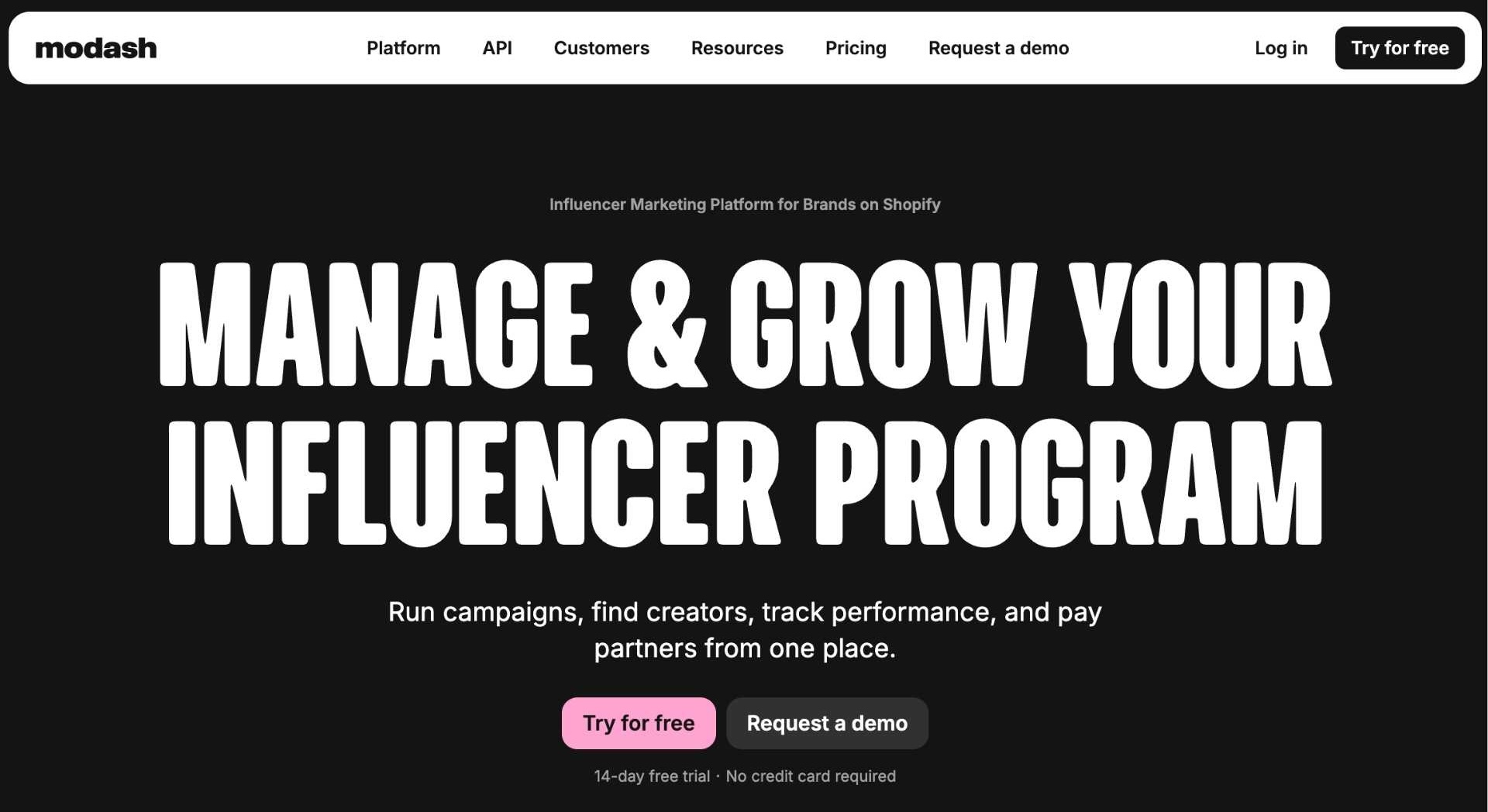
Modash is an end-to-end influencer marketing platform built around creator discovery, outreach, tracking, gifting, affiliate management, and payouts. For discovery specifically, its biggest advantage is that it searches a very large pool of public creator profiles rather than relying on an opt-in marketplace, which makes it particularly useful for brands that want broad sourcing across Instagram, TikTok, and YouTube.
Key features
- Large public creator database: Modash lets teams search 350M+ public creator profiles, giving brands much wider coverage than opt-in-only databases.
- Advanced influencer discovery: You can filter creators by niche topics, hashtags, captions, audience location, gender, age, engagement, and more to narrow down highly specific creator segments.
- AI discovery tool: Modash allows users to describe an ideal creator or upload an image to find creators with a similar visual style or content vibe.
- “Find Your Fans” tool: Modash can surface influencers who already follow your brand, which can improve outreach efficiency and campaign conversion potential.
- Bulk outreach: The platform supports one-to-one and bulk email outreach with templates, making it easier to contact creators at scale.
- CRM-style relationship management: Teams can organize creators into lists and move them through statuses like Contacted, Negotiating, and Confirmed.
- Campaign tracking: Once creators are live, Modash tracks mentions, hashtags, posts, impressions, reach, engagement, and affiliate performance in real time.
- Shopify-powered gifting: Brands can send creators unique product links, automate order tagging, and connect gifting activity to campaign performance.
- Affiliate tracking and payouts: Modash supports affiliate tiers, commission tracking, creator dashboards, and automated monthly payouts.
- Content collection: Campaign content is collected automatically and can be downloaded for internal use, subject to contract rights.
Platform coverage
Modash’s core platform coverage is Instagram, TikTok, and YouTube, with limited visibility into some additional creator profiles on channels like X and Snapchat.
Standout features
- Massive non-opt-in discovery database: Modash’s biggest differentiator is that it searches a very large pool of public profiles, which gives teams more flexibility when sourcing niche creators across markets.
- AI and visual creator search: The ability to search by text prompt or upload an image is a genuinely useful feature for brands that care about aesthetic fit, not just demographic filters.
- Strong Shopify workflow: Gifting, discount codes, affiliate links, code tracking, and payouts are tightly connected, which makes Modash especially attractive for Shopify-first e-commerce teams.
Limitations
- Only one major e-commerce integration: Modash is heavily centered on Shopify, which can be limiting for brands using WooCommerce, Magento, or other storefronts.
- No built-in content licensing workflow: Teams can collect and download content, but usage rights still need to be handled manually in creator contracts.
- Limited platform breadth compared with broader suites: Its strongest functionality is concentrated on Instagram, TikTok, and YouTube rather than a wider list of social channels.
- No native whitelisting or paid ads workflow: Brands wanting to boost creator content directly from the platform will need other tools or manual processes.
- May feel unnecessary for very small programs: Some user feedback suggests the platform makes more sense once campaigns are large enough to justify a dedicated workflow tool.
- Pricing can climb as teams scale: Recent user discussions also point to cost increases and limited automation depth once programs become more complex.
Integrations
- Shopify: Syncs products, gifting, discount codes, affiliate links, and code redemption tracking directly into Modash.
- Gmail: Connects your inbox so you can send outreach, manage replies, and track creator conversations without leaving the platform.
- Outlook: Gives teams the same outreach and communication sync as Gmail for brands already using Microsoft email workflows.
- Stripe: Supports creator payouts and affiliate payment workflows through connected payment infrastructure.
- API / data export workflows: Modash supports exports and operational data sharing so teams can move creator and campaign data into their broader reporting process. This is an inference based on its campaign tracking, exports, and enterprise workflow positioning.
Pricing
Modash offers a 14-day free trial with no credit card required. Paid plans start at $199/month when billed annually or $299/month when billed monthly on its official pricing page.
Reviews
4.9/5.0 (Capterra)
Influencer Hero Overview
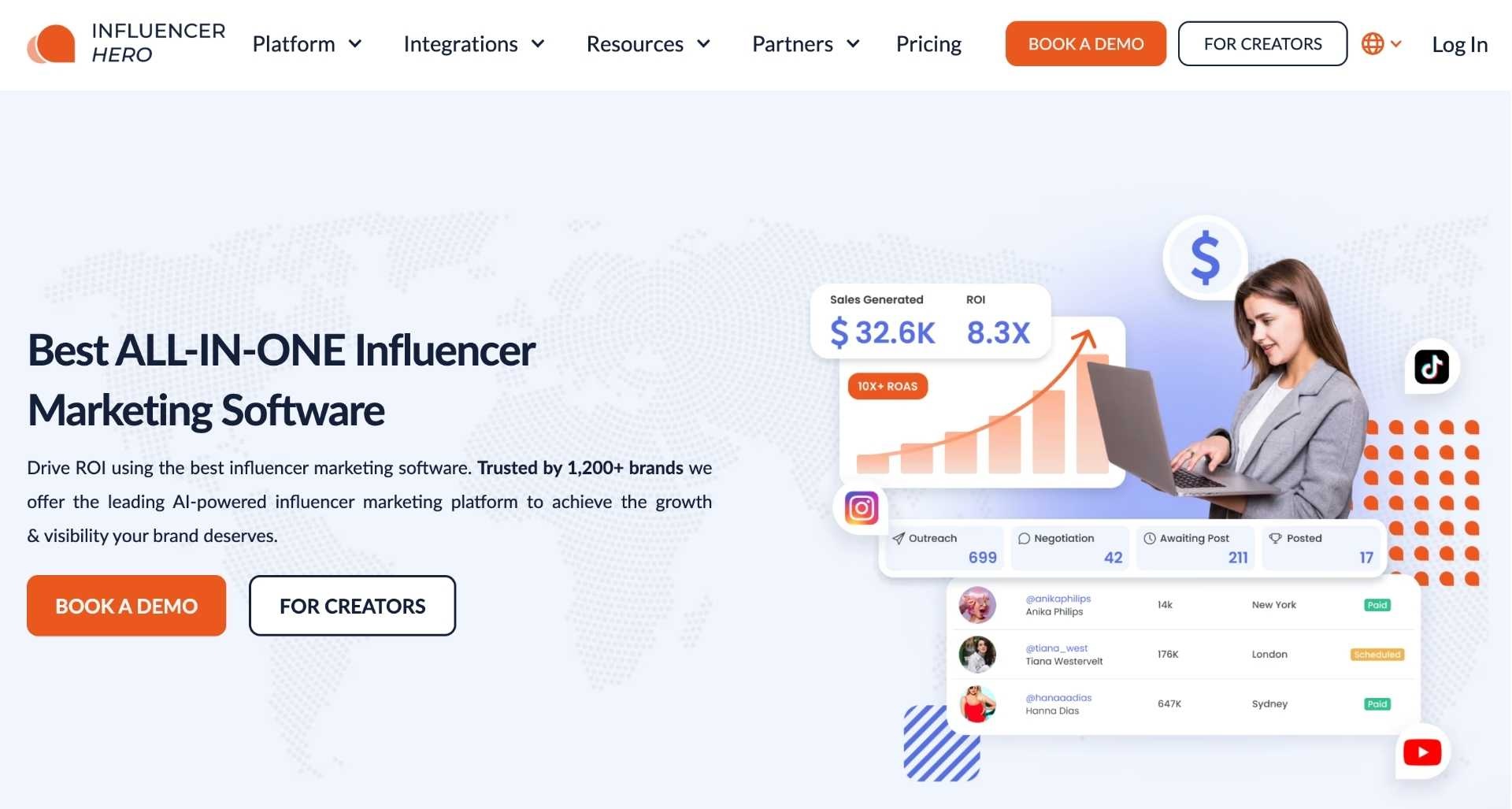
Influencer Hero is an all-in-one influencer marketing platform built for brands that want to discover creators, manage outreach, run campaigns, track sales, and organize influencer relationships in one system. For influencer discovery specifically, it combines advanced filters, fake follower checks, lookalike recommendations, Chrome-based profile importing, and signals such as whether creators already follow or engage with your brand, helping teams find relevant creators faster and with more context.
Key features
- Influencer discovery — Search creators using filters like location, audience demographics, interests, engagement rate, follower quality, and fake follower detection to narrow down high-fit profiles.
- Lookalike creator suggestions — Find creators similar to your best performers or shortlisted influencers to scale discovery more efficiently.
- Brand-following influencer detection — Surface creators who already follow or engage with your brand, which can improve outreach relevance and conversion.
- Chrome extension — Pull live creator stats while browsing social platforms and import influencers directly into campaigns or lists.
- Bulk and 1:1 outreach — Run personalized outreach at scale with bulk emails, one-to-one messaging, templates, and reply tracking.
- AI-powered outreach personalization — Generate personalized copy and automate follow-up sequences to reduce manual work.
- CRM and campaign boards — Track relationships, deliverables, campaign stages, and approvals through structured boards and visual workflows.
- Bulk campaign actions — Approve, decline, email, update statuses, and manage outreach in batches for high-volume programs.
- Reporting and ROI tracking — Monitor clicks, affiliate sales, content performance, UGC downloads, and ROI by influencer or campaign.
- Gifting and seeding — Sync products, track shipments, and manage gifting workflows through connected ecommerce systems.
- UGC collection — Automatically collect influencer content, store it centrally, and tag top-performing assets for reuse.
- Affiliate management and payouts — Create custom links and discount codes, track commissions, and automate payout workflows.
- Application pages and storefronts — Build branded landing pages for creator applications and storefronts for affiliate-driven product promotion.
Platform coverage
Influencer Hero supports Instagram, TikTok, YouTube, Facebook, Pinterest, Snapchat, X, and Twitch, with discovery and campaign workflows centered around major creator-led social channels.
Standout features
- Campaign-centric CRM automation — Its strongest differentiator is the CRM layer, with boards, bulk actions, automated email flows, and stage-based workflows designed for brands running large-scale influencer programs.
- Multi-platform ecommerce integration — The platform stands out for supporting Shopify, WooCommerce, and custom ecommerce setups, making gifting, affiliate attribution, and revenue tracking more flexible than many discovery-first tools.
- Brand-affinity discovery plus Chrome extension — Beyond standard database search, it helps identify creators already connected to your brand and lets teams capture creator data while browsing social platforms in real time.
Limitations
- No free trial — Influencer Hero does not currently offer a free trial, which may make initial evaluation more difficult.
- Learning curve — The wide feature set can feel dense at first, so new users may need some onboarding to get fully set up.
Integrations
- Shopify — Connect your store to manage gifting, sync orders, generate discount codes and track influencer-attributed sales inside the platform.
- WooCommerce — Sync store, revenue, and coupon data to attribute sales back to individual creators and campaigns.
- Klaviyo — Connect influencer and customer data to email flows and retention marketing workflows.
- Zapier — Use automation recipes to sync campaign events, creator updates, and workflow triggers with other tools in your stack.
- DocuSign — Automate contract workflows and signature collection as part of influencer onboarding and campaign operations.
Pricing
Influencer Hero offers flexible pricing based on outreach volume:
- Standard: $649/month (up to 1,000 outreaches/month)
- Pro: $1,049/month (up to 5,000 outreaches/month)
- Business: $2,490/month (up to 10,000 outreaches/month)
- Custom / Agency: Custom pricing available
All plans include core features and allow unlimited creators in the CRM.
Reviews
5.0/5.0 (Capterra)
Final Thoughts
Final thoughts on Upfluence vs Modash vs Influencer Hero come down to what type of team is buying and how they plan to run influencer campaigns. Upfluence is generally better suited to brands that want a broad ecommerce-focused platform with established workflows, Modash stands out for straightforward discovery, outreach, and creator analytics with a very user-friendly experience, and Influencer Hero is especially compelling for teams that want strong CRM automation, multi-platform campaign management, and flexible gifting, affiliate, and outreach workflows in one place.
The best choice depends less on which platform has the longest feature list and more on which one fits your operating style. Brands that prioritize simple discovery and fast execution may lean toward Modash, ecommerce teams that want a mature ecosystem may prefer Upfluence, and growing brands that need deeper automation and campaign orchestration may find Influencer Hero the strongest fit. Before choosing, it is worth comparing not just pricing, but also platform coverage, workflow depth, integrations, and how much manual work each tool removes for your team.