


Embold Pricing Explained: Plans, Features & Review
Most platforms in this space chase scale: hundreds of millions of profiles, every network, every market. Embold went the other way and built a deliberately small roster — roughly 9,000 vetted Canadian creators — on the theory that a brand selling in Canada does not need the other 374 million. It publishes its prices, charges a flat monthly fee plus a percentage on what you pay creators, and offers a managed tier when you want the work done for you. Whether that is a smart focus or a hard ceiling depends almost entirely on where your customers live. In this article, we break down Embold pricing, key features, reviews, limitations, and the best Embold alternatives to consider.
Embold Pricing
Two self-serve plans, both listed openly, plus a managed option priced on request. Starter is CA$299 a month, or CA$239 a month on annual billing, and covers unlimited influencers from the roster, paid, gifted and UGC campaign types, control over creator compensation, roster management, and support for Instagram, TikTok and YouTube — with help-centre and ticket support behind it. Pro is CA$599 a month, or CA$479 annually, and adds the human layer: a dedicated customer success manager, help recruiting creators into your campaigns, complimentary onboarding, one-on-one campaign strategy, and payment invoicing. Both carry a 5% service fee on top, applied to what you pay creators, plus standard card processing fees — so your real monthly cost is the subscription plus 5% of your creator spend, and that second number is the one worth modelling before you sign. Annual billing saves 20% on both tiers, there is no minimum term on either the self-serve or managed track, and a free account lets you look around before committing. Managed Campaigns sits above all of this with custom pricing, covering ambassador programs, roster development, and end-to-end execution by Embold's own team.
Free Trial
You can create a free account without paying, which is closer to a permanent free tier than a countdown trial, and third-party listings confirm both a free version and a trial exist. Use it for one specific job: confirming the roster actually contains creators who fit your product, in your provinces, at the follower tiers you want. Nine thousand creators is a small pool by category standards, and whether it is enough is a question only your own niche can answer — a Toronto beauty brand and a Prairie agricultural equipment brand will get very different answers from the same database. Search before you subscribe, save a shortlist, and count how many of them you would genuinely brief. If that number is under twenty, the subscription is unlikely to earn back the fee.
Contract
There is no minimum term on any tier, which is unusually clean for a platform in this price band and removes most of the risk from a monthly commitment. The commercial detail that deserves attention is the 5% service fee, because it is the part that scales with your program rather than sitting flat. On CA$5,000 of creator payments that is CA$250 a month on top of the subscription; on CA$20,000 it is CA$1,000, and at that point you are paying more in fees than in licence. Confirm what the 5% applies to — creator fees only, or product value on gifted campaigns too — and confirm whether card processing fees stack on top of it. On annual billing, check what happens to the 20% discount if you cancel partway through.
Embold Overview
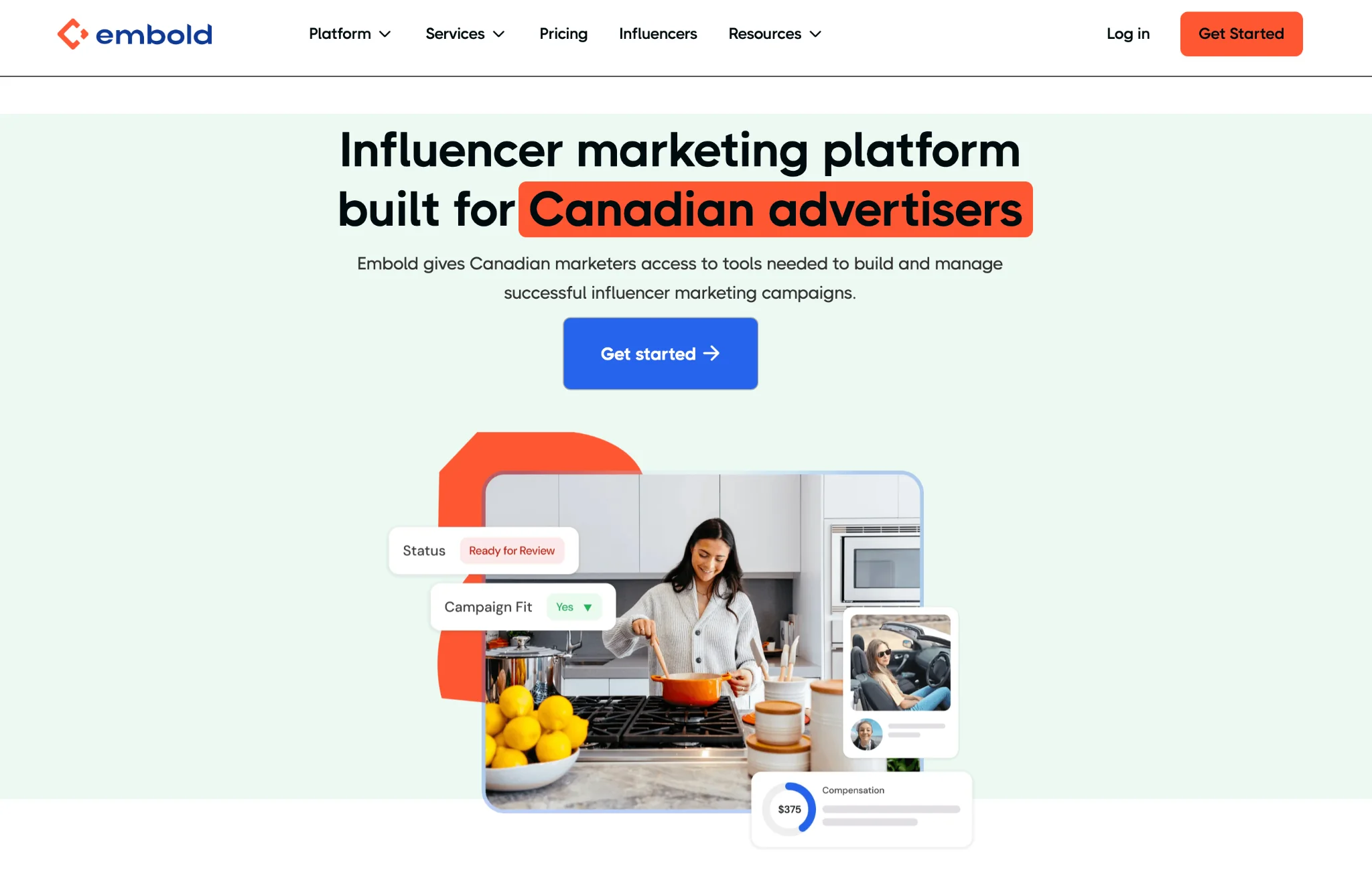
Embold is a Canadian influencer marketing platform positioning itself as the most accessible option in that market, with a vetted roster of more than 9,000 Canadian creators across Instagram, TikTok and YouTube and a stated base of over 500 brands and agencies, including recognisable national names such as BMO and Longo's. The product splits into three jobs. Discovery searches the roster with full analytics attached to each profile, so the vetting is done before you see the creator rather than after. Management covers campaign creation, a central hub for creators and their content, and control over how each creator is compensated — paid, gifted, or UGC-for-usage. Analysis handles campaign performance metrics and creator payments, with invoicing available on the Pro tier upward. Above the software sits a managed services arm that runs campaigns, builds ambassador rosters and develops annual programs for brands that would rather brief a team than operate a dashboard. The through-line is Canadian focus: the creators, the client base, and the operational knowledge are all concentrated in one market, and the product is built for brands whose customers are there too.
Key Features
9,000+ Vetted Canadian Creators
The roster is curated rather than scraped, so every profile has been checked before it appears — a meaningfully different proposition from filtering a 300-million-record index and hoping the numbers are real.
Three Campaign Types in One Workflow
Paid, gifted and UGC campaigns all run through the same builder, so a brand can seed product to one group and pay another without leaving the platform or splitting its reporting.
Creator Compensation Control
You set what each creator is paid rather than accepting a fixed marketplace rate, which matters when you are mixing a few larger names with a long tail of micro creators.
Content Management Portal
Creator submissions land in one place for review and approval, which is the step that quietly eats the most time in any campaign run across email and DMs.
Campaign Analytics and ROI Tracking
Performance metrics and customisable reports are built in, with real-time reporting rather than a monthly export.
Payments and Invoicing
Creator payments run through the platform, with invoicing available from the Pro tier — the piece that usually forces a finance workaround on cheaper tools.
Dedicated Customer Success on Pro
The CA$599 tier buys a named person, onboarding, and campaign strategy sessions, which is closer to a light agency retainer than a support queue.
Managed Campaign Services
A separate track where Embold's team runs the program end to end, including ambassador and annual roster development, for brands that do not want to operate the tool.
Best For
Embold makes most sense for Canadian brands and the agencies serving them — companies whose customers are in Canada, who want creators who understand that market, and who would rather work from a vetted roster than sift a global index. The pricing lands squarely in SMB territory, and the structure suits a brand running steady, modest campaigns rather than occasional large ones, since the 5% fee grows with creator spend while the subscription does not. It fits teams that mix gifted seeding with paid posts and want both in one workflow, and it fits a marketer who wants a real person to call: the Pro tier's success manager and strategy sessions replace a lot of the trial and error that self-serve tools leave you to work through alone.
It is not the right tool for a brand selling internationally, for anyone who needs networks beyond Instagram, TikTok and YouTube, or for a team whose main requirement is a very large searchable database — the roster is the product here, and 9,000 is a deliberate number, not a work in progress.
Embold Reviews
5.0 out of 5 stars
Capterra Canada (11 reviews)
The rating is perfect and the sample is small, which is the first thing to hold in mind. The second is more important: read the substance of those reviews and much of it comes from the creator side of the marketplace, not the brand side. The recurring complaints are about applying to campaigns, wanting visibility into all available campaigns rather than only personalised invitations, and submission bugs — the concerns of someone using Embold to get work, not someone using it to run a program. The praise skews the same way: an easy interface, straightforward payment flow, responsive support. That is genuinely useful information, since a platform creators find pleasant to work with will fill your campaigns faster than one they avoid, but it does not tell you much about reporting depth, roster coverage in your category, or whether the 5% fee is worth it at your spend level. The brand-side questions are largely unanswered by the public record. Ask for references from brands in your vertical, and treat the five stars as evidence about creator experience rather than a verdict on the software you would be buying.
Embold Standout Features
A Curated Roster Instead of a Scraped Index
Most platforms sell reach and leave verification to you. Embold sells a pre-vetted list and accepts a much smaller number as the cost. For a brand that has ever paid for an audit only to discover half a creator's followers were bought, that trade is worth more than it sounds.
Published Prices in a Category That Hides Them
Two tiers, both listed, with the service fee stated rather than buried. That alone puts Embold ahead of most of its competitors on the single thing buyers complain about most, and it makes a like-for-like comparison possible before you book a call.
A Managed Tier Sitting Behind the Same Roster
You can start self-serve at CA$299 and move to a fully run program without changing platforms, creators, or historical data. Growing brands usually have to switch vendors to make that jump; here it is a change of plan.
Embold Limitations
Canada Only
Nine thousand creators, all Canadian. If your customers are elsewhere, nothing else about the platform matters, and even within Canada a narrow or regional niche may find the roster thin — verify coverage in your specific category before you subscribe rather than after.
The 5% Service Fee Grows With You
The subscription is flat but the fee is not, and at meaningful creator spend it becomes the larger of the two numbers. Model your real cost at your intended budget, not at the headline price.
Three Networks Only
Instagram, TikTok and YouTube are covered. Brands wanting Pinterest, Twitch, LinkedIn or blog partnerships will need something else alongside it.
The Public Reviews Answer the Wrong Questions
A 5.0 rating from eleven reviews, weighted toward creators rather than brands, is thin evidence for a purchase decision. There is very little independent brand-side commentary on reporting quality, roster depth by category, or support responsiveness at scale.


Is Embold Worth It?
For a Canadian brand or agency, Embold is a straightforward yes to evaluate: the prices are public, the terms are clean, there is no minimum commitment, and the vetted roster removes a step most platforms leave you to handle yourself. The Pro tier's success manager and strategy support make it unusually hands-on for CA$599, and the managed track gives you somewhere to go as the program grows. The honest reservations are the market limit, the 5% fee that scales with spend, and a public review record that mostly reflects the creator experience rather than the brand one. Brands outside Canada, or those needing broader network coverage or a larger searchable database, should weigh it against:
- Influencer Hero — an all-in-one platform combining creator discovery across eight networks with outreach automation, CRM, gifting and product seeding workflows, affiliate tracking, and creator payouts on published plans.
- Afluencer — a marketplace where brands post collaborations and creators apply, useful for filling gifted and UGC campaigns with inbound applicants rather than working a fixed roster.
- Later Influence — creator management paired with social publishing and scheduling, suited to teams that want their influencer program sitting alongside their owned content calendar.
- Aspire — campaign workflow, creator relationship management, and content rights for brands running multiple concurrent programs across markets.
- Insense — a creator marketplace built around UGC and paid social, connecting brands with creators producing ad-ready content for direct use in campaigns.
Final Thoughts
Geography decides this one. If you sell in Canada, Embold's pitch is coherent and its pricing is refreshingly plain: CA$299 to run campaigns yourself, CA$599 if you want a person alongside you, 5% on creator payments either way, and no lock-in if it does not work out. Spend the free account testing the roster in your own category before anything else — that single check settles the question faster than any feature list, because a curated database is only an advantage when the curation includes people who sell what you sell. If you sell outside Canada, the roster is the wrong shape for you no matter how good the software is, and your shortlist should start with platforms built for your markets.