

Mavely Alternatives: Best Influencer Marketing Platforms
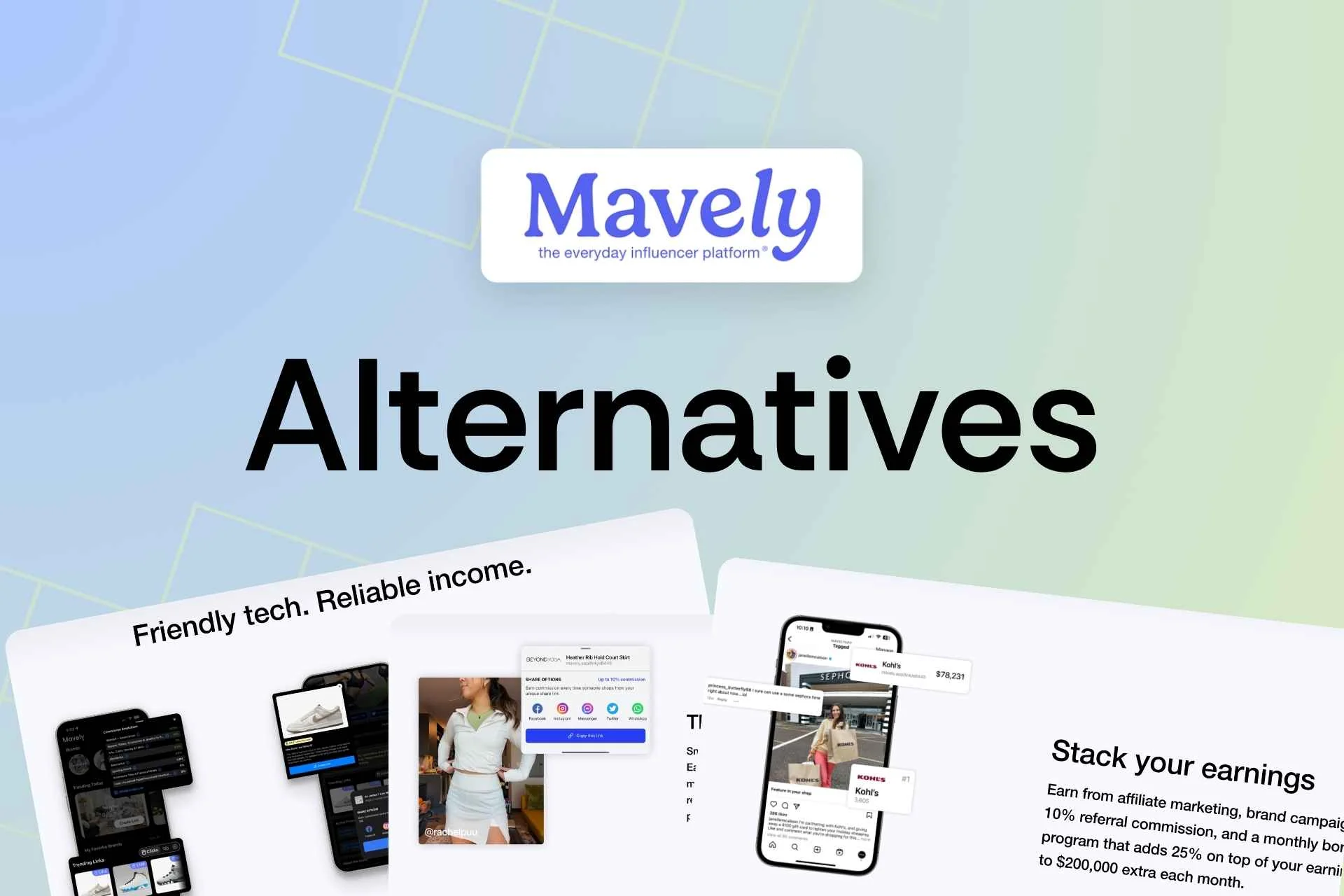
Commission-based creator promotion has a clean appeal: nobody gets paid until something sells. That is the premise Mavely runs on, giving creators trackable SmartLinks for a catalogue of retail and D2C brands, and giving brands a performance channel with no upfront media cost. Since its acquisition by Later, it has become one of the larger link-monetisation networks in the market.
The limits show up as soon as a brand wants more control over the program. Mavely is built creator-first, so brands do not choose who promotes them, cannot search a database for the right partners, and have no outreach, CRM or gifting workflow to manage relationships over time. Measurement stops at last-click affiliate conversion, which credits the link that closed the sale and ignores the content that built the intent.
Brand-side pricing is the third friction point — there is no published rate card, take rate or minimum, so evaluating cost means booking a call. Add a creator base that skews heavily toward the US, and Mavely alternatives start to look attractive to any team that needs creator selection, campaign management and full-funnel reporting rather than a distribution layer bolted onto checkout.
Each of the ten platforms below fills part of that gap, ranging from full program management to discovery-only tools and application-based marketplaces. Anyone weighing up the wider category will find the landscape mapped out across the best influencer marketing platforms, but the ten compared here are Influencer Hero, GRIN, Afluencer, Influencity, Upfluence, Modash, SARAL, Traackr, Heepsy and Kolsquare.
Criteria for Suggesting Platform Alternatives
Core Features
Evaluation of each platform’s essential capabilities, including influencer discovery, outreach, CRM, campaign reporting, gifting, UGC and content collection, affiliate tracking and payments, storefronts, application pages, and AI-powered tools.
Supported Social Media Platforms
Assessment of how well each platform integrates with major social networks such as Instagram, YouTube, TikTok, Facebook, Pinterest, and many more
Pricing & Contract Flexibility
Comparison of pricing models, subscription costs, and contract requirements to help brands choose solutions that match their budget and scalability needs.
Standout & Differentiating Features
Highlighting unique or innovative functionalities that set each platform apart, such as real-time tracking dashboards, creator benchmarking, TikTok email discovery, or advanced automation tools.
Customer Reviews & User Satisfaction
Analysis of verified user feedback from credible platforms like G2, TrustRadius, Capterra, focusing on usability, reliability, value for money, customer support, and real-world performance.
Mavely Overview

Mavely is an affiliate and link-monetisation platform where creators generate trackable SmartLinks for products from a large catalogue of retail and D2C brands, earning commission on the sales those links produce. There is no application process or follower minimum on the creator side, and brands pay only on performance rather than on reach. Later acquired the company in early 2025, and it now operates as the creator-commerce arm of that business.
Key Features
- SmartLinks: trackable shoppable links generated in-app, on desktop or through a browser extension, deep-linking into retailer apps.
- Open Creator Access: no application, no follower minimum and no fees, which keeps the network large and broad rather than curated.
- Real-Time Analytics: clicks, conversions, earnings and top-performing products reported as sales come in.
- Fast Payouts: bi-weekly payment cycles with low thresholds, well ahead of standard affiliate settlement periods.
- Commission Boosts: a live feed of temporary brand-wide and product-level rate increases of up to three times the standard commission.
- Brand-Side Reporting: access to a creator network in the low hundreds of thousands, with click-to-conversion data and ROAS reporting.
Platform Coverage
platform-agnostic by design, since the tracked unit is the link rather than the post. Creators share SmartLinks on Instagram, TikTok, Facebook, Pinterest, YouTube, blogs, newsletters and link-in-bio pages.
Pricing
- Creator Side: free, with no signup fee, subscription or application cost. Commission rates are set by each brand and vary widely by category.
- Brand Side: performance-based spend with no upfront platform fee and no long-term commitment, quoted individually.
- Visibility Packages: optional paid placement and optimisation packages priced on request.
Brand-side pricing is not published. There is no public rate card, take rate or minimum spend, so cost has to be established through a sales conversation before a program can be modelled.
Reviews
4.1/5.0 (Trustpilot), with a notably split distribution — strong scores from active creators alongside a sizeable block of one-star reviews. No verifiable brand-side rating exists on the major B2B software review sites.
Standout Features
- Zero-Gate Network Access: creators join without approval, which gives brands access to a very large and diverse promoter base immediately.
- Payout Speed: bi-weekly settlement with a low minimum, which keeps creators actively posting rather than waiting on quarterly cycles.
- Dynamic Commission Windows: boosted rates published in real time, turning static affiliate terms into a promotable event.
Limitations (Why Users Look for Mavely Alternatives)
Limited performance insights
Mavely provides click, sales, and earnings tracking, but lacks deeper metrics such as EPC, conversion rates, and reversal rates that advanced affiliates may want.
Commission rates can vary
Brand-specific rules, product exclusions, coupon codes, and changing commission rates can make earnings less predictable.
Geographic limitations
Mavely has historically focused heavily on the U.S. creator market, so creators outside supported regions may need another platform.
Account and payout concerns
Some recent creator reviews report account reviews, restrictions, or disputes around unpaid earnings, which can make creators seek platforms they perceive as offering more predictable account management.
10 Best Influencer Marketing Platform Alternatives:
| TOOL | REVIEWS | BEST FOR | TRIAL INFO | PRICING | ||
|---|---|---|---|---|---|---|
1 |

|
⭐ | Influencer CRM & automation | Book Demo | Pricing | Website |
2 |

|
⭐ | DTC creator management | Book Demo | Pricing | Website |
3 |

|
⭐ | Influencer marketplace campaigns | Book Demo | Pricing | Website |
4 |
|
⭐ | Campaign management | Book Demo | Pricing | Website |
5 |

|
⭐ | Influencer discovery | Book Demo | Pricing | Website |
6 |

|
⭐ | Influencer discovery | Book Demo | Pricing | Website |
7 |

|
⭐ | Influencer outreach | Book Demo | Pricing | Website |
8 |

|
⭐ | Enterprise influencer analytics | Book Demo | Pricing | Website |
9 |

|
⭐ | Influencer discovery | Book Demo | Pricing | Website |
10 |

|
⭐ | Data-driven influencer discovery & campaign analytics | Book Demo | Pricing | Website |
Influencer Hero

Influencer Hero runs the full creator program in one place — finding creators, contacting them, shipping product, collecting content, tracking affiliate revenue and paying out — rather than covering a single stage of it. It is aimed at D2C and eCommerce teams that want to own the program internally, and its automation depth is what lets small teams manage creator counts that would otherwise require headcount. Enterprise programs run on the same infrastructure as growing brands.
Key Features
- Creator Discovery: filtering by location, demographics, interests, engagement and follower quality, with fake-follower detection, lookalike suggestions and brand-follower detection.
- Outreach Automation: bulk and one-to-one email with AI-personalised templates, drip sequences and reply tracking.
- Influencer CRM: relationship boards tracking every conversation, campaign stage and deliverable across the roster.
- Affiliate and Payment Tracking: custom links, discount codes, commission and conversion tracking with automated creator payouts.
- Product Seeding: Shopify and WooCommerce auto-fulfilment with shipping and delivery status tracked per creator.
- Creator Storefronts: customisable storefronts that give each creator a shoppable page driving affiliate sales.
- UGC and Content Collection: influencer posts gathered automatically and made downloadable for paid and owned channels.
- ROI Dashboards: clicks, affiliate sales, UGC downloads and revenue reported per influencer, with exportable reports.
Platform Coverage
Instagram, TikTok, YouTube, Facebook, Pinterest, Snapchat, X and Twitch.
Pricing
- Standard: $649/month for up to 1,000 creators or contacts.
- Pro: $1,049/month for up to 5,000.
- Business: $2,490/month for up to 10,000.
- Custom and Agency: tailored pricing for larger programs and agencies managing several accounts.
Reviews
5.0/5.0 (Capterra)
Standout Features
- Chrome Extension: creator insights and one-click imports directly from a social profile while browsing.
- Bulk Program Tools: outreach, follow-ups, seeding and deal management executed in batches instead of one creator at a time.
- Integration and API Layer: DocuSign, GoAffPro, Klaviyo, Slack and Zapier connections, plus API access to millions of creator profiles.
Mavely vs Influencer Hero
Mavely gives a brand distribution; Influencer Hero gives it a program. On Mavely, creators find your products in a catalogue and decide whether to promote them, so the brand influences the outcome mainly through commission rates. On Influencer Hero, the brand picks the creators, runs the outreach, ships the product, collects the content and tracks the revenue — the selection decision, which is where most influencer performance actually comes from, stays in-house.
The reporting difference follows from that. Mavely attributes the sale that a SmartLink closed. Influencer Hero attributes clicks, affiliate sales, UGC output and total ROI to named creators inside the CRM, which makes it possible to see who is worth renewing and who is not. Mavely is a genuinely efficient way to reach a wide promoter base at low risk, and it costs nothing upfront to test. But at $649/month, an owned program across eight networks with automated gifting, creator storefronts and per-creator attribution builds an asset the brand keeps, rather than renting access to someone else's network.
GRIN
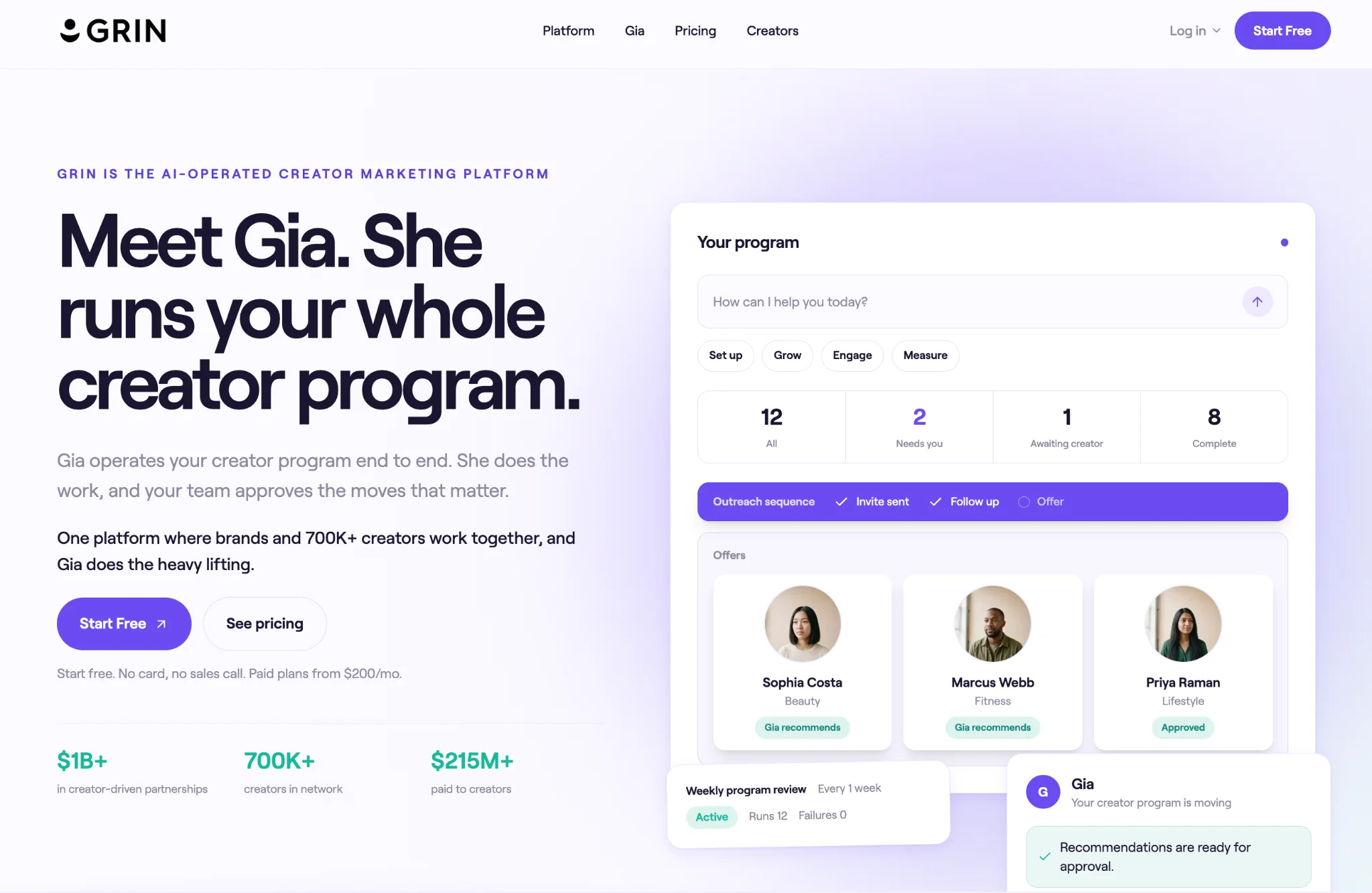
GRIN gives D2C and eCommerce brands a creator management system built around an AI agent, Gia, that carries out discovery, outreach, negotiation, payment and reporting work rather than handing it back as suggestions. The original workflow product runs alongside it for teams that prefer manual control. Its move to published, usage-metered pricing has made it far easier to evaluate than it used to be.
Key Features
- Agent-Run Workflows: discovery, outreach and payments executed automatically instead of queued for manual completion.
- Relationship Records: a creator CRM holding partnership history and performance across years of collaboration.
- Opted-In Marketplace: a large pool of creators who have joined the network, with no commission taken on affiliate programs.
- Automated Shortlisting: brand goals and audience criteria used to generate the first creator list.
- Stakeholder Reporting: report templates configurable for different internal audiences.
Platform Coverage
Facebook, Instagram, TikTok, X, Pinterest, YouTube and Twitch for activation, with creator search concentrated on the major social and video networks.
Pricing
- Free: $0/month with a monthly credit allowance and no card required.
- Starter: $200/month with metered usage under a cap the brand sets.
- Growth: $500/month including the classic workflow product for up to 100 active creators.
- Scale: $1,000/month for up to 250 active creators.
- Complete: $1,500/month for up to 500 active creators.
Reviews
4.5/5.0 (G2)
Standout Features
- Work Executed, Not Suggested: the agent completes tasks end to end, which changes what a small team can realistically manage.
- Free Entry Tier: a permanent no-card plan that removes the sales cycle from evaluation.
- Usage-Based Cost: billing tracks work done rather than seats occupied, which suits uneven campaign calendars.
Mavely vs GRIN
The contrast is who initiates. Mavely waits for creators to pick products they want to promote; GRIN goes and gets them. For a brand with strong retail recognition, waiting works reasonably well — plenty of creators will pick a familiar name off the catalogue. For a newer brand with no pull, the same model produces very little activity, and there is no lever to fix it beyond raising commission.
GRIN also closes the loop that Mavely leaves open. Negotiations, deliverables, content and payouts all sit in one record per creator, so a program can be actively shaped rather than passively measured. The trade is cost and effort: Mavely charges nothing until a sale happens, while GRIN charges from $200 a month and expects a team to run the program. That is a fair price for control, but only for brands that intend to use it.
Afluencer
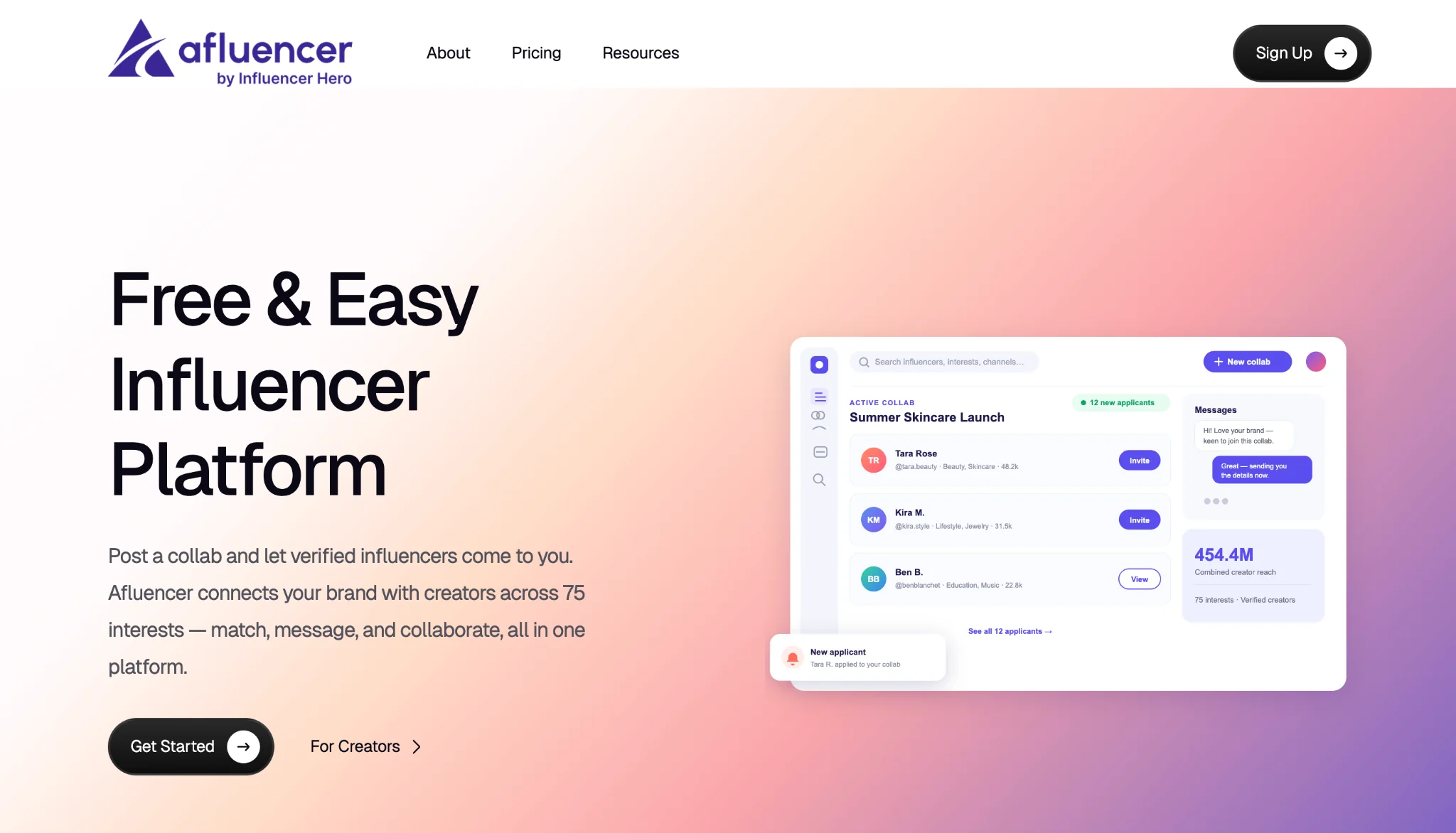
Afluencer works on applications rather than outreach. Brands publish collaboration offers, verified creators apply, and the brand selects from a pool that has already put its hand up — which removes most of the cold-contact volume that makes influencer programs slow to start. Its centre of gravity is SMB and D2C, with a heavy Shopify presence on the brand side.
Key Features
- Posted Collabs: collaboration offers published to the network, with creators applying directly rather than being sourced.
- Verified Profiles: creators are registered users on the platform rather than scraped public accounts.
- Category Search: a large creator directory segmented across dozens of interest categories for outbound browsing.
- Integrated Messaging: matching, direct messaging and collaboration tracking handled in a single dashboard.
- Gifting and Payments: product send-outs and creator payment handling included on paid brand plans.
Platform Coverage
Instagram, TikTok, YouTube and X.
Pricing
- Marketplace: free, covering collab posting and access to the creator network.
- Standard: $649/month with 1,000 reach-outs per month, product send-outs and influencer payments.
- Pro: $1,049/month with 5,000 reach-outs, a dedicated account manager and extra seats.
Reviews
4.6/5.0 (G2)
Standout Features
- No-Cost Entry: a brand can post collabs and review applications without spending anything.
- Pre-Qualified Interest: every applicant has already read the offer, which lifts response quality well above cold outreach.
- Commerce Integrations: Shopify, Klaviyo, Amazon, Slack and DocuSign connections handle the operational side.
Mavely vs Afluencer
Both are inbound models, which makes them unusually comparable — but they let the brand in at different points. On Mavely, creator participation is entirely self-directed and the brand sees the result after the fact. On Afluencer, creators apply to a specific brief and the brand approves each one, so the same low-friction supply comes with an approval gate attached.
That gate matters for brand fit. Affiliate catalogues surface products to creators with no filter on audience relevance or content quality, and a brand can end up promoted in contexts it would not have chosen. Afluencer's free marketplace tier costs no more than Mavely does upfront while returning control over who represents the brand, plus the ability to run gifted, paid and affiliate collaborations rather than commission alone.
Influencity

Influencity bundles influencer management with social media management and social listening, which is a wider footprint than most tools in this category attempt. It works for brands, agencies and eCommerce teams across a broad set of markets, and its modular structure means a buyer can start with discovery and add the rest later. The searchable profile database runs into the hundreds of millions.
Key Features
- Profile Search: a very large creator database filterable by audience demographics, engagement and performance.
- Talent Rosters: custom creator databases and lists with historical performance attached to each profile.
- Casting and Approval: briefing, content validation and sign-off handled inside the campaign workflow.
- Social Hub: content calendar, scheduling and a combined comment and DM inbox alongside the influencer tools.
- Brand Monitoring: mentions, competitor activity and trend detection tracked in the same platform.
Platform Coverage
Instagram, TikTok, YouTube and Twitch.
Pricing
- Professional: around $398/month, or roughly $318/month billed annually.
- Business: in the region of $700–800/month for larger teams and higher limits.
- Enterprise: custom pricing with tailored usage caps and support.
A seven-day trial is available without a sales call, and because plans are modular, teams that only need discovery pay considerably less than teams adding listening and campaign management.
Reviews
4.5/5.0 (G2)
Standout Features
- Suite Breadth: influencer marketing, social publishing and listening under one subscription rather than three tools.
- Pay-For-What-You-Use Structure: modules added as needed instead of an all-or-nothing enterprise bundle.
- Trial Without Sales: a self-serve trial that lets a team test the database before committing budget.
Mavely vs Influencity
The two answer opposite questions. Mavely tells a brand what its creator-driven sales were; Influencity tells it which creators to work with in the first place. Audience demographics, credibility scoring and engagement quality are visible before any money moves, which is precisely the information an affiliate catalogue withholds.
For brands with a specific target audience, that pre-spend visibility is worth more than post-sale reporting. Mavely's network is broad but undifferentiated — a brand selling to new parents in Germany has no way to steer promotion toward creators whose audiences match. Influencity's filtering and market-level data make that targeting the starting point rather than a hoped-for outcome, though the brand then has to run the outreach and negotiation itself.


Upfluence
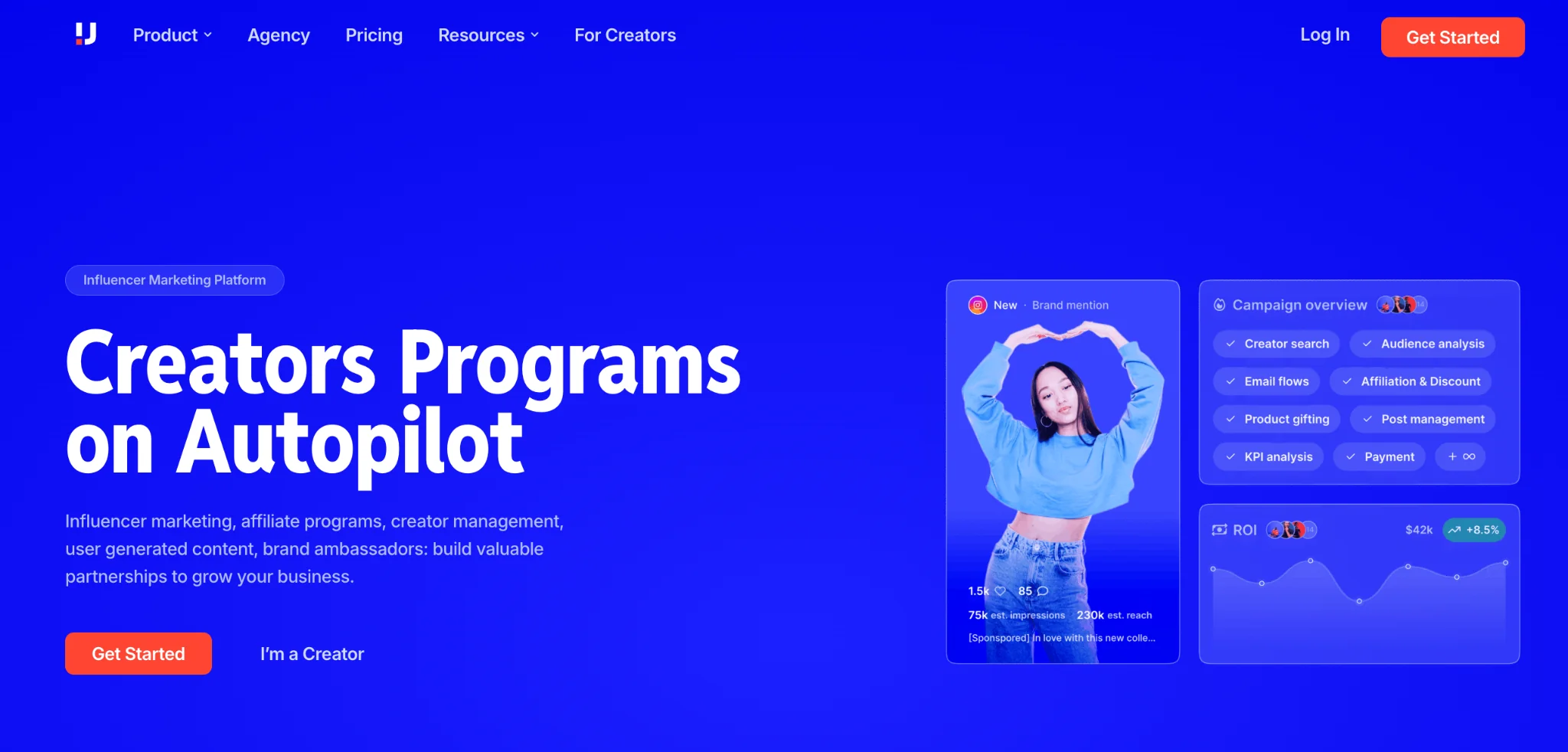
Upfluence sits at the intersection of influencer and affiliate marketing, with deeper commerce-data integration than most competitors attempt. Its most distinctive capability is matching a brand's existing customer list against creator profiles, which turns buyers who already have audiences into partners. Both the product and the commercial process lean enterprise.
Key Features
- AI Co-Pilot: creator selection and outreach drafting automated to cut research time significantly.
- Customer-to-Creator Matching: eCommerce and email integrations surface customers who already hold influence.
- Unified Discovery: cross-network creator search with audience and performance data shown together.
- Revenue Attribution: sales tied to individual creators through Shopify, WooCommerce, Magento, BigCommerce and Klaviyo.
- Compliant Payouts: multi-currency creator payments with tax forms and compliance handled in-platform.
Platform Coverage
Instagram, TikTok, YouTube, Twitch, Pinterest and X.
Pricing
- Modular Plans: three tiers spanning discovery, program scaling and full automation, each quoted individually.
- Custom Quote: no public pricing, with cost driven by modules, team size and program volume.
- Contract: twelve-month minimum term, a fixed platform fee and no share taken of creator-driven sales.
Reviews
4.6/5.0 (G2)
Standout Features
- Six-Network Search: the widest discovery coverage of any platform in this comparison.
- Advocates From Your Own Data: partnerships built from proven customers rather than strangers browsing a catalogue.
- Finance-Grade Payments: international payouts and tax documentation without a separate finance process.
Mavely vs Upfluence
Both take revenue attribution seriously, which makes this the closest functional overlap on the list — but Upfluence attributes across the whole program rather than only the affiliate link. Content, gifting, paid partnerships and affiliate sales all report into one view, so a brand can see how the top of the funnel feeds the bottom instead of only counting conversions.
Upfluence's customer-to-creator matching also solves a problem Mavely structurally cannot. Recruiting promoters from an existing buyer list produces creators with real product familiarity, which shows in the content. The counterweight is commitment: Mavely costs nothing until a sale, while Upfluence requires a sales process and a twelve-month contract, so it only makes sense for brands treating creator marketing as a standing channel.
Modash
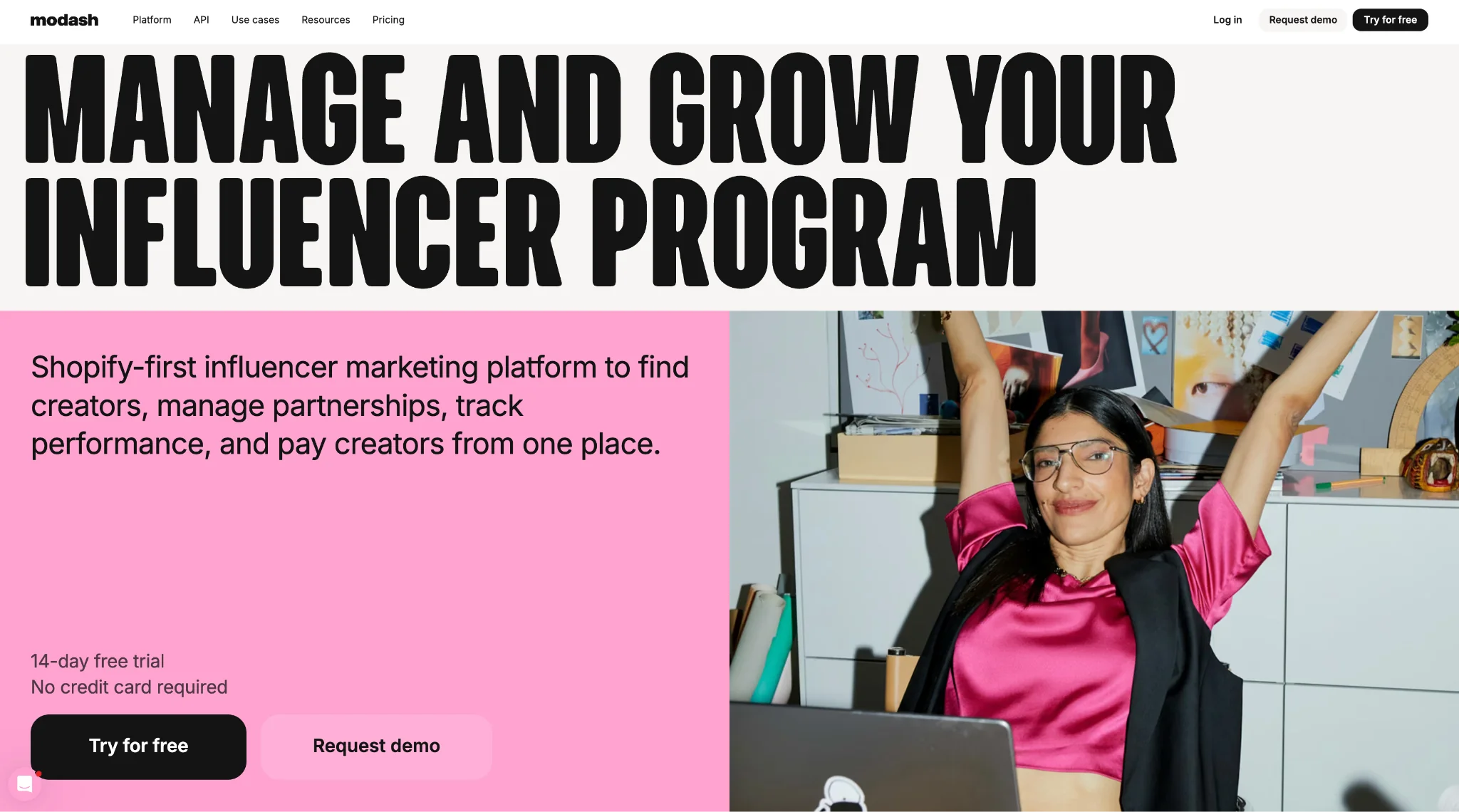
Modash was built for in-house teams at eCommerce and D2C brands, and its defining decision is that creators never have to sign up for anything. Because the platform indexes public profiles, discovery and post tracking work on any creator, whether or not they have heard of Modash. Pricing is published in full, which makes evaluation unusually straightforward.
Key Features
- Open Database Search: AI-assisted search across hundreds of millions of profiles, including every account above a low follower floor.
- Automatic Post Detection: partnered creators' content tracked without any authorisation step on the creator's side.
- Creator Records: contacts, notes and collaboration history stored per creator.
- Inbox Sync: Gmail and Outlook conversations pulled in with campaign context attached.
- International Payments: creator payouts with no processing fee up to defined annual volumes.
Platform Coverage
Instagram, TikTok and YouTube.
Pricing
- Essentials: $199/month for two seats, suited to programs up to around 100 creators.
- Performance: $499/month for five seats, adding payments and affiliate management.
- Enterprise: from $14,700/year with custom limits, a dedicated success manager and a custom tracking domain.
A fourteen-day trial runs without a credit card, capped at a limited number of profile views and tracked creators.
Reviews
4.9/5.0 (G2)
Standout Features
- No Creator Onboarding: tracking that works without asking creators to connect accounts, removing a common point of failure.
- Influential Fans: identifies creators already following or engaging with the brand as warm partnership candidates.
- Fully Published Pricing: every limit and price visible before any contact with sales.
Mavely vs Modash
Mavely produces sales data; Modash produces creator data. That distinction decides which one fits. A brand that already knows a wide affiliate net converts and simply wants more of it is well served by Mavely. A brand that needs to work out which creators to build relationships with will get further with a searchable database and content tracking.
The affiliate-management feature on Modash's Performance plan narrows the gap further, since a brand can run its own commission program against creators it selected rather than a network it does not control. At $499 a month that costs real money where Mavely costs nothing upfront, but it produces a roster, a contact history and post-level tracking that stay with the brand regardless of which network it uses next.
SARAL
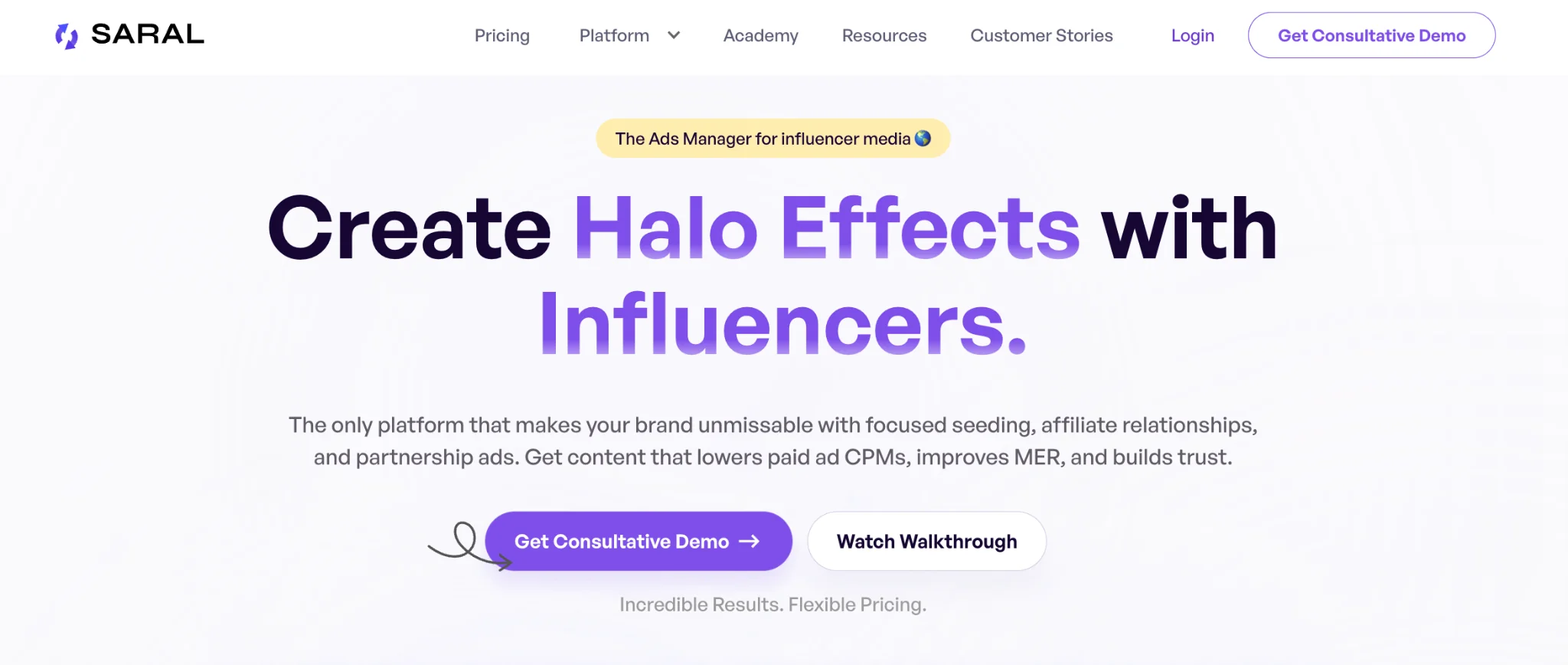
SARAL treats influencer marketing as an acquisition channel and builds accordingly, combining discovery, outreach, affiliate tracking and UGC rights into a workspace aimed at D2C brands. Every plan carries a heavy service component — onboarding, a named success manager and a shared Slack channel — which is unusual at the entry tier. The feature set is narrow by design and opinionated about how programs should run.
Key Features
- Public-Profile Index: a large creator index built without requiring creators to register.
- Lookalike Expansion: new creator suggestions generated from saved profiles rather than rebuilt filter by filter.
- Native Affiliate Links: cookieless commission tracking built into the core product rather than added on.
- Post Detection: automatic alerts when a partnered creator publishes.
- Ambassador Pipelines: application forms that convert existing customers into long-term brand ambassadors.
Platform Coverage
Instagram, TikTok and YouTube.
Pricing
- Starter: $12,000/year for 100 active partnerships and one seat.
- Business: $15,000/year for 500 active partnerships, unlimited post tracking and three seats.
- Professional: $25,000/year for 1,000 active partnerships, unlimited social listening and ten seats.
Plans are sold in annual or quarterly blocks with no commitment beyond the billing period, and expert-led onboarding plus a dedicated success manager are included at every tier.
Reviews
4.8/5.0 (G2)
Standout Features
- Affiliate Tracking Built In: commission attribution is native rather than dependent on a separate affiliate platform.
- Service Included Everywhere: onboarding and a named success manager on the entry plan, not just at enterprise level.
- Lists That Grow From Winners: creator lists expanded from proven performers instead of rebuilt each campaign.
Mavely vs SARAL
Both platforms are built on the same conviction — that creator marketing should be measured in revenue — and both include native affiliate tracking. Where they part company is ownership. Mavely's affiliate program runs on Mavely's network, on Mavely's terms, with creators the brand did not choose. SARAL's runs on the brand's own selected partnerships.
That distinction becomes expensive in both directions. SARAL's $12,000 annual floor is a serious commitment against a platform that costs nothing until a sale occurs, so a brand with modest volume will struggle to justify it. For brands past that threshold, the combination of ambassador pipelines, cookieless attribution and hands-on onboarding turns creator spend into a managed channel rather than a commission line on someone else's dashboard.
Traackr
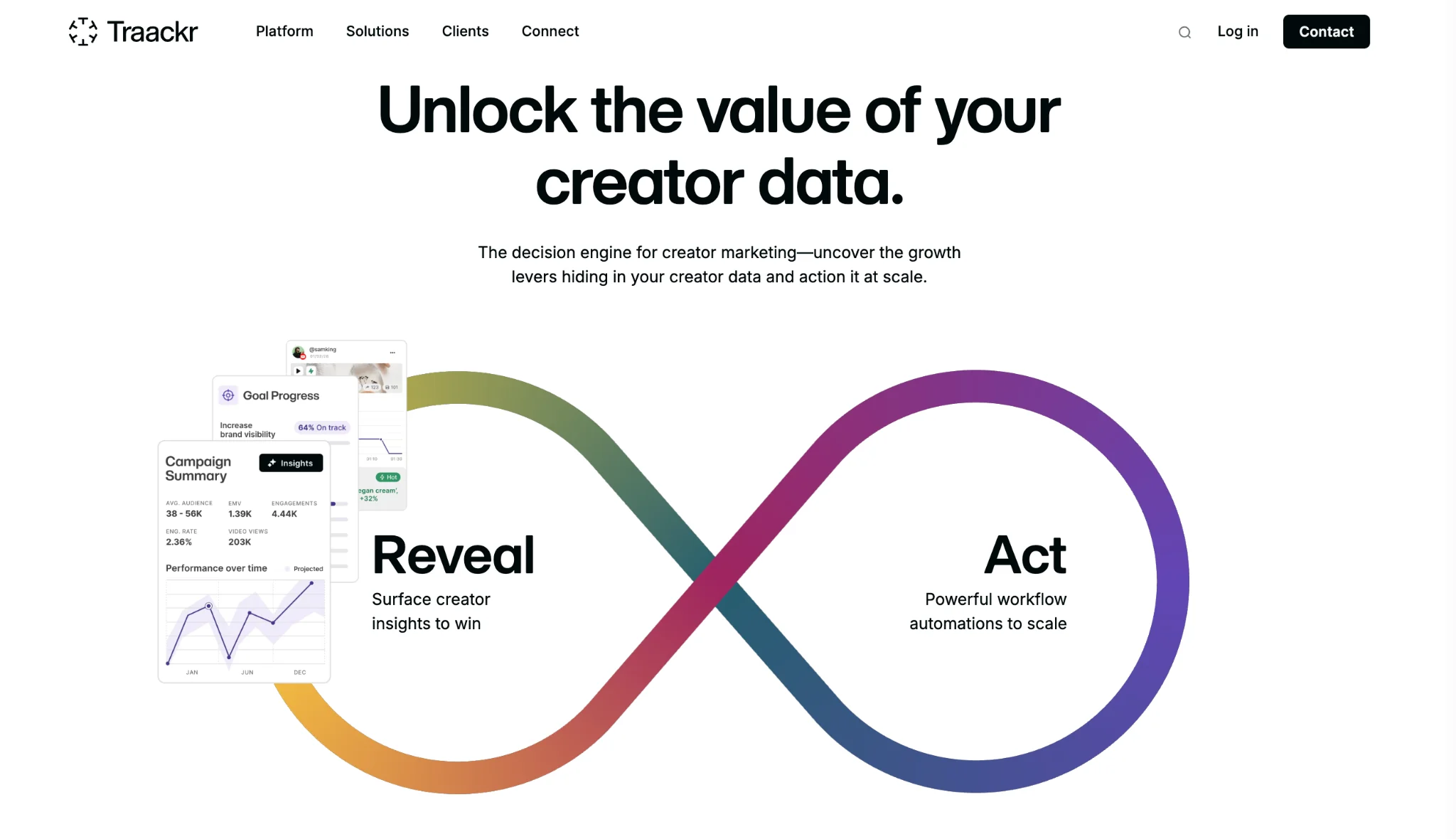
Traackr is an enterprise relationship management and measurement platform built for organisations that need to prove what influencer investment returns. It is used by large global brands and agencies, with particular depth in beauty, fashion and travel. Rather than executing campaigns, it structures planning, activation oversight and measurement across markets.
Key Features
- Data-Led Discovery: content analysis, lookalike search and detailed audience data used to construct shortlists.
- Partnership History: briefs, content and gifting recorded per creator across the life of the relationship.
- Outcome Benchmarking: creator and campaign performance measured against business results and spend benchmarks.
- Share-of-Voice Tracking: brand presence measured against competitors across a wide range of international markets.
- Program Health Metrics: creator acquisition, retention and churn tracked as program-level indicators.
Platform Coverage
Coverage extends across the major social networks, though Traackr does not publish a definitive list.
Pricing
- Custom Quote: no public pricing, with packages agreed through a sales process.
- Entry Point: third-party listings put the starting cost well into five figures, with the billing period reported inconsistently.
- Commitment: no free plan and no free trial.
Reviews
4.3/5.0 (G2)
Standout Features
- Category Benchmarking: results compared against competitors across dozens of markets rather than only against past performance.
- Long-Horizon Relationship Data: records that support multi-year creator tenures instead of one-off activations.
- Spend Reallocation: budget shifted between partnerships based on measured return.
Mavely vs Traackr
These two occupy opposite ends of the same funnel. Mavely reports the transaction; Traackr reports the contribution — how creator investment moved brand presence, category share and retention across markets over time. One is an operational number, the other is the case a marketing director takes into a budget meeting.
Practically, that means Traackr answers questions Mavely cannot even frame. Which creators lifted awareness in a market where sales lag by two quarters? Is spend allocated efficiently against category peers? The trade-off is severe: Traackr executes nothing, offers no trial and requires enterprise budget, while Mavely starts producing attributable sales the week a brand joins. The choice depends entirely on whether the immediate problem is generating revenue or explaining it.
Heepsy

Heepsy is a discovery-first tool for SMBs, startups, eCommerce brands and small agencies that want serious database access without an enterprise contract. It has since added outreach sequences, campaign pipelines and creator payments, but search remains the core of the product. Its entry pricing is the lowest of any platform in this comparison.
Key Features
- Multi-Mode Search: intent-based AI search alongside lookalike and keyword modes across the creator database.
- Follower Quality Scoring: fake-follower detection and audience authenticity analysis applied to every profile.
- Sequenced Outreach: templates, AI-composed emails and multi-step mailing sequences on higher plans.
- Inbound Marketplace: creator applications received alongside outbound search results.
- Pipeline Management: customisable campaign pipelines with live media tracking and a content gallery.
Platform Coverage
Instagram, TikTok and YouTube.
Pricing
- Free: $0/month with capped search results and advanced profile views.
- Starter: €69/month adding bulk emailing, templates and marketplace access.
- Plus: €149/month adding AI email composition, sequences, creator payments and analytics.
- Advanced: €229/month with the highest result and outreach limits plus custom reporting.
Reviews
4.5/5.0 (G2)
Standout Features
- Working Free Plan: a usable free tier with no card required, making evaluation essentially risk-free.
- Authenticity Analysis as Standard: follower quality checks applied across profiles rather than sold as an add-on.
- Sub-€70 Paid Entry: the lowest paid starting point among the platforms here.
Mavely vs Heepsy
For brands whose real problem is not knowing who to work with, Heepsy addresses the gap Mavely leaves untouched. Affiliate networks assume the creator relationship already exists or will form itself; Heepsy exists to create it, with audience data and authenticity scoring available before a single message goes out.
Cost keeps the comparison honest in Mavely's favour. Heepsy's €69 entry plan is a real expense against a platform that charges nothing until it produces a sale, and Heepsy's reporting is shallower than the enterprise tools here. What it delivers instead is a searchable pipeline and outreach history the brand owns — the raw material for a program, rather than participation in someone else's.
Kolsquare
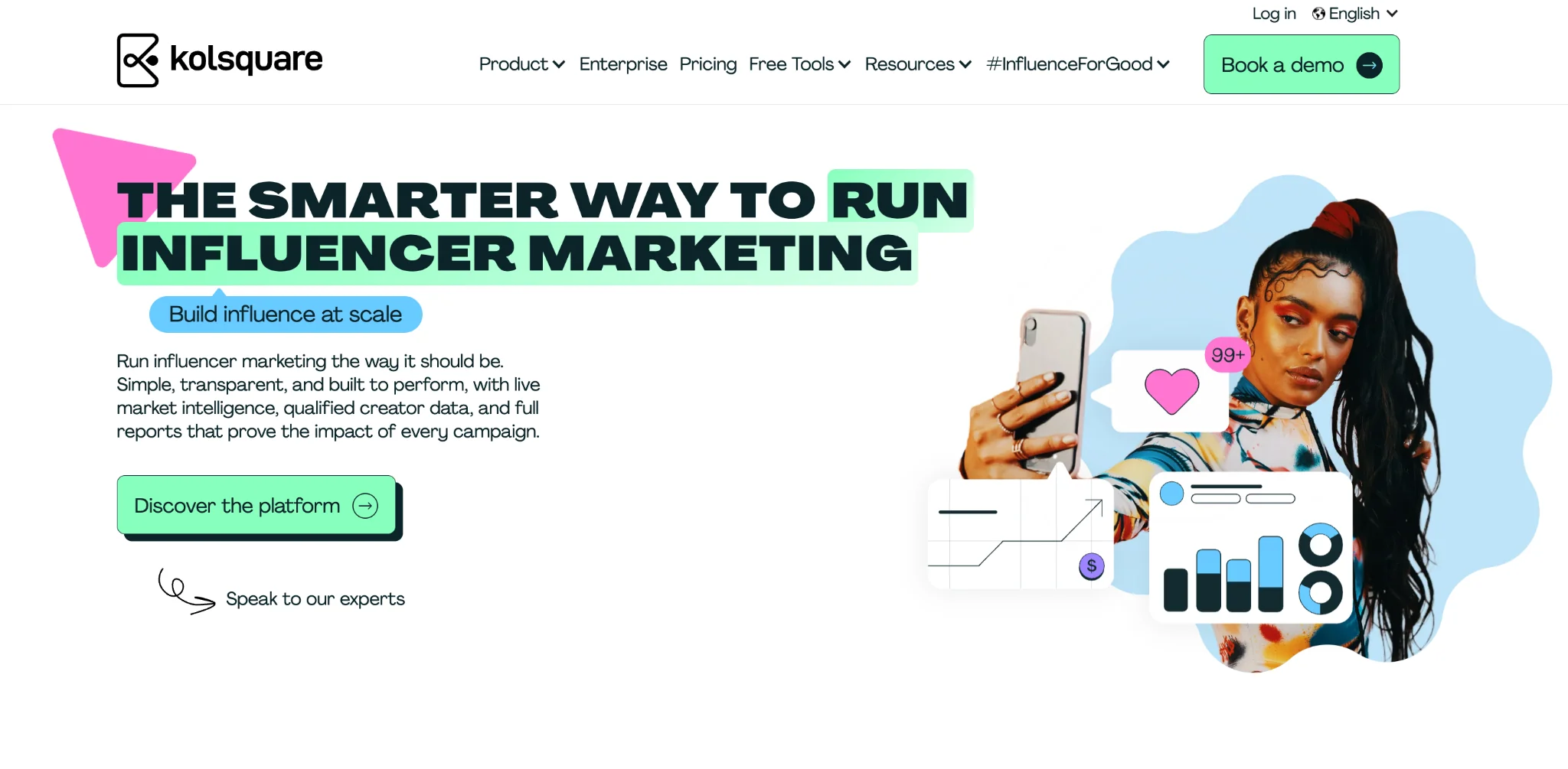
Kolsquare is a European platform combining AI creator discovery, campaign management and social listening, used by a large base of brands and agencies across EU markets. Its search leans on image recognition and speech-to-text rather than profile metadata alone, and it places unusual weight on compliance and responsible-influence practice. Market coverage is strongest across Europe.
Key Features
- Content-Level Search: image recognition and speech-to-text search alongside multilingual keyword filtering.
- Audience Comparison: demographic breakdowns with overlap analysis and credibility scoring between creators.
- Relationship Management: an integrated CRM with custom fields, messaging and content validation.
- Competitor Dashboards: customisable listening dashboards benchmarking a brand against direct competitors.
- Tracking and Reporting: tracking links, ROI calculation, automated reports and a Shopify plugin.
Platform Coverage
Instagram, TikTok, YouTube, Facebook and Snapchat, with listening dashboards focused on Instagram and TikTok.
Pricing
- Discovery: creator search, AI search, audience insights and integrated CRM, quoted on request.
- Listening: competitor dashboards and share-of-voice benchmarking, quoted on request.
- Enterprise: adds influencer payments, API access, unlimited campaigns, tracking links and automated reporting.
No public pricing, free plan or trial is offered, though published discounts exist for early-stage startups and non-profits.
Reviews
4.3/5.0 (G2)
Standout Features
- Search by What's In the Content: creators surfaced by what appears or is said on screen, not just by bio keywords.
- Listening in the Same Tool: competitor benchmarking handled alongside creator management rather than in a separate subscription.
- European Coverage and Compliance: stronger EU market depth and disclosure tooling than most US-built platforms.
Mavely vs Kolsquare
Geography settles most of this. Mavely's creator base and retail catalogue are overwhelmingly US-oriented, and non-US creators report friction on the platform. A brand running campaigns across France, Germany or Spain will find very little to work with there, while Kolsquare's market depth and multilingual search were built for exactly that scenario.
Regulatory difference reinforces the point. European influencer disclosure rules are stricter and more actively enforced, and Kolsquare's compliance tooling reflects that. Mavely's model, where uncontrolled creators promote a brand under commission terms, gives a brand limited visibility into how its products are being represented — a manageable risk in one market and a serious one across several.
Final Thoughts on Mavely Alternatives
There is nothing wrong with Mavely's core proposition: a large promoter network, no upfront cost, and clean last-click attribution on the sales it drives. It works best as a distribution layer for brands with recognition strong enough that creators pick them without prompting.
The alternatives here matter when a brand needs to decide who represents it, build relationships that outlast a single commission window, or measure creator impact above the checkout. Heepsy and Modash solve selection cheaply, Afluencer adds an approval gate at no upfront cost, Traackr and Kolsquare handle multi-market measurement, and Influencer Hero, GRIN and Upfluence replace the network with a program the brand owns end to end.
For a closer look at what Mavely itself costs a brand to run, the Mavely pricing breakdown goes through it in detail.