

Motom Alternatives: Best Influencer Marketing Platforms
Send a shopper to a creator's affiliate storefront and you usually hand a third party your traffic, your checkout and your customer data at the same time. Motom exists to stop that. Its Anchor platform gives every creator a branded shop hosted on your own domain, so the sale, the analytics and the first-party data stay in-house. Macy's, Sephora, Bloomingdale's and Chewy all run on it, and reported conversion lifts sit in the 3x to 10x range.
The catch is where the product starts. Anchor is built for the moment after you already have creators, so there is no search database, no outreach engine and no way to find your next hundred partners without buying managed services or another tool. Pricing is demo-only on six or twelve month terms, and there is no public rating to check it against. Any of those can send a team looking for influencer marketing software that covers more of the job. These ten Motom alternatives are worth putting side by side: Aspire, Influencer Hero, CreatorIQ, NeoReach, Afluencer, IZEA, Later, Brandbassador, Lefty and Klear.
Criteria for Suggesting Platform Alternatives
Core Features
Evaluation of each platform's essential capabilities, including influencer discovery, outreach, CRM, campaign reporting, gifting, UGC and content collection, affiliate tracking and payments, storefronts, application pages, and AI-powered tools.
Supported Social Media Platforms
Assessment of how well each platform integrates with major social networks such as Instagram, YouTube, TikTok, Facebook, Pinterest, and many more
Pricing & Contract Flexibility
Comparison of pricing models, subscription costs, and contract requirements to help brands choose solutions that match their budget and scalability needs.
Standout & Differentiating Features
Highlighting unique or innovative functionalities that set each platform apart, such as real-time tracking dashboards, creator benchmarking, TikTok email discovery, or advanced automation tools.
Customer Reviews & User Satisfaction
Analysis of verified user feedback from credible platforms like G2, TrustRadius, Capterra, focusing on usability, reliability, value for money, customer support, and real-world performance.
Motom Overview
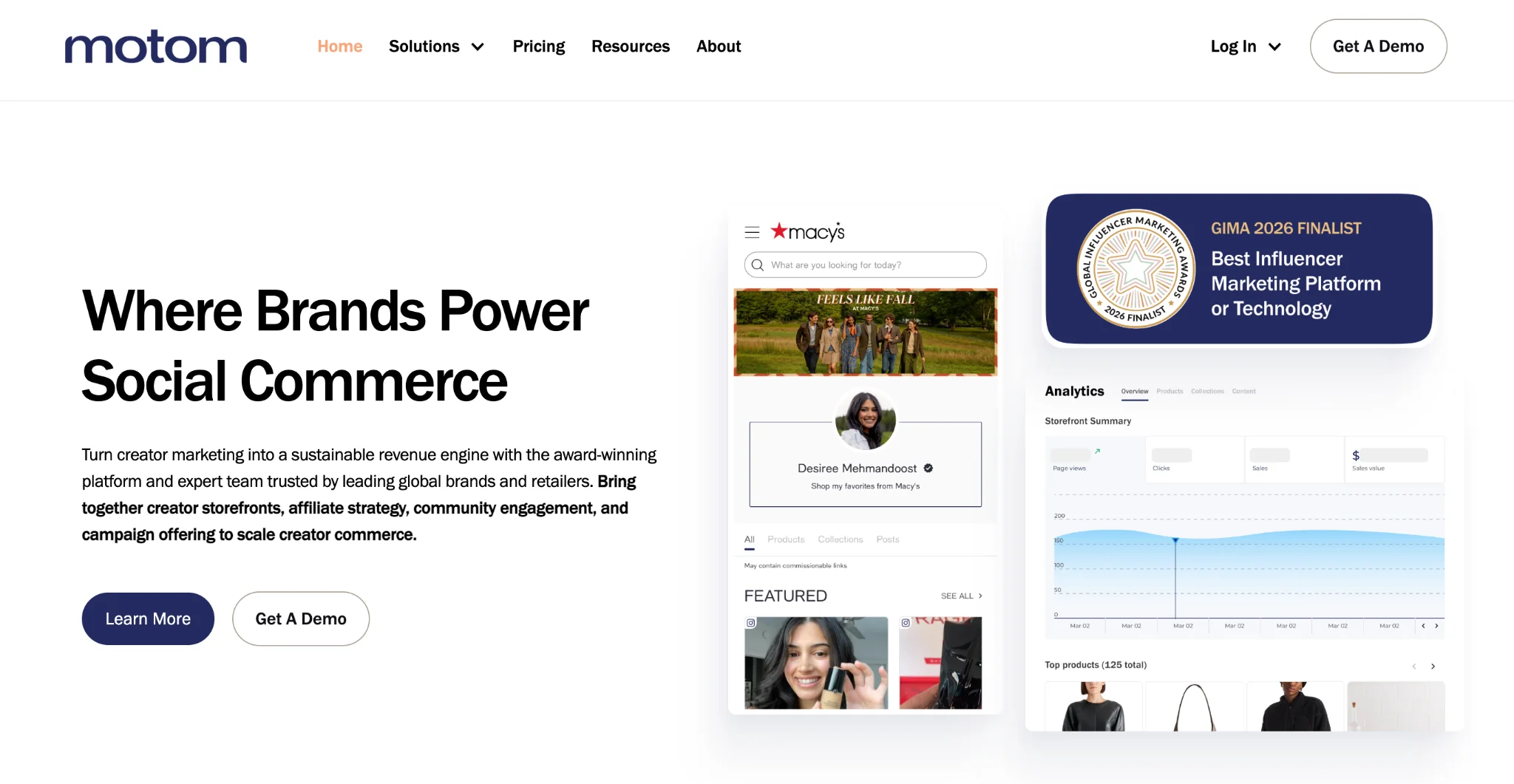
Motom is a creator commerce company whose main product, Anchor, hands each creator a branded shop that lives on the brand's own domain and mirrors the main site. Behind it sits the Anchor Portal, where teams invite creators in batches, review applications, message partners and read performance down to the individual creator and product. Its customers are mostly large multi-brand retailers, and it offers managed services for teams that want the program run for them.
Key Features
- White-Label Storefronts: each creator gets a branded shop on your domain, so shoppers never leave your site and you keep the checkout data.
- Anchor Portal: batch invites, application review, onboarding and messaging in one dashboard built for running hundreds of creators.
- First-Party Analytics: storefront views, clicks, sales and revenue split by creator, group, product, timeframe and traffic source.
- Affiliate Network Integrations: connects to Rakuten, CJ, Impact, Awin, ShareASale and Partnerize for commission tracking and payouts.
- Application and Vetting Flows: custom forms let you screen inbound creators before handing over a storefront.
- Creator Messaging: briefs, announcements and campaign updates sent from inside the platform rather than scattered email.
- Managed Services: onboarding webinars, paid recruitment, gifting and full or partial program management from Motom's team.
- Retail Media Extensions: employee storefronts, vendor and co-op storefronts, and tagging for retail media placements.
Platform Coverage
Motom is a commerce layer rather than a social listening tool. Creators drive traffic from wherever they post, and Anchor measures what happens once a shopper lands on the storefront, so there is no per-network tracking to speak of.
Pricing
- Anchor platform: quote-only after a demo, scoped on storefront volume, creator program size, integration depth and services.
- Managed services: priced as an add-on alongside the platform term.
- Creator accounts: free. Creators keep their storefront, dashboard and commission payouts at no cost.
- Affiliate network fees: billed separately by Rakuten, CJ, Impact, Awin, ShareASale or Partnerize, so commission costs sit on top of the platform fee.
- Terms: six or twelve month commitments, no month-to-month option and no free trial. Storefronts typically go live between 48 hours and three weeks.
Reviews
No reliable public star rating. Motom has no meaningful score on the major software directories, so its record rests on its client roster and reported results rather than review volume.
Standout Features
- The Shop Lives on Your Domain: SEO value, retargeting audiences and purchase data stay with the brand instead of an aggregator.
- Revenue Traced to a Traffic Source: reporting goes past creator-level totals to the path the shopper actually took.
- Software or Service: buy the platform alone, or hand recruitment and onboarding to Motom's team.
Limitations (Why Users Look For Motom Alternatives)
It starts after discovery
Anchor has no creator search database. Finding, vetting and contacting new partners happens in another tool or as a managed services line item, which is a second bill for the half of the job Motom does not cover.
No published price and no trial
Every conversation starts with a demo and ends with a scoped proposal. Budgeting early is guesswork, and there is no self-serve way to test whether creator storefronts convert in your category.
Six or twelve months before you know
Terms are shorter than most enterprise commerce contracts but still long for an unproven program. A brand testing the model commits before the data arrives.
The results depend on creator adoption
Storefronts only earn anything if creators actually promote them. That takes onboarding and ongoing enablement, and programs that skip it end up paying for a lot of empty shops.
Almost no independent evidence
There is no dependable public rating anywhere, so due diligence has to come from references and a pilot rather than from a body of reviews you can read before the call.
10 Best Influencer Marketing Platform Alternatives:
| TOOL | REVIEWS | BEST FOR | TRIAL INFO | PRICING | ||
|---|---|---|---|---|---|---|
1 |

|
⭐ | Influencer partnerships | Book Demo | Pricing | Website |
2 |

|
⭐ | Influencer CRM & automation | Book Demo | Pricing | Website |
3 |

|
⭐ | Enterprise influencer marketing | Book Demo | Pricing | Website |
4 |

|
⭐ | Influencer campaigns & data analytics | Book Demo | Pricing | Website |
5 |

|
⭐ | Influencer marketplace campaigns | Book Demo | Pricing | Website |
6 |

|
⭐ | Influencer marketplace | Book Demo | Pricing | Website |
7 |

|
⭐ | Social media & influencer campaigns | Book Demo | Pricing | Website |
8 |

|
⭐ | Ambassador Marketing | Book Demo | Pricing | Website |
9 |
|
⭐ | Influencer analytics & discovery | Book Demo | Pricing | Website |
10 |
|
⭐ | Influencer analytics | Book Demo | Pricing | Website |
Aspire

Aspire runs an opt-in creator marketplace alongside its campaign software, so brands publish briefs and creators apply rather than being contacted cold. Its roughly 800 customers cluster in beauty, apparel, food, drink and health, and the campaign workflow carries a partnership from brief through content approval to paid amplification.
Key Features
- Marketplace Applications: creators respond to your brief, which turns recruitment into a shortlisting job.
- Performance-Based Matching: AI ranks candidates on brand fit and how they have performed before.
- Approval Workflows: deliverables, revisions and sign-off tracked against each partnership.
- Commission Setup: affiliate links, promo codes and per-creator commission rules.
- Whitelisting via CreatorAds: usage rights requested in-platform, then content run as Meta paid media.
Platform Coverage
TikTok, Instagram, Facebook, YouTube and Pinterest are covered, with Shopify, PayPal and Klaviyo connected on the commerce side.
Pricing
- All tiers: quote-only. Nothing is published, and a legacy Capterra figure of $2,499 per user per month is too old to rely on.
Reviews
4.6/5.0 (G2, 146 reviews)
Standout Features
- Creator Storefronts Included: shoppable pages come with the platform rather than as the platform.
- Rights and Paid Media Built In: the best-performing content can become an ad without a separate deal.
- An Applicant Pool: the marketplace supplies candidates, which Motom does not attempt.
Motom vs Aspire
Creator storefronts exist in both products, which makes the difference easy to see. Motom's live on your domain and are the whole point of the platform. Aspire's are one feature inside a campaign system that also finds creators, runs briefs, handles approvals and turns strong content into paid media. If your problem is that you have no creators yet, Aspire solves it and Motom assumes it is already solved.
Neither publishes a price, so cost transparency is a wash. Where Motom stays ahead is control of the shopping experience. Aspire's storefronts sit on Aspire's infrastructure, while Anchor keeps the domain, the SEO value, the retargeting audiences and the checkout data with the brand. A large retailer that already has a roster and cares about owning that data will still prefer Motom. A brand that needs the roster first will not get there with Motom alone.
Influencer Hero

Influencer Hero scales from a growing D2C brand to an enterprise team on the same product, priced by how many creators and contacts you hold rather than by seats or by spend. It covers the full program: finding creators across eight networks, contacting them, tracking the relationship, sending product, running affiliate codes and paying commission.
Key Features
- Filtered Creator Search: location, demographics, interests, engagement and follower quality, with fake-follower detection, lookalike search and brand-follower search.
- One-Click Imports: a Chrome extension shows creator stats while you browse and pulls profiles straight into the platform.
- Sequenced Outreach: bulk or individual emails with AI personalisation, timed follow-ups and reply tracking.
- Pipeline CRM: boards showing every creator, the stage they are at and the deliverables still outstanding.
- Automated Gifting: seeding orders fulfil through Shopify or WooCommerce with shipping and delivery tracked.
- Affiliate Codes and Payouts: links and discount codes, commission calculated in-platform, payments sent automatically.
- Storefronts and Application Pages: creator storefronts plus branded pages that collect inbound applications.
- UGC and ROI Dashboards: posts collected and downloadable, with clicks, affiliate sales and return reported per creator.
Platform Coverage
Instagram, TikTok, YouTube, Facebook, Pinterest, Snapchat, X and Twitch are all supported.
Pricing
- Standard: $649/month for up to 1,000 creators and contacts.
- Pro: $1,049/month for up to 5,000.
- Business: $2,490/month for up to 10,000.
- Custom & Agency: tailored pricing for larger or multi-brand programs.
Reviews
5.0/5.0 (Capterra)
Standout Features
- Discovery and Commerce in One Product: the same platform finds the creator and pays their commission.
- Volume Automation: outreach, follow-ups and gifting all run across hundreds of creators without extra headcount.
- Published Tiers: four prices on the website, with quarterly and yearly discounts.
Motom vs Influencer Hero
Motom is strong at exactly one stage of the program and openly stops there. Anchor takes creators you already have and turns them into a storefront network with real attribution. It will not find anyone, will not email anyone, and holds no CRM. Influencer Hero runs the stages either side of that too: search across eight networks with follower-quality screening, automated outreach with reply tracking, a CRM holding every deliverable, gifting fulfilled through Shopify or WooCommerce, and its own creator storefronts with commission and automated payouts attached.
The commercial models are not close. Motom quotes after a demo, locks you in for six or twelve months, and adds affiliate network fees on top of the platform fee. Influencer Hero lists $649, $1,049 and $2,490 a month by contact volume, drops 20% on quarterly billing and 30% on annual, and handles commission tracking and payouts itself. It costs more than a discovery-only tool and there is no free trial, so it is not the cheapest first step. What it does is cover the search, the emailing and the commission work that a Motom deployment still has to buy somewhere else.
CreatorIQ
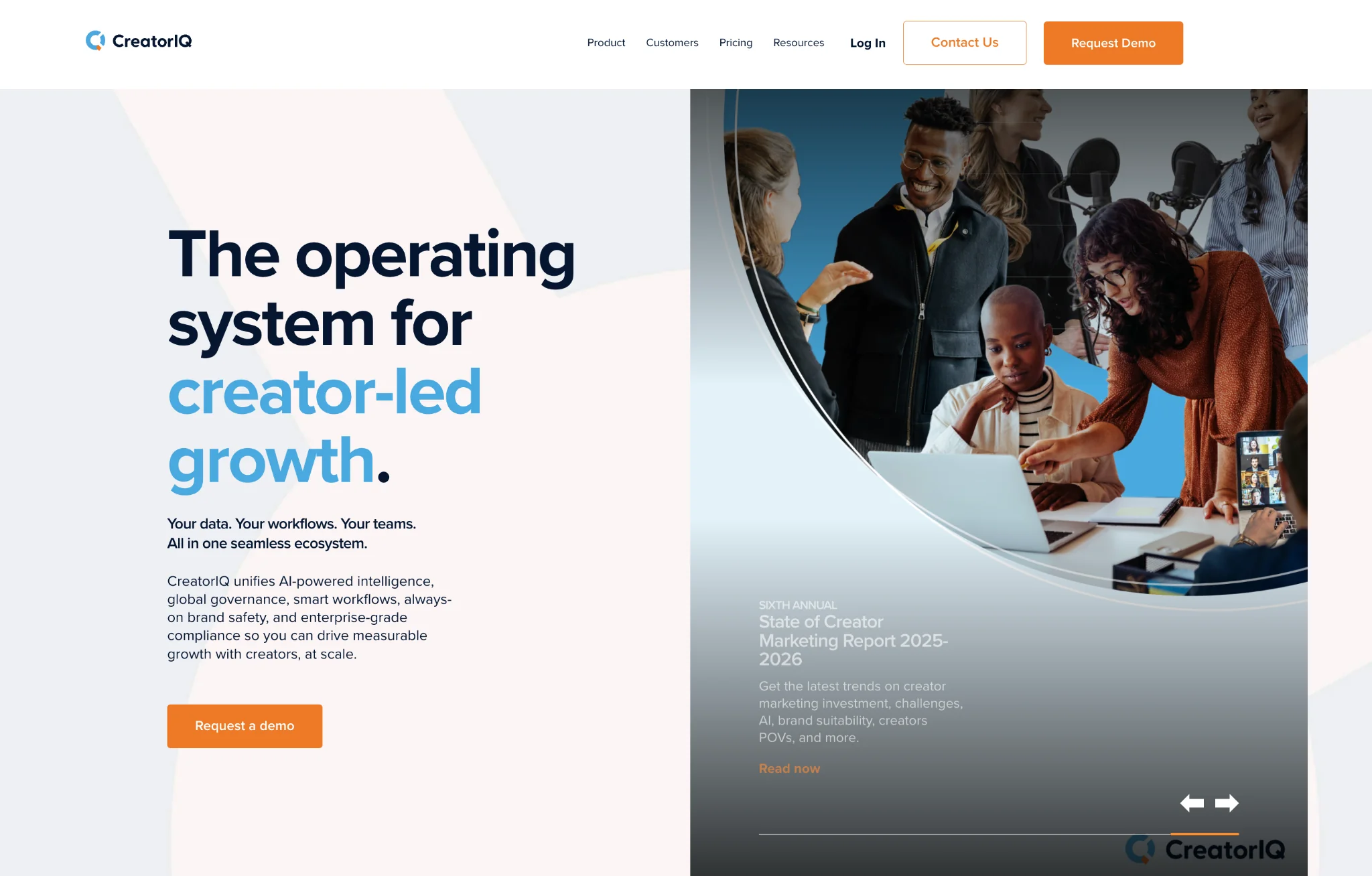
CreatorIQ is used by more than 1,300 brands and agencies, and it sells a suite rather than a tool: SafeIQ for vetting, BenchmarkIQ for competitive analysis, CreatorIQ Pay for payments and ExchangeIQ for integrations, all reading from a shared data layer. It is the heaviest enterprise option in this comparison.
Key Features
- Shared Data Layer: the Creator Graph feeds discovery, measurement and benchmarking from one dataset.
- Pre-Contract Screening: SafeIQ reviews a creator's history for brand safety risk.
- Category Benchmarking: BenchmarkIQ tracks performance and share of voice against named competitors.
- In-Platform Payments: CreatorIQ Pay handles creator invoicing and payment.
- Enterprise Integrations: ExchangeIQ provides APIs and permission controls for large stacks.
Platform Coverage
Instagram, TikTok, YouTube, Facebook, Snapchat and Amazon are supported.
Pricing
- All tiers: quote-only, with the pricing page leading to a booked call.
Reviews
4.6/5.0 (G2, 581 reviews); 4.5/5.0 (Capterra, 17 reviews)
Standout Features
- Screening at Scale: brand safety checks run before anyone signs a contract.
- Governance for Many Brands: permissions and reporting separate cleanly by brand and region.
- A Deep Evidence Base: almost 600 G2 reviews to read before you commit.
Motom vs CreatorIQ
Both are enterprise purchases sold by demo, so the question is which enterprise problem you have. CreatorIQ manages creators as a portfolio: vetting them, contracting them, paying them and comparing your results against rivals across brands and regions. Motom manages what happens at checkout, with storefronts on your domain and revenue traced back to the traffic source. Neither replaces the other, and large retailers occasionally run both.
Evidence is the sharper contrast. CreatorIQ has 581 G2 reviews and a published client count. Motom has a strong roster and reported conversion lifts, but no dependable public rating anywhere, which puts more weight on references and a pilot. Against that, CreatorIQ implementations are long and its governance features are wasted on a team that just wants shoppable creator pages live in three weeks. Motom is far quicker to stand up.
NeoReach
NVIDIA, Netflix, Walmart and Airbnb are among NeoReach's published clients, which says most of what you need to know about who it serves. It is a managed agency across roughly a dozen verticals, casting from a proprietary index of more than 250 million creators and running campaigns end to end for brands that would rather buy the outcome.
Key Features
- 250 Million Profiles: an in-house index with more than 400 data points on each creator.
- Precision Filtering: over 40 filters across demographics, platform and audience data.
- End-to-End Delivery: strategy, casting, execution and reporting handled by NeoReach staff.
- Fraud and Safety Checks: audiences screened before a creator is approached.
- Regulated Sectors: campaign handling for finance, healthcare and similar categories.
Platform Coverage
TikTok, Instagram, YouTube, Twitch and LinkedIn are covered, the last two rarely supported elsewhere.
Pricing
- All engagements: quote-only and scoped per campaign, starting with a strategy call and a proposal in roughly ten days. An old Capterra listing at $399 per user per month belongs to a retired self-serve product.
Reviews
4.5/5.0 (G2, 11 reviews). The sample is small, so treat it as directional.
Standout Features
- The Casting Is the Product: you are buying a shortlist and a campaign, not a subscription.
- Depth Behind Each Name: 400-plus data points per creator makes selection defensible.
- Twitch and LinkedIn: gaming and B2B audiences most platforms leave uncovered.
Motom vs NeoReach
These two split the program neatly down the middle. NeoReach finds and casts the creators, which is precisely what Motom does not do. Motom builds the commerce layer those creators sell through, which NeoReach does not do either. A brand buying NeoReach still routes shoppers to somebody else's storefront, and a brand buying Motom still has to fill the roster.
Where they genuinely compete is on managed services, since Motom will also run recruitment and onboarding for you. NeoReach's version is backed by an index of 250 million profiles and 40-plus filters, which is a different order of casting rigour. Motom's version is grounded in the storefront program itself, so the creators it recruits are recruited to sell. Buy NeoReach if the campaign is the deliverable. Buy Motom if the storefront network is.
Afluencer
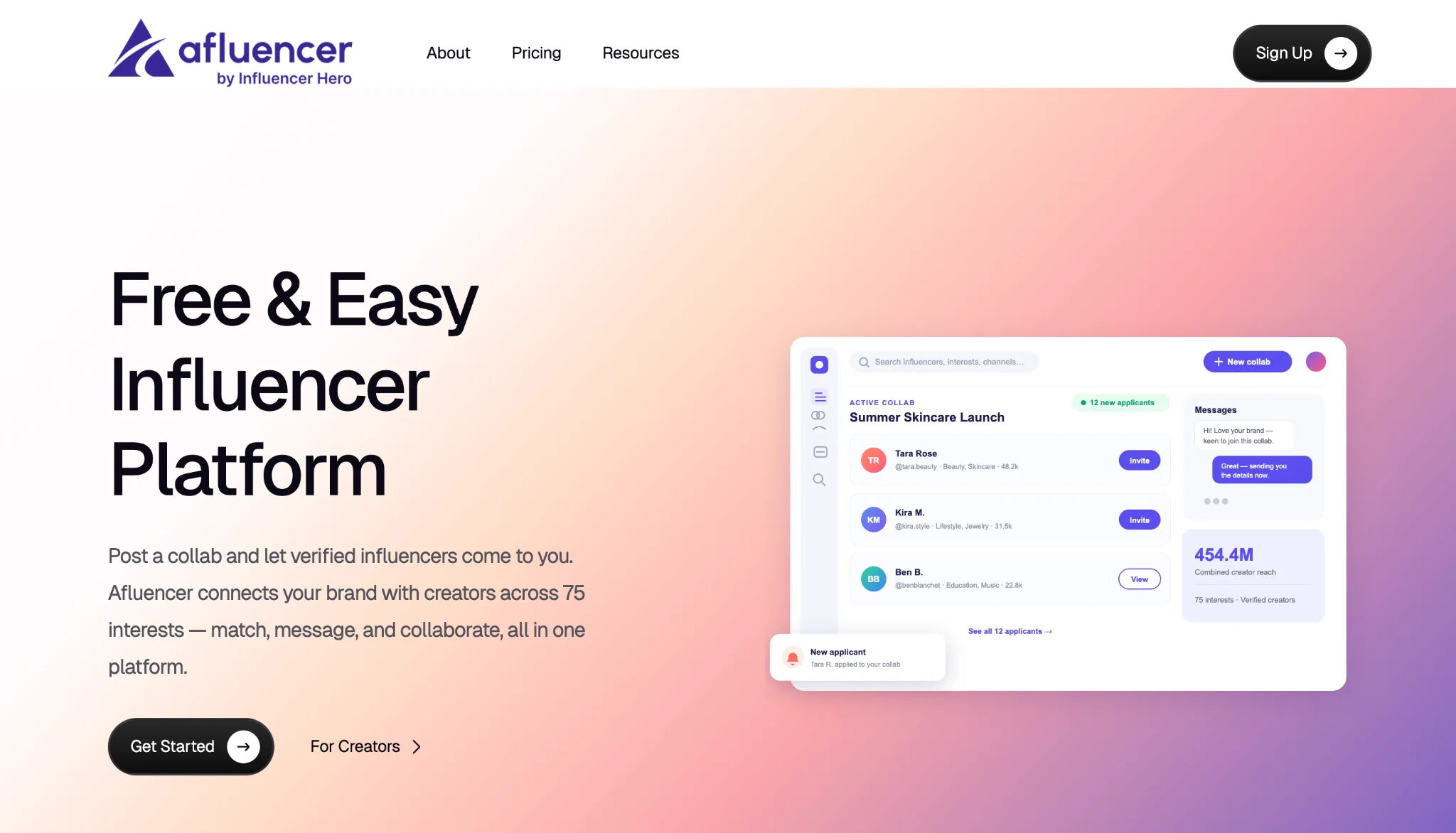
More than 7,000 brands use Afluencer, most of them SMBs and DTC teams building a first creator program without a dedicated hire. Brands post a collaboration, verified creators across 75-plus interest categories apply to it, and the whole thing runs from one dashboard. It now sits within Influencer Hero.
Key Features
- Public Collab Posts: publish what you need and let creators put themselves forward.
- Verified Categories: opt-in profiles spanning more than 75 interest areas.
- Messaging and Tracking: conversations and collaboration status in a single view.
- Commerce Integrations: more than 40, including Shopify, Klaviyo, Amazon and Slack.
- Applicant Data: audience demographics and engagement figures on every profile.
Platform Coverage
Instagram, TikTok, YouTube and X are supported.
Pricing
- Marketplace: $49/month including 60 invitation credits.
- Standard: $649/month for 1,000 reach-outs, product send-outs and influencer payments.
- Pro: $1,049/month for 5,000 reach-outs, a dedicated account manager and three or more seats.
Reviews
4.6/5.0 (G2, 738 reviews). It is the deepest review base in this comparison, covering creator-side users as well as brands.
Standout Features
- A Published $49 Entry: the cheapest transparent starting point here by a wide margin.
- Recruitment Runs Inbound: creators apply, which lifts response rates and cuts chasing.
- 738 Reviews to Read: a real evidence base for a low-cost tool.
Motom vs Afluencer
This pairing solves opposite halves of the same program, which makes it more useful than most comparisons here. Afluencer fills the roster: post a collaboration and verified creators apply, from $49 a month. Motom monetises a roster you already have, giving each creator a branded storefront on your domain with attribution down to the traffic source. Neither does the other's job at all.
On terms, the gap is stark. Afluencer publishes three prices and asks for no commitment. Motom requires a demo, a scoped proposal and six or twelve months, with affiliate network fees on top. Afluencer also includes influencer payments on its higher tiers, so a small brand can run a whole modest program there. What it cannot give you is a storefront on your own domain, which is the reason large retailers buy Motom in the first place.


IZEA

IZEA operates a two-sided marketplace where brands and creators match directly, with free accounts on both sides and paid tiers above them. It is publicly listed, sells managed services alongside the software, and its current platform is ZED, launched in March 2026 to replace the older Flex system.
Key Features
- Two-Sided Marketplace: brands and creators find each other without an account manager in the middle.
- ZED Lifecycle: plan, partner, produce, publish, promote and pay handled as one connected flow.
- Live Campaign Analytics: creator intelligence reporting that supports optimisation mid-campaign.
- FormAI: AI community tooling built into the marketplace side.
- Optional Managed Team: strategy, content studio, social commerce and performance marketing delivered by IZEA.
Platform Coverage
No explicit network list is published. TikTok recurs throughout its materials, with platform partnerships described in general terms.
Pricing
- Free: $0 for basic marketplace membership.
- Creator Pro: $9/month, with AI tiers at $23 and $47/month.
- Marketer Pro: $129/month for brand-side marketplace access.
- Managed services: quote-only, scoped by proposal.
Reviews
3.9/5.0 (G2, 32 reviews). The reviews sit against the legacy Flex product and may not describe ZED.
Standout Features
- Free to Look: you can see the marketplace before spending anything.
- Listed Company Transparency: a public filer behind the product, unusual in this category.
- Payment Inside the Flow: the ZED cycle ends in paying creators rather than exporting a list.
Motom vs IZEA
Commitment is the first thing that separates them. IZEA lets you open a free account, browse the marketplace and pay $129 a month for brand-side access, cancellable. Motom asks for a demo, a proposal and half a year minimum. For a brand that has not yet proven creators sell its product, that difference decides the shortlist on its own.
Depth of commerce is Motom's reply. IZEA's cycle ends in paying a creator for a post. Motom's begins there, with a branded shop, checkout on your own domain and revenue attributed to a creator, a product and a traffic source. IZEA's 3.9 rating is also the lowest here and its network coverage is undocumented. Test the idea on IZEA. Graduate to something shaped like Motom once creator revenue is large enough that owning the checkout pays for itself.
Later
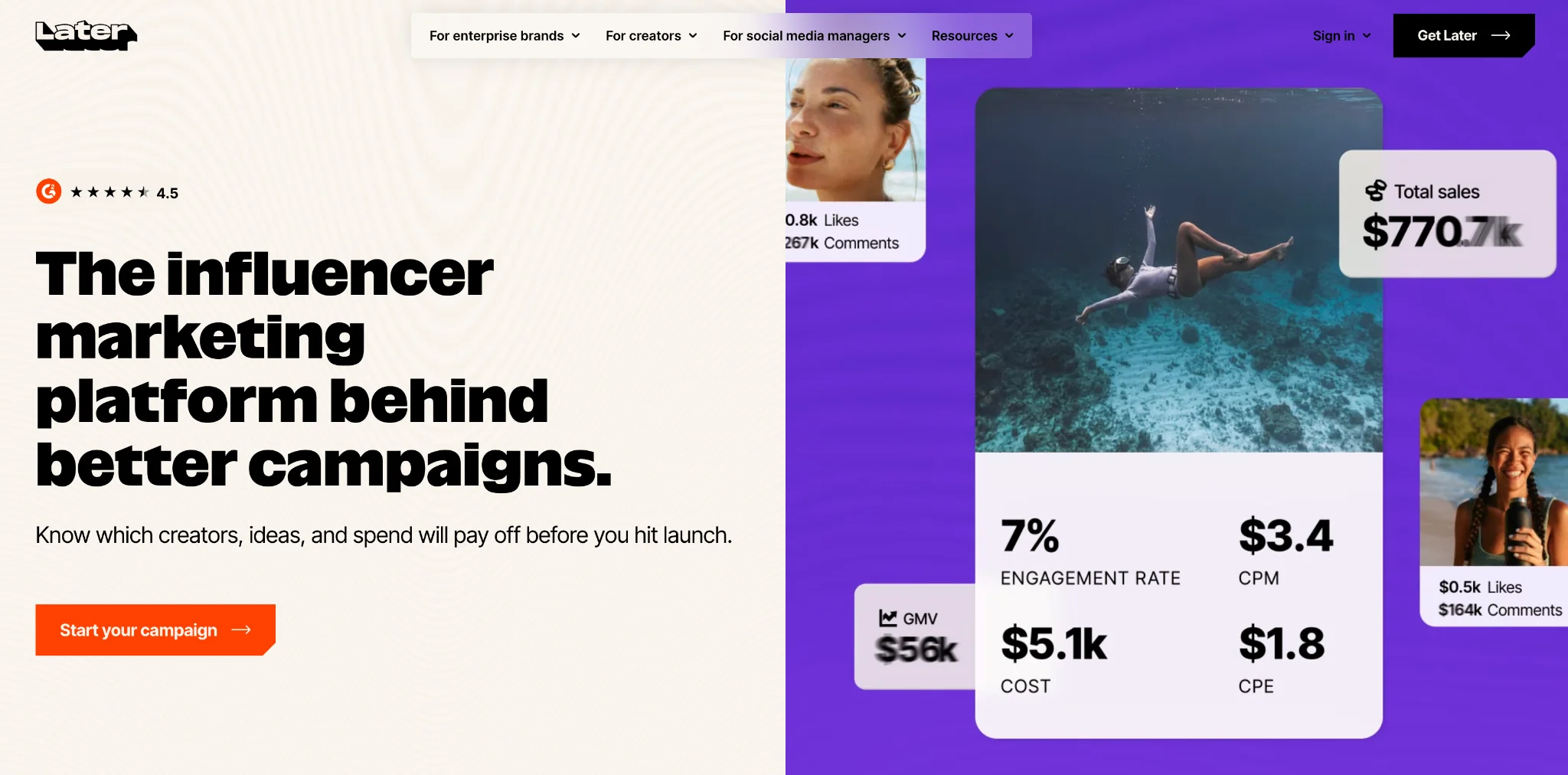
Later acquired Mavrck and now sells it as Later Influence, an enterprise creator platform used by Wayfair, Nike, Southwest, Unilever and Chewy, with an agency team available alongside. The name it shares with Later's social scheduling product causes regular confusion, since the two are sold separately and priced nothing alike.
Key Features
- Brand-Signal Search: more than 20 million creators, filtered on brand signals with risk flagged early.
- Incentive Advisor: channel-level benchmarks for what creators are typically paid.
- EdgeAI: forecasts campaign performance from historical data before budget is approved.
- Combined Metrics: paid, organic and sales reporting in one place.
- Overlap Detection: highlights shortlisted creators whose followings duplicate each other, and recommends how to redistribute budget.
Platform Coverage
No network list is published for Later Influence, though Instagram and TikTok dominate everything it publishes. The similarly named scheduling product supports the major networks, but it is sold separately.
Pricing
- Later Influence: quote-only, through a booked strategy call.
- Social media management (separate product): Starter $18.75/month, Growth $37.50/month, Scale $82.50/month, billed annually.
Reviews
4.5/5.0 (G2, 469 reviews); 4.6/5.0 (Capterra, 135 reviews under the legacy Mavrck listing)
Standout Features
- Forecast Before Commit: EdgeAI models the result while you can still change the plan.
- Rate Guidance: compensation benchmarks instead of guessing what a creator should cost.
- In-House or Outsourced: the same platform runs either way.
Motom vs Later
Attribution is where both make their case, from opposite ends. Motom traces revenue from a storefront back to a creator, a product and a traffic source after the sale. Later works before the sale, using EdgeAI to forecast results, Incentive Advisor to set the rate, and overlap detection to stop two creators being paid to reach one audience. One tells you what happened, the other tells you what is likely to happen.
Later also has the roster tools Motom lacks, with a searchable index of more than 20 million creators. Both are quote-only enterprise buys, so neither is fast to purchase. Motom's advantage is that its output is a shop rather than a report: Later can tell you a campaign worked, but it will not host the checkout on your domain or keep the purchase data with you.
Brandbassador (Club)
Brandbassador now trades as Club, with brandbassador.com redirecting to club.co. The product turns a brand's existing customers into a rewarded ambassador community, gives them tasks to complete through a branded app, and pays out automatically on what they earn. Samsung, Celsius, Daniel Wellington and Fabletics all use it.
Key Features
- Prebuilt Missions: more than 100 task templates ambassadors complete in exchange for rewards.
- Automatic Payouts: commission calculated and paid without manual reconciliation.
- Branded Portal: a white-labelled app and web experience carrying your identity.
- Segmented Push: target and notify the specific group of ambassadors you want active.
- Reviews and UGC: content collection and review generation, with a Shopify connection.
Platform Coverage
Posting missions reference Instagram and TikTok. Beyond those two, the vendor names no networks.
Pricing
- Club Hub, Club Suite and Club Universe: all quote-only, priced by active ambassadors and missions run.
Reviews
4.7/5.0 (G2, 107 reviews, listed as Club formerly Brandbassador). It is the highest score here on a credible sample.
Standout Features
- Missions Make It Repeatable: the template library turns ambassador activity into a routine.
- The App Is Yours: ambassadors experience your brand, not the vendor's.
- Recruits From Your Own Buyers: the roster comes from people who already purchased.
Motom vs Brandbassador
Both fix the roster problem by looking at people already close to the brand, but they act on different groups. Brandbassador converts your customers into ambassadors and keeps them posting with missions and rewards. Motom equips creators you have already partnered with, giving each one a branded shop that sells directly. Brandbassador answers where the people come from. Motom answers where they send the traffic.
Rating and evidence favour Brandbassador clearly, with 107 G2 reviews at 4.7 against no reliable public score for Motom. Both are quote-only, and Brandbassador's cost climbs with the number of active ambassadors, so a large community is not cheap. What Brandbassador does not offer is a storefront on your domain, which is the one thing Motom exists to provide.
Lefty
Louis Vuitton, Tommy Hilfiger, Ralph Lauren and Guerlain are Lefty's reference clients, and its product reflects them. Casting, benchmarking and gifting are all tuned to luxury, fashion and beauty programs, and its network coverage stretches into Chinese platforms that Western tools almost never support.
Key Features
- Curated Profiles: more than 30 million vetted creators, not an open-signup pool.
- Shared Casting: a CRM where a team shortlists and comments on the same campaign together.
- Competitor Analytics: performance compared against direct rivals in your category.
- Seeding at Scale: gifting workflows designed for programs sending product to many creators.
- Affiliation: affiliate tracking is live, with creator payments still listed as coming.
Platform Coverage
Instagram, TikTok, X, YouTube, Snapchat, Weibo, Douyin and Red are all covered.
Pricing
- All plans: quote-only, by demo request, with no figures published.
Reviews
4.7/5.0 (G2, 92 reviews)
Standout Features
- Chinese Platform Access: Weibo, Douyin and Red support that is genuinely rare here.
- Luxury-Tuned Casting: built for the categories where brand fit outweighs reach.
- Share-of-Voice Reporting: results read against competitors rather than only your own history.
Motom vs Lefty
Retail categories overlap almost exactly, since both sell into fashion, beauty and multi-brand retail. The split is between finding and selling. Lefty gives you 30 million vetted profiles, collaborative casting and competitor benchmarking, which is the front half Motom does not touch. Motom gives you the storefront, the checkout on your own domain and revenue attributed by traffic source, which is the back half Lefty does not have. Lefty still lists creator payments as forthcoming.
International reach is Lefty's other advantage. Weibo, Douyin and Red matter enormously for a luxury brand with Chinese customers, and Motom has nothing equivalent. Both are quote-only, and Motom's six or twelve month term is at least a defined commitment you can plan around. A brand with a full roster and no commerce layer wants Motom. A brand with a commerce layer and no roster wants Lefty.
Klear

Meltwater now owns Klear and sells it as the influencer module inside its media, social and consumer intelligence suite, with the old standalone brand retired. That packaging means it usually reaches PR and communications teams already tracking earned coverage rather than performance marketers.
Key Features
- Learning Search: more than 30 million profiles, with results improving against your brand over time.
- True Reach: reach recalculated with fraudulent and suspicious followers removed.
- Approvals and Payment: content sign-off workflows plus creator payment processing.
- Code Attribution: Shopify and WooCommerce conversions tracked through unique discount codes.
- EMV Across Markets: earned media value and ROI reporting in more than 190 countries.
Platform Coverage
There is no up-to-date list of supported networks for the module anywhere on Meltwater's site, so treat coverage as something to pin down in the demo.
Pricing
- All plans: quote-only, by demo request, with no published figures.
Reviews
4.3/5.0 (Capterra, 13 reviews). These predate the Meltwater consolidation, so there is no current standalone rating.
Standout Features
- Reach Worth Reporting: inflated followers stripped out before the number reaches a slide.
- Sits Beside PR Data: creator results in the same suite as media monitoring.
- Genuinely Global: measurement across 190-plus countries with multi-language search.
Motom vs Klear
Sales attribution exists in both, and comparing the two versions is instructive. Klear tracks conversions through unique discount codes on Shopify and WooCommerce, which works but stops at the code. Motom hosts the storefront itself, so it sees views, clicks, products and traffic source, not just the redemption. For a retailer trying to work out which creators drive revenue and how, that resolution is a real difference.
Klear covers ground Motom does not, though. It searches 30 million profiles, screens audiences with True Reach and reports across 190-plus countries, so the discovery and measurement halves are handled. Both are quote-only and neither has a current public rating worth much. The practical read: Klear if you need to find creators and value their coverage, Motom if you need those creators to sell.
Final Thoughts on Motom Alternatives
The question is not really whether Motom is good, because for what it does it is. The question is what sits either side of it. If the missing piece is the roster, Influencer Hero handles discovery, outreach, gifting, storefronts and payouts on published monthly plans, and Afluencer fills the same gap from $49 if the budget is tight. If the missing piece is measurement across earned media and multiple markets, Klear and Lefty both go further than Anchor was built to. If the objection is the commitment itself, IZEA is free to open and $129 a month to use properly, which is a cheaper way to find out whether creators sell your product before anyone signs for six months. And if you already know they do, and revenue is running through affiliate links you do not control, owning that storefront is worth what Motom charges for it.