

Peg.co Alternatives: Best Influencer Marketing Platforms
Peg sold one idea harder than anyone else in the category: that a creator should be judged on what they actually say on camera, not on how many people follow them. A safety score built from scanning their content, a meter tracking public sentiment turning against them, a record of every brand they had already worked with — for an agency pitching a cautious client, that was a better argument than a bigger database.
The reason to search for Peg.co alternatives now is more basic than any feature gap. Current acquired the Peg platform in 2021 and it is no longer sold as a standalone product, so this is a replacement decision rather than a comparison. Even at full strength the scope was tight — roughly 33,000 creators, YouTube first with Instagram added later, TikTok never — and buying it meant a custom quote on a six- or twelve-month term plus a 5% finder's fee on any creator it introduced. The influencer marketing software below is ordered by how much of Peg's vetting instinct each option carries into something a brand can buy today. Influencer Hero leads because it pairs authenticity checking with the entire program around it, Traackr and Kolsquare are where brand safety and compliance became enterprise disciplines, Modash and Influencity answer the audience-quality question at very different prices, GRIN and Upfluence bring the campaign and commerce layer Peg never had, and Afluencer, Heepsy and SARAL cover the lower-cost and workflow-first ends of the same problem.
Criteria for Suggesting Platform Alternatives
Core Features
Evaluation of each platform's essential capabilities, including influencer discovery, outreach, CRM, campaign reporting, gifting, UGC and content collection, affiliate tracking and payments, storefronts, application pages, and AI-powered tools.
Supported Social Media Platforms
Assessment of how well each platform integrates with major social networks such as Instagram, YouTube, TikTok, Facebook, Pinterest, and many more
Pricing & Contract Flexibility
Comparison of pricing models, subscription costs, and contract requirements to help brands choose solutions that match their budget and scalability needs.
Standout & Differentiating Features
Highlighting unique or innovative functionalities that set each platform apart, such as real-time tracking dashboards, creator benchmarking, TikTok email discovery, or advanced automation tools.
Customer Reviews & User Satisfaction
Analysis of verified user feedback from credible platforms like G2, TrustRadius, Capterra, focusing on usability, reliability, value for money, customer support, and real-world performance.
Peg.co Overview
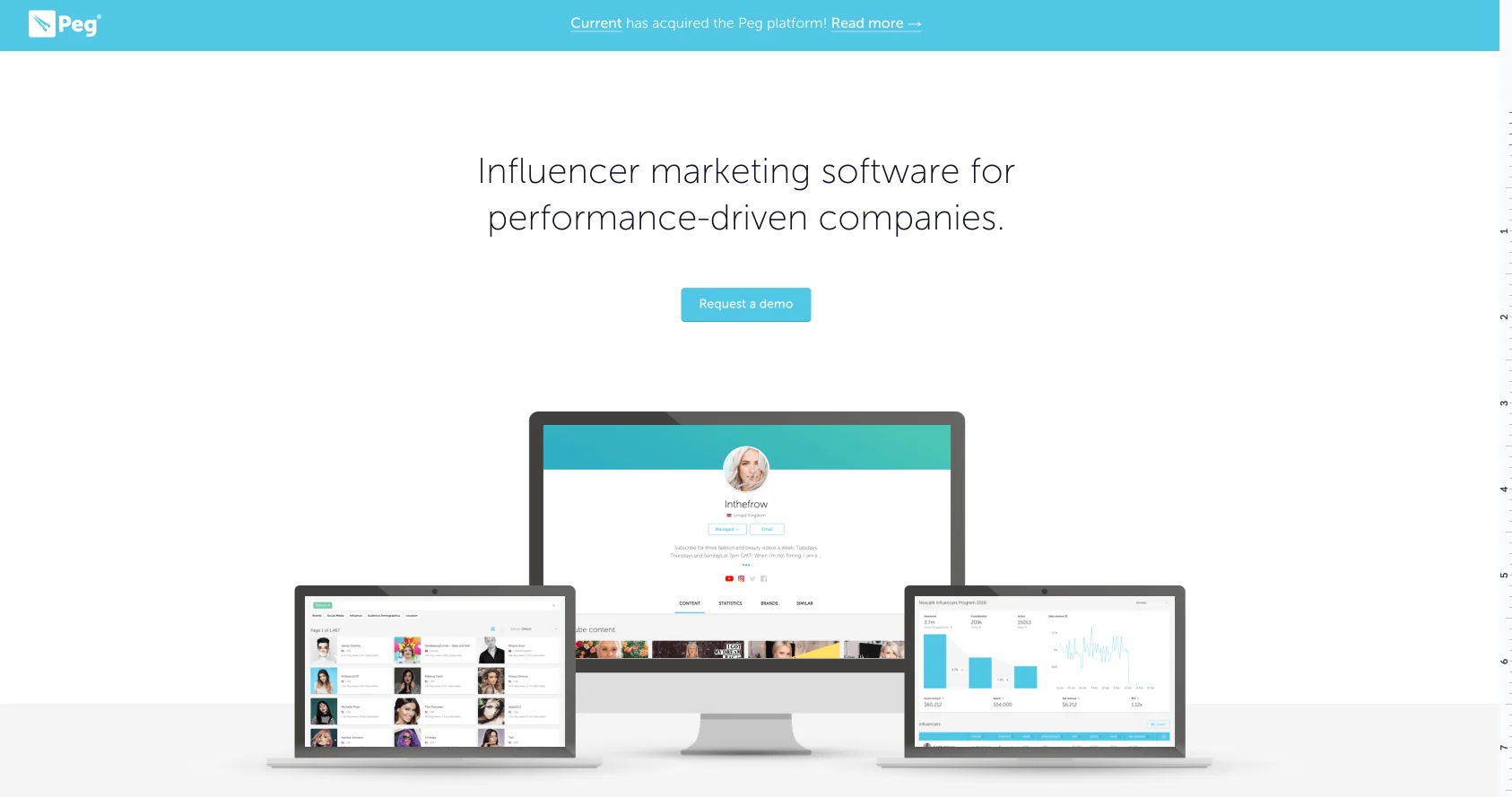
Peg.co was a London-built influencer marketing platform for brands and agencies that made its name vetting video creators rather than simply listing them. It launched covering YouTube and later added Instagram, sourcing much of its roster through talent-agency partnerships instead of open sign-ups, which kept the database small and the quality predictable. Current acquired the platform in 2021, so the description here reflects the product as it last operated rather than something available to buy.
Key Features
- Curated Creator Search: keyword and filter-based discovery across YouTube and Instagram, narrowed by audience demographics, brand affinity and engagement.
- Safety Score: a proprietary brand-safety rating generated by scanning what a creator actually published for risk and family-friendliness.
- Language Tracking: the specific vocabulary a creator used on camera surfaced so a brand could judge tone fit before booking.
- Backlash Meter: public sentiment toward a creator tracked over time, flagging anyone in the middle of a controversy.
- Collaboration History: the brands a creator had already worked with, which caught competitor conflicts before they became client problems.
- Shortlists and Pitch Decks: shared shortlists, team notes and generated decks for sign-off, built around how agencies actually present work.
- Conversion Tracking: campaign reporting with Google Analytics, Shopify, AppsFlyer and Adjust integrations for sales and install attribution.
Platform Coverage
YouTube and Instagram for creator search, with supplementary profile data from Facebook and X. TikTok was never supported.
Pricing
- Brand Subscriptions: custom-quoted, with no public rate card at any point in the product's life.
- Commitment: six- or twelve-month minimum terms, with a custom-priced single-project option for brands testing it.
- Finder's Fee: 5% charged when Peg recommended a creator who went on to sign a deal.
- Creator Access: free for influencers and talent managers, without the paid feature set.
Reviews
No reliable public user rating exists. Peg.co never held a listing on the major software review sites, and the scores that circulate are editorial assessments rather than verified customer feedback, so they should not be read as a satisfaction signal.
Standout Features
- Vetting at Content Level: creators assessed on what they said and how they behaved rather than on audience size alone.
- A Deliberately Small Database: a talent-agency-sourced pool that traded breadth for reliability, which was the point rather than a shortcoming.
- Agency-Shaped Workflow: shortlists, notes and client-ready decks assumed somebody had to sell the recommendation internally.
Limitations (Why Users Look For Peg.co Alternatives)
It is no longer sold as its own product
Current acquired the Peg platform in 2021 and the standalone service stopped being independently operated. Anyone evaluating it today is looking at a brand that no longer takes new customers, which makes every other limitation academic.
Discovery stopped at two networks
Search covered YouTube and Instagram and never extended to TikTok, so an entire generation of short-form creators sat outside the tool. A brand whose category lives on TikTok could not run its main channel through the platform at all.
The creator pool was small by design
Roughly 33,000 vetted profiles bought consistency at the cost of reach. Filling a campaign in a narrow niche, a smaller market or a language the roster did not cover meant sourcing elsewhere and importing the results.
Buying it meant a quote, a year and a cut
Nothing was published, terms ran six or twelve months, and a 5% finder's fee applied to creators the platform introduced. That combination made short tests expensive and put the real cost of the channel out of view until a sales conversation had happened.
There was no commerce layer
Product seeding at scale, affiliate links and discount codes, creator storefronts, inbound application pages and automated payouts were all outside the scope. Vetting was excellent; converting a vetted creator into tracked revenue was somebody else's job.
10 Best Influencer Marketing Platform Alternatives:
| TOOL | REVIEWS | BEST FOR | TRIAL INFO | PRICING | ||
|---|---|---|---|---|---|---|
1 |

|
⭐ | Influencer CRM & automation | Book Demo | Pricing | Website |
2 |

|
⭐ | DTC creator management | Book Demo | Pricing | Website |
3 |

|
⭐ | Influencer marketplace campaigns | Book Demo | Pricing | Website |
4 |

|
⭐ | Campaign management | Book Demo | Pricing | Website |
5 |

|
⭐ | Influencer discovery | Book Demo | Pricing | Website |
6 |

|
⭐ | Influencer discovery | Book Demo | Pricing | Website |
7 |

|
⭐ | Influencer outreach | Book Demo | Pricing | Website |
8 |

|
⭐ | Enterprise influencer analytics | Book Demo | Pricing | Website |
9 |

|
⭐ | Influencer discovery | Book Demo | Pricing | Website |
10 |

|
⭐ | Data-driven influencer discovery & campaign analytics | Book Demo | Pricing | Website |
Influencer Hero

Influencer Hero treats vetting as the first step of a much longer process rather than the product itself. Fake-follower detection and audience quality scoring sit at the front of a system that also handles outreach, a creator CRM, product seeding tied to the store, affiliate tracking and payouts. It serves D2C and ecommerce brands, agencies running several accounts and enterprise programs, and it publishes its prices rather than quoting them.
Key Features
- Discovery Across Eight Networks: filter by interests, engagement, demographics, location and follower quality, then extend a shortlist with lookalike suggestions and brand-follower detection.
- Authenticity Checks First: fake-follower detection and audience quality scoring before anyone is contacted, with a Chrome extension surfacing the same data while browsing a profile.
- AI Matching to a Goal: candidate lists assembled from a campaign objective written in plain language.
- Outreach as a Process: bulk or one-to-one email, AI-personalized templates, drip sequences and reply tracking.
- Creator CRM: relationship boards holding conversations, campaign stage and deliverables against each partner.
- Seeding From the Store: Shopify and WooCommerce auto-fulfillment with shipping and delivery tracking, plus script support for custom builds.
- Affiliate Tracking and Payouts: custom links, discount codes, commission and conversion tracking, with creator payments triggered automatically.
- UGC, Storefronts and Application Pages: published content collected and tagged for reuse, branded creator storefronts, and inbound application pages.
- Integrations and API: DocuSign, GoAffPro, Klaviyo, Slack, Zapier and hundreds more, with API access to millions of creator profiles.
Platform Coverage
Instagram, TikTok, YouTube, Facebook, Pinterest, Snapchat, X and Twitch.
Pricing
- Standard: $649/month for up to 1,000 creators or contacts.
- Pro: $1,049/month, raising that to 5,000.
- Business: $2,490/month, raising it to 10,000.
- Custom and Agency: tailored scopes for enterprise programs and agencies handling several brands.
Reviews
5.0/5.0 (Capterra)
Standout Features
- A Price You Can Read Before Calling: the whole rate card is public, which is the opposite of how Peg was sold.
- Vetting That Leads Somewhere: the profile a brand screened is the same record it later ships to, tracks and pays.
- Scale Without Headcount: bulk actions put product with hundreds of creators under one manager, each shipment chased on its own timeline.
Peg.co vs Influencer Hero
Peg's value was a judgment call made before any money moved, and influencer search here reaches the same conclusion by a different route — audience authenticity, follower quality and demographic composition, applied across eight networks rather than two, with TikTok included. What it will not do is read a creator's transcript and score the language, which was Peg's specific trick; the check is quantitative rather than editorial. For most consumer brands that is the trade they would make anyway, since audience fraud costs more campaigns than an ill-judged phrase does.
Everything after the shortlist is where the gap becomes obvious. Peg handed a vetted name to a team that then had to negotiate, ship, track and pay elsewhere. Influencer Hero runs the sequence in one system and ends it with a tracked commission and a downloadable piece of content, and it does so on published pricing with no minimum term and no finder's fee on creators it introduces. The honest counterweights are that it asks for an operator, carries a real learning curve, and offers no free trial to soften the first month.
GRIN
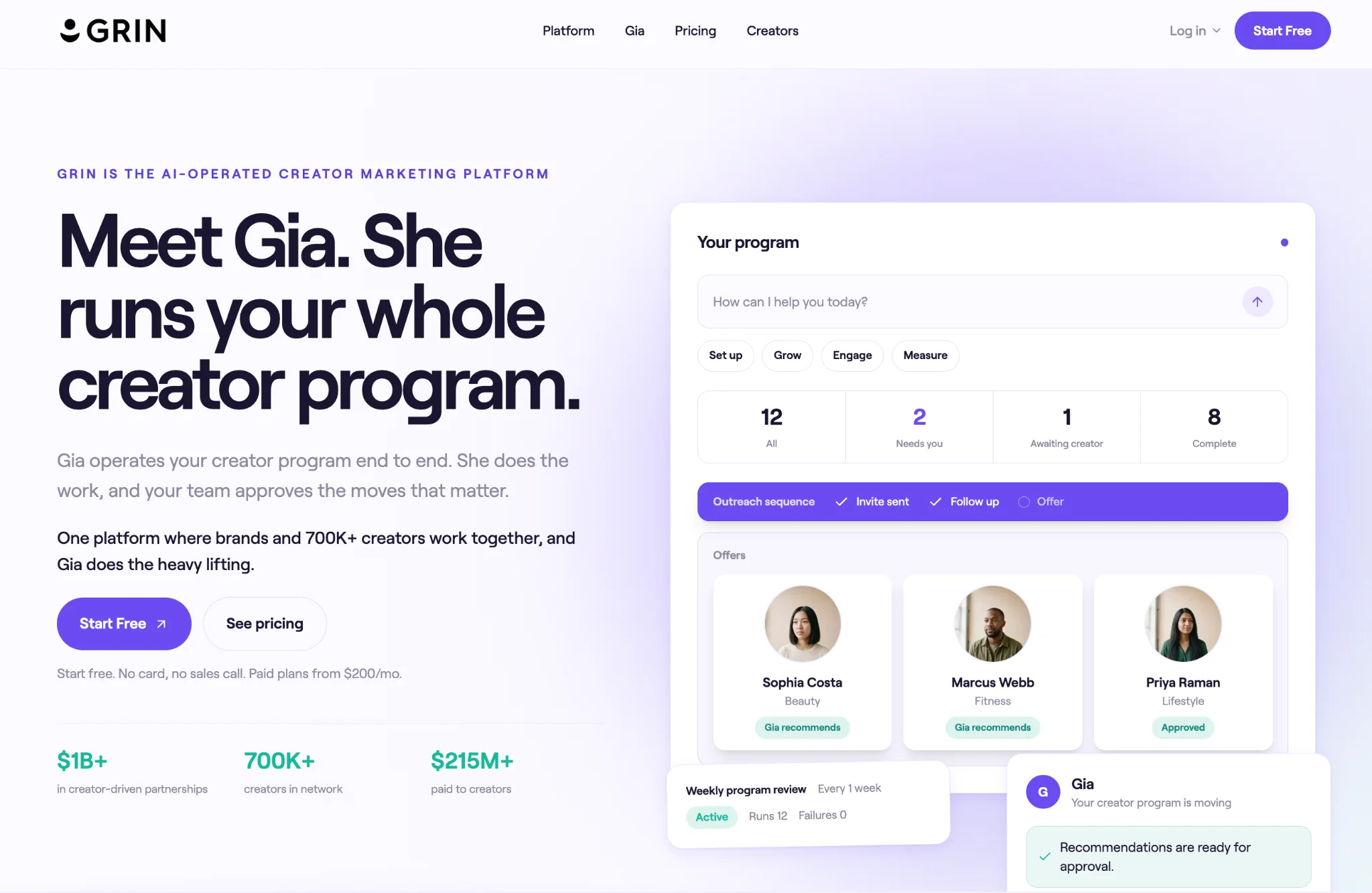
GRIN builds for consumer brands that treat creators as ongoing relationships rather than media buys, and it prices the way modern software should — published plans, usage metered in credits and a free tier with no expiry. An AI agent absorbs the repetitive end of discovery, outreach drafting and reporting, with a person approving what it produces.
Key Features
- Two Routes to a Roster: AI matching inside GRIN's creator network plus web-wide search and branded recruitment landing pages.
- The Complete Partner File: contract, shipment, message thread and published content held against each creator.
- Store Sync: Shopify, WooCommerce and Magento connections that mint codes and fulfill creator orders automatically.
- Commissions Kept Whole: creator-driven sales tracked and settled with no percentage taken by the platform.
- Reviews on a Schedule: customizable reports plus recurring automated program reviews.
Platform Coverage
Instagram, TikTok and YouTube, backed by ecommerce, email and communication integrations.
Pricing
- Free: $0/month with 200 credits and no card required.
- Starter: $200/month for 2,000 credits.
- Growth: $500/month for 7,500 credits and up to 100 active creators.
- Scale: $1,000/month for 20,000 credits and up to 250 active creators.
- Complete: $1,500/month for 30,000 credits and up to 500 active creators.
Reviews
4.5/5.0 (G2)
Standout Features
- A Bill That Cannot Surprise You: credit spend is capped by the brand and never billed above the ceiling it sets.
- A Free Tier With No Clock: the zero-dollar plan does not expire, so evaluation takes as long as it needs.
- An Agent That Executes: discovery, outreach and reporting are carried out rather than merely recommended.
Peg.co vs GRIN
The contrast worth drawing is commercial rather than technical. Peg cost a quote, a minimum term and 5% of any deal it introduced. GRIN publishes five tiers starting at zero, caps spend at a ceiling the brand sets, and takes no cut of creator-driven revenue at any level — which for a brand that once paid a finder's fee on every successful match is a structurally different relationship with the vendor.
On vetting GRIN is thinner. There is no safety score, no sentiment tracking and no content-level read, so brand-risk screening falls back to manual review or a second tool. What it adds instead is everything Peg deliberately left out: contracts, shipments, discount codes fulfilled from Shopify, WooCommerce or Magento, and a creator file that holds the whole history. Agencies that liked Peg for the pitch-deck workflow will find the reporting side familiar; those that liked it for the safety score will not find a replacement here.
Afluencer
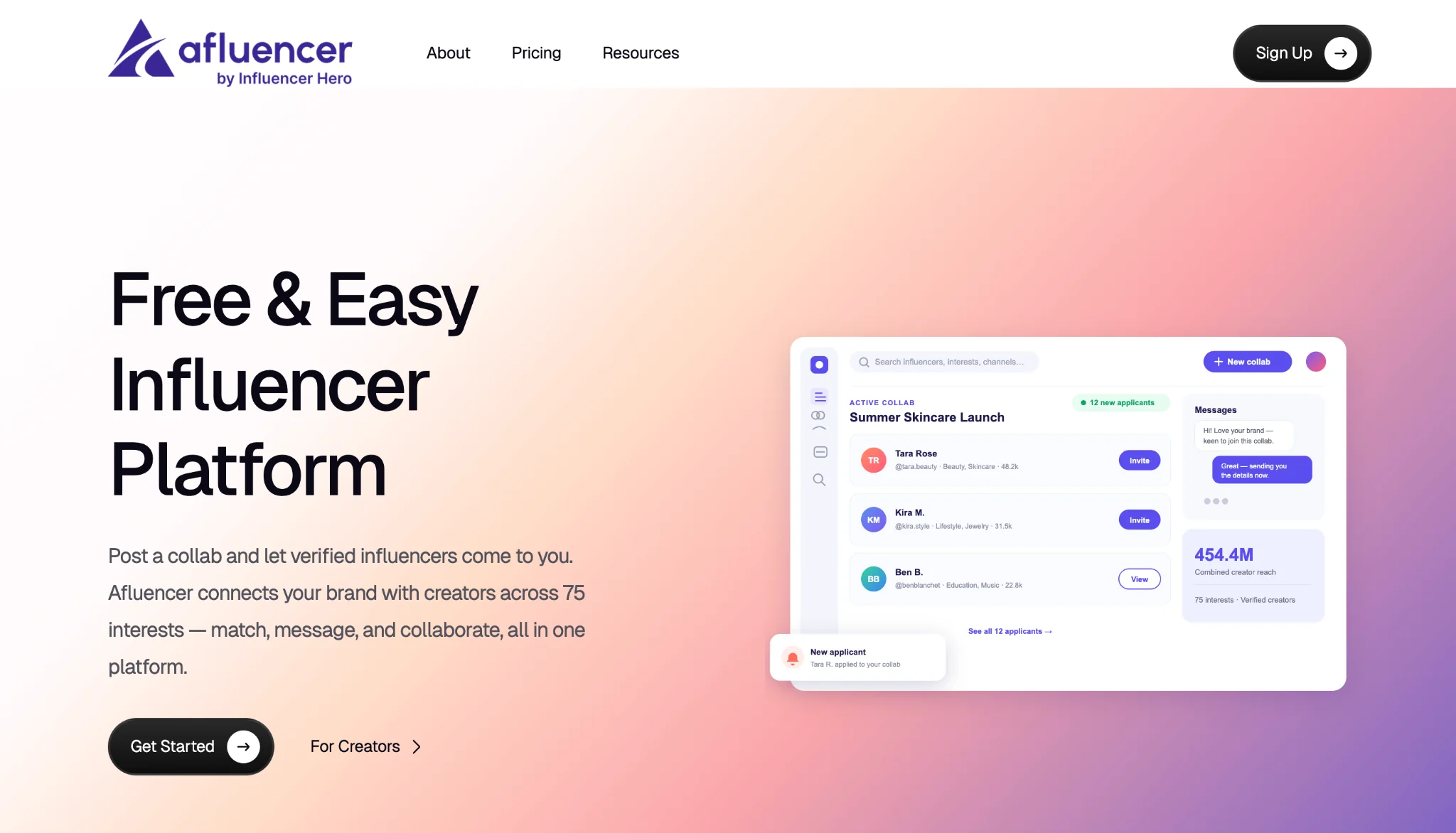
Afluencer turns recruitment around. Instead of building a list and emailing it cold, a brand publishes a collaboration brief into a marketplace and opted-in creators apply, so the first conversation happens with somebody who already read the offer. It is also the cheapest entry point here, with a working free tier and direct invitations from $49 a month.
Key Features
- Published Collab Briefs: campaign details go live in the marketplace and matching creators apply to them.
- Verified Creator Directory: searchable profiles filtered by platform, follower count, niche and audience demographics.
- Monthly Invite Credits: allocations for approaching named creators directly, scaling with the plan.
- Deals Handled In-App: conversations, product send-outs and creator payments settled inside the dashboard.
- Forty-Plus Integrations: Shopify, Klaviyo, Amazon, Slack and DocuSign among them.
Platform Coverage
Instagram, TikTok, YouTube and X.
Pricing
- Free: $0/month to publish collabs and receive creator applications.
- Marketplace: $49/month for 60 invitation credits and premium filters.
- Standard: $649/month covering 1,000 reach-outs, product send-outs and creator payments.
- Pro: $1,049/month covering 5,000 reach-outs, three or more seats and a dedicated account manager.
Reviews
4.6/5.0 (G2)
Standout Features
- Consent Before Contact: every applicant has read the brief, which is why reply rates beat cold outreach.
- A First Campaign That Costs Nothing: an entire collaboration can run before any money changes hands.
- Named Invites at $49: proactive outreach at a price point this category rarely offers.
Peg.co vs Afluencer
Both work from a curated pool rather than the open internet, and both put a human filter between a brand and a random follower count — but the filter points in opposite directions. Peg vetted creators on the brand's behalf and charged accordingly. Afluencer lets creators self-select into a brief and then leaves the judgment to the brand, which costs nothing to try and puts the marketer in every conversation from the first message.
The trade is depth of screening. There is no safety score, no sentiment history and no record of which competitors a creator has already promoted, so due diligence stays manual. Against that, four networks including TikTok, a free tier that runs a real campaign, and $49 a month for direct invitations make it the least expensive way to rebuild a roster after losing a tool. For a small brand that used Peg for a project or two, this plus a cheap vetting tool covers most of what disappeared.
Influencity

One Influencity subscription covers three products: creator campaigns, social publishing and listening. Its buyers are brands, ecommerce teams and agencies handling multiple accounts, and its centre of gravity is analysis — an index of hundreds of millions of profiles filtered on who is actually watching rather than how many.
Key Features
- Audience-First Search: hundreds of millions of profiles queried through twenty-plus filters covering audience, authenticity and performance.
- Lists That Survive: segmented creator lists carry between campaigns, so a shortlist is assembled once.
- Briefing Through Reporting: casting, negotiation, content validation and reporting in one continuous flow.
- Metered Email Automation: automated sequences with a monthly send allowance per plan.
- Payouts in 180+ Countries: multi-currency creator payments processed in-platform.
Platform Coverage
Instagram, TikTok, YouTube and Twitch.
Pricing
- Basic, Professional, Business and Custom: four tiers assembled in an in-app calculator from seats and usage, with no fixed figures published.
- Trial: seven days free before any commitment.
- Annual Terms: a discount applies to yearly billing.
Reviews
4.5/5.0 (G2)
Standout Features
- Who, Not How Many: audience composition and authenticity describe the people behind a follower count.
- Three Jobs, One Invoice: creator campaigns, scheduling, the social inbox and listening on a single bill.
- Approvals Inside the Campaign: content validation is a built-in stage rather than an email thread running beside it.
Peg.co vs Influencity
Content validation is the feature that will matter most to a former Peg user. Approving what a creator plans to publish before it goes live is a structured stage here rather than a chase, which is the closest anything in this comparison comes to Peg's habit of catching a problem before it became one. Around it sits audience analysis at a scale Peg never attempted, across four networks including TikTok and Twitch.
The gap is editorial judgment. Influencity tells a brand who a creator's followers are and whether they are real; it does not read the content or track sentiment turning against someone. Pricing is also assembled in a calculator rather than published, so a budget still needs a session with the tool. Agencies get the most from it, since the seat and usage model is designed for running several clients from one login — the workflow Peg's shortlists and pitch decks were built to serve.


Upfluence
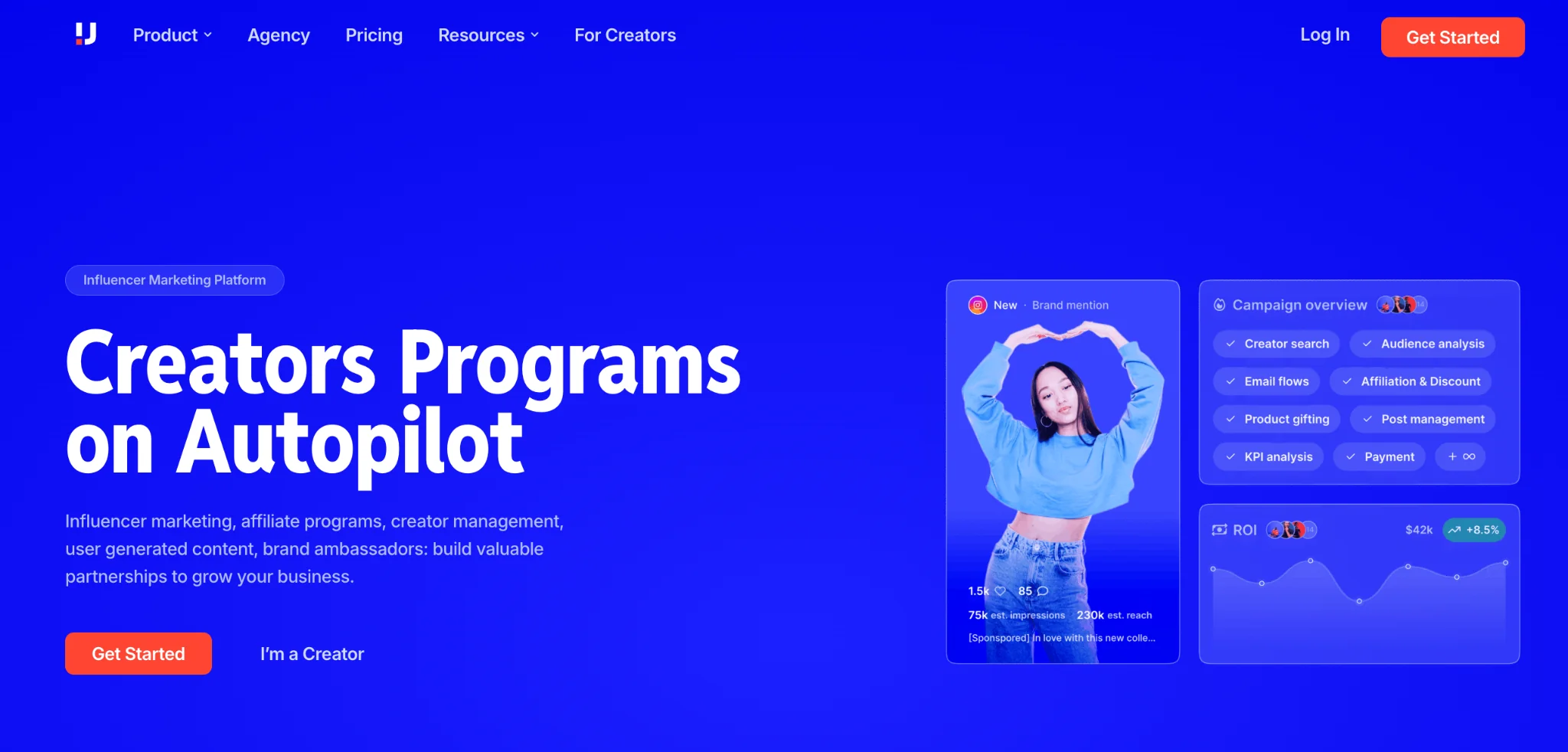
Upfluence merges influencer and affiliate management into one product for D2C and ecommerce brands, with an AI copilot handling shortlisting, campaign setup and the first draft of outreach. Its most distinctive move is reading connected store and email data to surface creators who are already customers, and it reaches more social networks and more ecommerce platforms than most tools here.
Key Features
- Fourteen Million Profiles: a creator index searchable by network and audience criteria.
- Copilot Work: shortlists, campaign recommendations and outreach drafts produced automatically.
- Customers With Audiences: connected store and email data reveals existing buyers who happen to carry reach.
- Sales Traced to the Creator: attribution through Shopify, WooCommerce, Magento, BigCommerce and Amazon.
- International Payouts: creator payments abroad with tax verification handled in-platform.
Platform Coverage
Instagram, TikTok, YouTube, Twitch, Pinterest and X.
Pricing
- Three Modular Packages: unpriced bundles covering discovery, program scaling and full automation.
- Priced on Modules, Seats and Volume: with no share of tracked creator revenue taken by the platform.
- Quote Only: nothing published, a twelve-month minimum term and a trial that follows a consultation call.
Reviews
4.6/5.0 (G2)
Standout Features
- Partners Who Already Buy: creators recruited from the order book need no convincing about the product.
- Networks Past the Big Three: Twitch, Pinterest and X reach categories the usual trio misses.
- Growth That Does Not Inflate the Fee: a larger affiliate channel costs nothing extra in platform terms.
Peg.co vs Upfluence
The buying process will feel familiar in the worst way: quoted pricing, a twelve-month minimum and a trial that only starts after a call. What differs is what sits at the end of the year. Peg delivered vetted names; Upfluence delivers a roster, an affiliate program, revenue attribution across five ecommerce platforms and payouts with tax verification handled, all owned by the brand rather than rented from a vendor.
The recruitment angle is the genuine upgrade. Finding creators inside the existing customer base solves the brand-fit problem from a completely different direction than a safety score does — somebody who already buys the product is unlikely to be a tonal mismatch, and needs no persuading. Vetting proper is lighter than Peg's, and there is no sentiment monitoring, so a brand in a genuinely reputation-sensitive category should treat this as the commerce layer and put the screening somewhere else.
Modash
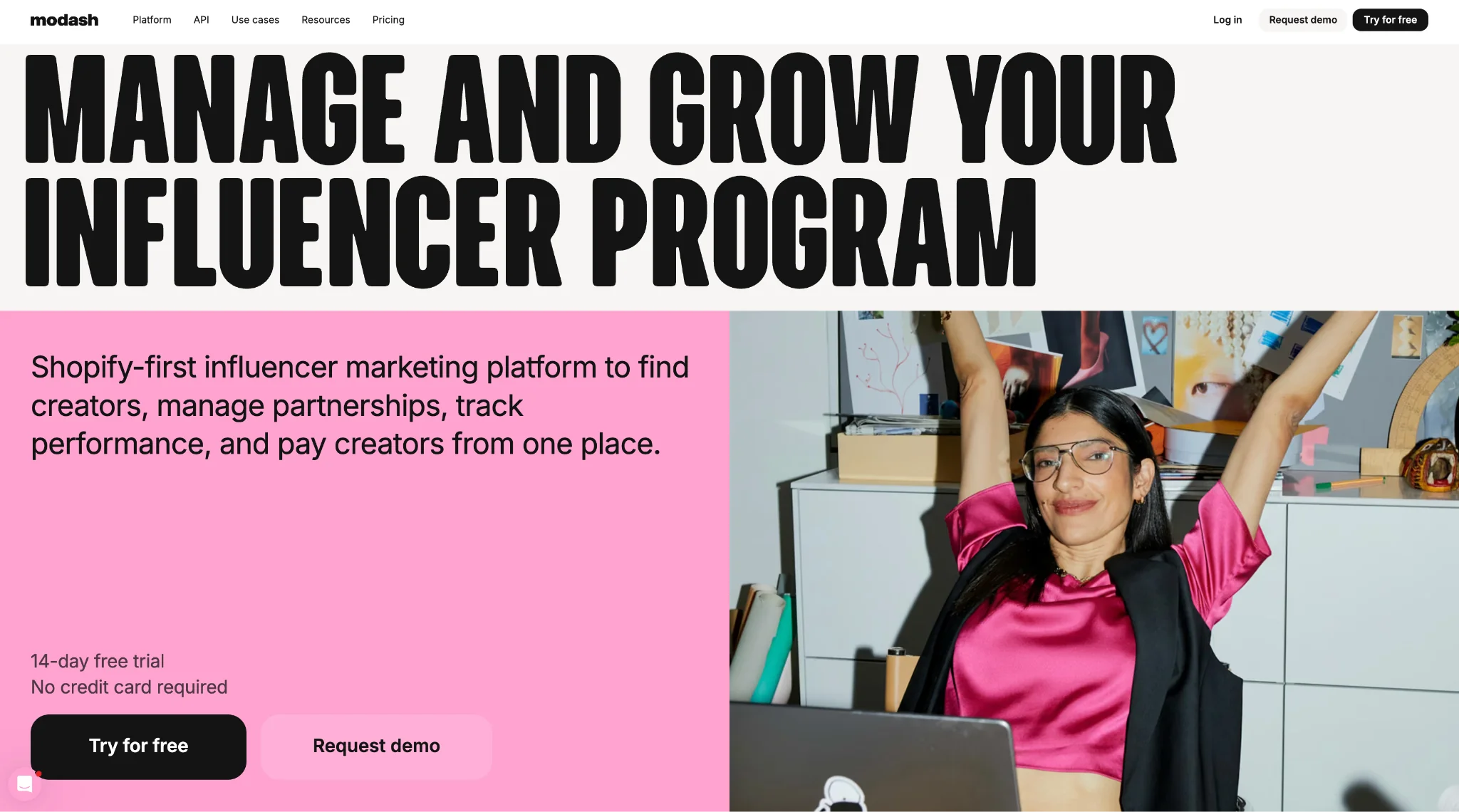
Modash exists so that nothing gets missed. Every public profile above 1,000 followers on Instagram, TikTok and YouTube sits in its index, and campaign content is collected without the creator opting in or connecting an account. Vetting, a light CRM, outreach and payment tools have grown around that core for in-house ecommerce teams.
Key Features
- Everyone Above 1,000 Followers: AI-assisted search across more than 350 million profiles, each carrying audience analytics.
- Vetting Before Contact: demographic breakdowns and fake-follower detection available before a first message goes out.
- A CRM With No Setup: contacts, notes, collaboration history and per-creator performance without a configuration project.
- Outreach From Your Own Inbox: Gmail or Outlook sending with campaign context carried into the thread.
- Content Logged Automatically: stories, posts and metrics captured with no creator participation required.
Platform Coverage
Instagram, TikTok and YouTube, with every public profile above 1,000 followers included on all three.
Pricing
- Essentials: $199/month — two seats, 300 opened profiles, 150 email unlocks, 100 tracked creators.
- Performance: $499/month — five seats, 800 opened profiles, 400 email unlocks, 250 tracked creators.
- Enterprise: from $14,700/year with negotiated limits and custom tracking domains.
- Terms: fourteen days free, a discount for annual billing and no lock-in.
Reviews
4.9/5.0 (G2)
Standout Features
- No Feature Paywalls: plans differ by volume alone, so nothing useful is reserved for larger contracts.
- Stories Captured For You: the format that disappears in a day is recorded without chasing screenshots.
- No Opt-In Wall: results never depend on a creator having joined a network first.
Peg.co vs Modash
These two sit at opposite ends of the same argument. Peg curated 33,000 creators and told a brand which ones were safe. Modash indexes every public profile above 1,000 followers on three networks and hands the brand the evidence to decide for itself — audience country, age band, engagement quality, follower authenticity, all visible before a message is sent. Curation versus transparency, and for a category Peg's roster never covered, transparency wins by default.
TikTok is the practical dividing line. Peg never supported it; Modash treats it as a first-class network with the same completeness rule as the other two. Pricing is the other: $199 a month, published, cancellable, with fourteen days free, against a custom quote on a twelve-month term. What Modash does not do is judge tone or track sentiment, so a brand that specifically needs the editorial read Peg gave should pair it with something like Traackr or Kolsquare rather than expect it here.
SARAL
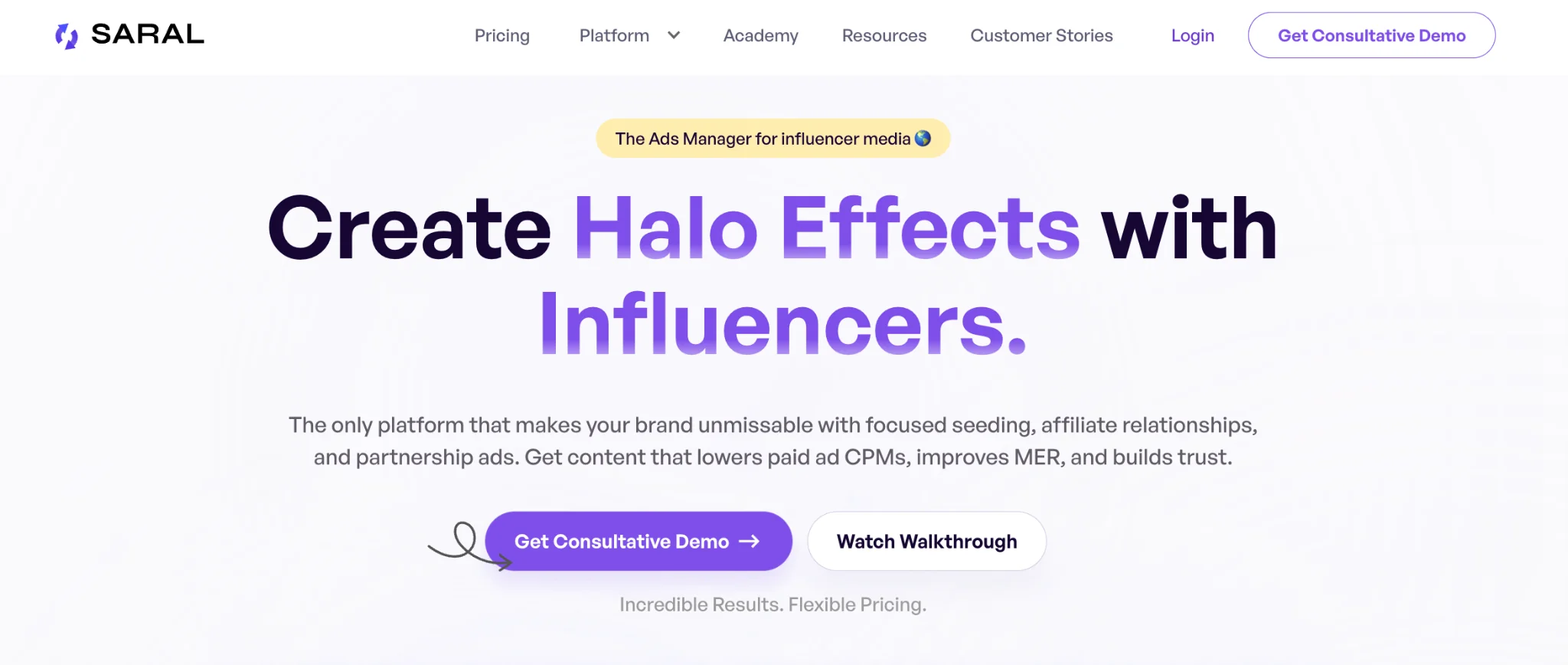
SARAL narrows on purpose: one buyer, the D2C ecommerce brand, and one user, the person running its creator program. A single annual subscription bundles discovery, outreach automation, a pipeline CRM, affiliate tracking and payouts, with an AI assistant absorbing much of the prospecting and follow-up.
Key Features
- 200 Million Profiles, Filtered Hard: sort by topic, location, engagement, audience data and whether a contactable email exists.
- Sequences Into One Inbox: personalized outreach at volume with every conversation visible to the team.
- Pipeline CRM: stages, tasks and history moving each partnership forward with its record attached.
- Cookieless Affiliate Tracking: native attribution, discount codes, commission calculation and payouts.
- Mentions Found Automatically: brand mentions detected and content collected for reporting and usage rights.
Platform Coverage
Instagram, TikTok and YouTube, extended by a Chrome extension usable while browsing profiles.
Pricing
- Starter: $12,000/year — 100 active partnerships, 300 new influencers a month, one seat.
- Business: $15,000/year — 500 active partnerships, unlimited post tracking, three seats.
- Professional: $25,000/year — 1,000 active partnerships, full social listening, ten seats.
- Terms: quarterly billing is possible at a higher effective rate, with no long lock-in.
Reviews
4.8/5.0 (G2)
Standout Features
- Opinionated By Design: serving one buyer type lets the workflow be prescribed rather than configured from scratch.
- Capture From the Browser: one click saves a creator profile while the manager is already looking at it.
- Commissions Included: affiliate tracking ships inside the subscription instead of arriving as a second bill.
Peg.co vs SARAL
Budget-wise these two finally look alike, which makes the comparison clean. Both ask for an annual commitment in the same broad range, and both assume somebody is running the program full time. The difference is what the year buys: Peg bought judgment about creators, SARAL buys throughput — 200 million searchable profiles, sequenced outreach and a pipeline that remembers what was agreed last quarter, ending in tracked commissions and automated payouts.
Vetting is the weak side. Filters cover audience data and engagement but stop short of content-level screening or sentiment history, so a brand with genuine reputational exposure needs a second opinion from somewhere. Social listening on the top tier partly covers the sentiment gap, though it is a category-monitoring tool rather than a per-creator backlash meter. For an agency that used Peg's shortlists to keep clients organised, SARAL's pipeline is the closer successor; for one that used its safety score, it is not.
Traackr
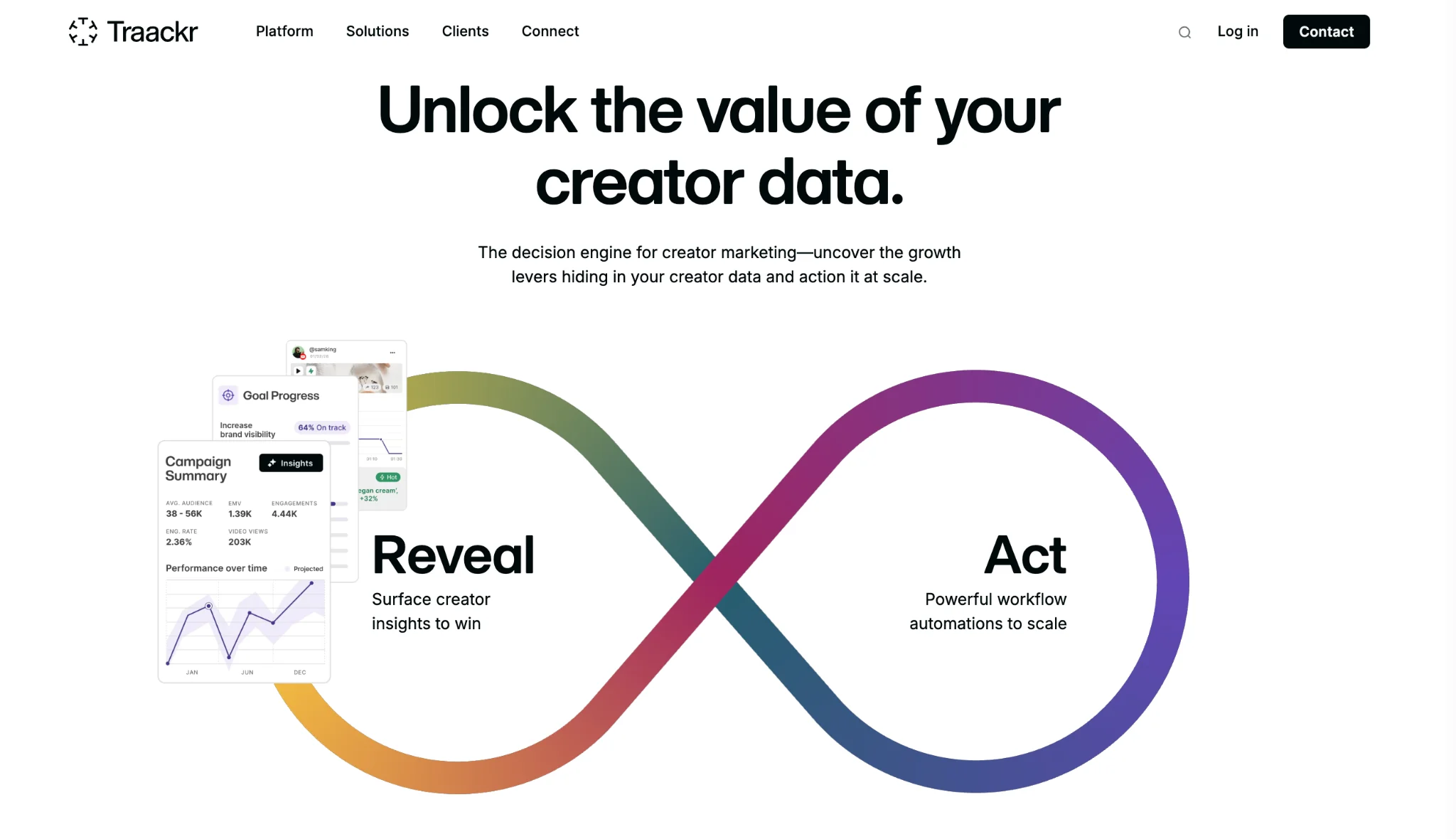
Traackr is where brand safety grew into an enterprise discipline. Global brands and their agencies use it to plan, activate and measure creator programs market by market, with governance, permissions and comparable measurement taking priority over self-serve convenience. Few platforms in the category have run at this scale for as long.
Key Features
- Search With Guardrails: discovery narrowed by brand safety, brand affinity, performance and the quality of the audience behind the numbers.
- Permissioned Creator Records: central files with configurable workflows and access rules across brands and regions.
- Activation End to End: briefs, content approvals, seeding and creator payments in local currency.
- Two Kinds of Proof: engagement and EMV-style metrics reported next to ecommerce clicks, conversions and revenue per creator.
- Share of Influence: performance benchmarked against named competitors across dozens of markets, sold as an add-on.
Platform Coverage
More than a dozen platforms, with blogs sitting alongside the major social networks.
Pricing
- Quote Only: a specialist call sizes cost against seat count and program scale.
- Annual Contracts: yearly terms, with entry reportedly starting in the tens of thousands a year.
- Benchmarking Sold Separately: the competitive module is priced apart from the core platform.
Reviews
4.3/5.0 (G2)
Standout Features
- One Framework Across Regions: every market reports against a single agreed model instead of licensing its own tools.
- Feeds the Wider Stack: creator performance data flows into marketing reporting rather than sitting in a silo.
- A Long Reference List: more than a decade of large deployments means a buyer can call someone who has already done it.
Peg.co vs Traackr
This is the closest thing to a direct successor for the buyer Peg was built for. Brand safety and brand affinity are explicit filters rather than an afterthought, approvals happen inside the platform, and creator records carry permissions so a regional team cannot quietly book someone the brand has ruled out. Where Peg produced a score, Traackr produces an auditable process — which is what a cautious client was really buying.
The differences are scale and price. Traackr covers more than a dozen platforms against Peg's two, and reports creator performance consistently across markets and business units, which is what defends a channel budget upstairs. It is also considerably more expensive, sold on annual contracts starting in the tens of thousands, with a benchmarking module priced separately on top. An agency that used Peg to vet a handful of YouTubers for one client will find this a heavy replacement; an agency that used it to keep several cautious clients out of trouble will find it the right one.
Heepsy

Heepsy occupies the self-serve end of creator discovery: published prices, a genuinely free tier, and nothing to sign before seeing what the database holds. It began as an audience analytics tool and has since grown outreach, campaign pipelines, post tracking, a marketplace and creator payments around that core.
Key Features
- Thirty-Plus Filters: database search across millions of profiles with AI-assisted and lookalike options layered on.
- Is the Audience Real: every profile carries a demographic breakdown, an authenticity read and a fake-follower risk score.
- Templated Outreach: mass sends built from dynamic templates or drafted by AI, with opens and replies tracked.
- Campaign Boards: customizable pipelines with live post tracking and a gallery of published content.
- Store Hooks: creator payments plus Shopify and WooCommerce integrations.
Platform Coverage
Instagram, TikTok and YouTube.
Pricing
- Free: €0/month with results and advanced profile views capped low.
- Starter: €69/month — 5,000 results, 100 advanced profiles, 300 outreach emails, five projects.
- Plus: €149/month — 25,000 results, 500 advanced profiles, 1,200 outreach emails, plus creator payments.
- Advanced: €229/month — 50,000 results, 1,000 advanced profiles, 6,000 outreach emails, unlimited projects.
Reviews
4.5/5.0 (G2)
Standout Features
- Inbound Beside Outbound: marketplace listings collect applicants while database search prospects for them.
- Fans First: upper plans surface followers who already engage with the brand and route them to a sign-up page.
- Limits in Public: usage ceilings are published in full, so a budget can be modeled without a sales call.
Peg.co vs Heepsy
Authenticity scoring is the piece of Peg's toolkit that survives here, and it costs €69 a month rather than a negotiated annual contract. Every profile carries a demographic breakdown and a fake-follower risk score, three networks are covered rather than two, and the free tier answers whether a category has any depth before a card is entered. For a brand that used Peg mainly to avoid embarrassing itself with an inflated follower count, that is most of the value at a fraction of the price.
It is a thinner tool in the ways Peg was thick. There is no content-level read, no sentiment tracking, no collaboration history against a creator, and no agency-facing shortlist and deck workflow. Reviewers also flag data quality, with inactive profiles appearing in results, so lists need a manual pass before outreach — the opposite of Peg's curated-pool promise. Treat it as a cheap sourcing and screening layer rather than a like-for-like swap.
Kolsquare
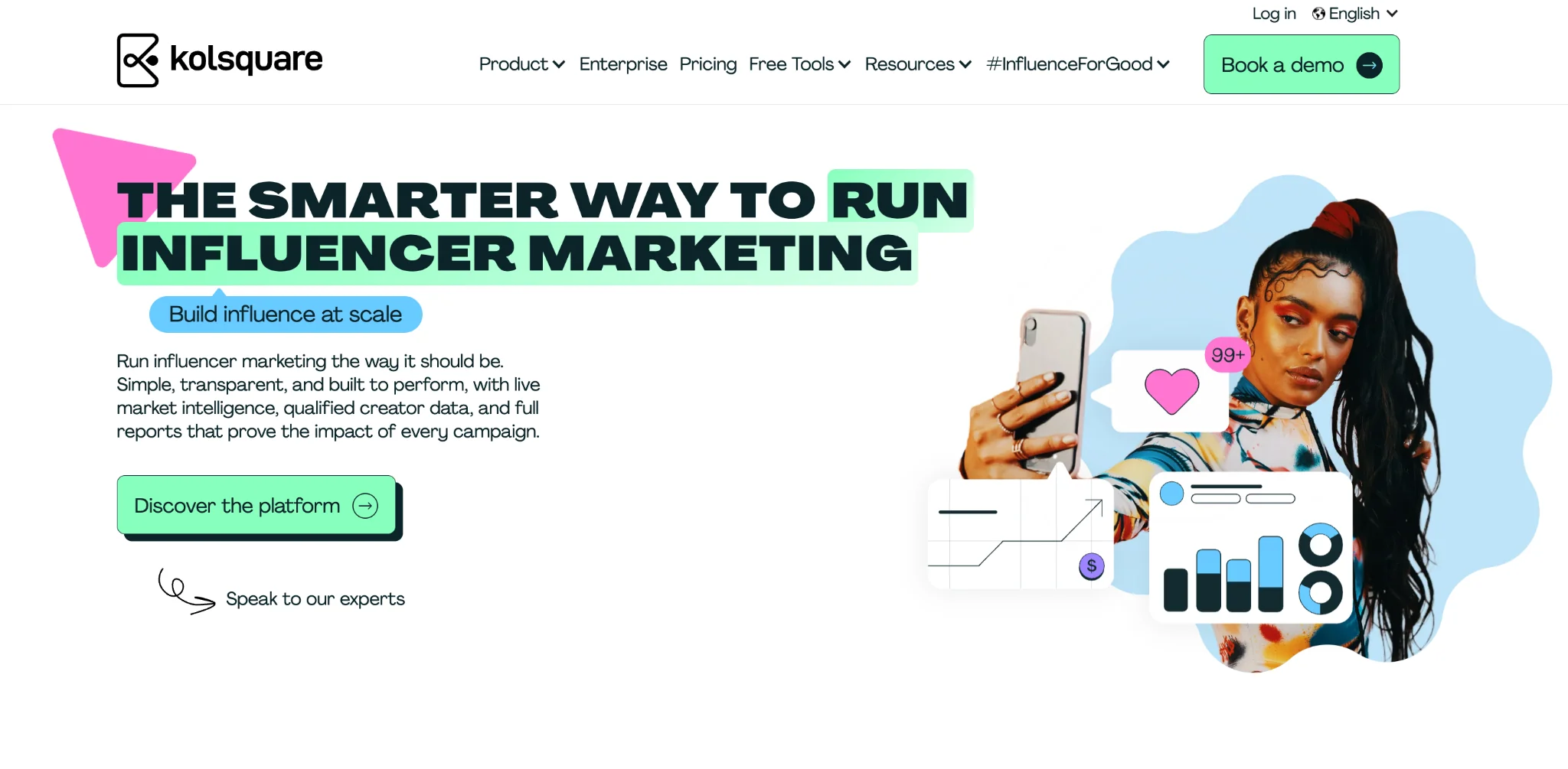
Built in Europe and used by brands, agencies, enterprises and non-profits, Kolsquare knows France, DACH, Southern Europe and the UK better than it knows anywhere else. Campaign management, CRM, discovery, automated reporting and competitive listening share one platform, and the parts most tools treat casually — where profile data comes from, whether disclosures hold up, how personal data is handled — are the ones it takes most seriously.
Key Features
- Credibility-Scored Search: AI search across millions of profiles in 180-plus countries, each carrying a credibility score.
- Briefs and Deadlines in One Place: a campaign workspace covering briefs, approvals, communication and deadline tracking.
- Casting Through Payment: a CRM carrying casting, negotiation, approvals and payments across multiple markets.
- Dashboards That Build Themselves: reach, EMV, engagement and sentiment reported live with nothing collected by hand.
- Category Listening: a module for competitor activity and benchmarking, sold separately.
Platform Coverage
Instagram, TikTok, YouTube, Facebook, Snapchat, Twitch and X.
Pricing
- Discovery Module: database, AI search, audience insights and CRM, quoted on request.
- Listening Module: dashboards, competitive benchmarking and share of voice, also quoted.
- Enterprise: a custom scope adding payments, API access and single sign-on.
- Terms: discounted rates for qualifying startups and non-profits, with no off-the-shelf licence in any case.
Reviews
4.3/5.0 (G2)
Standout Features
- Data Through the Front Door: profile information arrives through platform APIs rather than scraping, which regulated advertisers care about.
- Compliance Built In: credibility scoring and disclosure verification designed around European advertising standards.
- Depth US Tools Skim: European-market creator coverage that US-first databases handle thinly.
Peg.co vs Kolsquare
Both were built on the idea that a creator needs verifying before a brand attaches its name to them, and Kolsquare extends that from reputation into regulation. Credibility scores sit on every profile, disclosure compliance is checked rather than assumed, and profile data comes through official platform APIs instead of scraped pages — which is the difference between a vetting story a brand tells itself and one it can show a regulator.
Coverage is the other upgrade. Seven networks against two, creator depth across European markets and languages, and sentiment reporting that updates live rather than as a periodic meter. What has not changed is the buying experience: like Peg, Kolsquare is quoted rather than published, and the listening module costs extra on top of the core platform. A UK or European agency that valued Peg for keeping clients out of trouble will recognise most of what it is paying for here.
Final Thoughts on Peg.co Alternatives
Peg's disappearance changes what this list is for. There is no product left to compare against, only a set of habits worth preserving — screening creators on more than reach, catching a conflict before a client does, and keeping a record of why somebody was approved. Traackr and Kolsquare carry those habits furthest and price accordingly. Modash, Influencity and Heepsy cover the audience-quality half at a fraction of the cost but stop short of editorial judgment. Influencer Hero, GRIN, Upfluence and SARAL add the commerce and workflow layer Peg never had, which for most brands is where the channel actually pays for itself. The right shortlist depends less on which tool feels closest and more on whether the vetting was protecting a cautious client or simply avoiding a bad buy.