

Sideqik Alternatives: Best Influencer Marketing Platforms
Managing creator partnerships at scale requires more than manual outreach and spreadsheets, which is why influencer marketing software has become essential for handling discovery, communication, campaign workflows, and performance tracking in one place. Sideqik is a well-established platform in this space, offering strong audience analytics, influencer CRM capabilities, and ROI-focused reporting, making it a solid option for brands running structured creator programs. However, many teams start exploring Sideqik alternatives due to limited pricing transparency, a user interface that can feel less intuitive compared to newer tools, and occasional challenges with highly specific influencer discovery—factors that can slow down onboarding or make the platform less flexible for smaller or fast-moving teams. As a result, marketers evaluating influencer marketing software often compare multiple solutions to find the right balance between usability, data depth, and cost.
In this guide, we’ll break down the 10 best Sideqik alternatives—Influencer Hero, Upfluence, Aspire, SARAL, CreatorIQ, Sprout Social, GRIN, Modash, Influencity, and IZEA—to help you identify the platform that best fits your workflow and growth goals.
Criteria for Suggesting Platform Alternatives
Core Features
Evaluation of each platform’s essential capabilities, including influencer discovery, outreach, CRM, campaign reporting, gifting, UGC and content collection, affiliate tracking and payments, storefronts, application pages, and AI-powered tools.
Supported Social Media Platforms
Assessment of how well each platform integrates with major social networks such as Instagram, YouTube, TikTok, Facebook, Pinterest, and many more
Pricing & Contract Flexibility
Comparison of pricing models, subscription costs, and contract requirements to help brands choose solutions that match their budget and scalability needs.
Standout & Differentiating Features
Highlighting unique or innovative functionalities that set each platform apart, such as real-time tracking dashboards, creator benchmarking, TikTok email discovery, or advanced automation tools.
Customer Reviews & User Satisfaction
Analysis of verified user feedback from credible platforms like G2, TrustRadius, Capterra, focusing on usability, reliability, value for money, customer support, and real-world performance.
Sideqik Overview

Sideqik is an enterprise-focused influencer marketing platform designed to help brands and agencies manage the entire creator lifecycle—from discovery and recruitment to campaign execution, payments, and performance tracking. Positioned as a data-driven solution, Sideqik stands out for its emphasis on audience analytics and ROI measurement, enabling marketers to go beyond vanity metrics and connect influencer activity directly to business outcomes like conversions and revenue.
Key Features
- Advanced Influencer Discovery: Access a database of millions of creator profiles across multiple social networks. Search using detailed filters such as audience demographics, brand affinity, engagement rates, and interests to find highly relevant creators.
- Deep Audience Analytics: Go beyond surface-level metrics with detailed audience insights, including age, gender, location, ethnicity, and income brackets—helping brands ensure true audience alignment.
- Influencer CRM & Relationship Management: Centralize creator communication, contracts, notes, and campaign history in one place. This makes it easier for teams to build long-term relationships and avoid fragmented workflows.
- Campaign Management & Automation: Organize campaigns by keywords, hashtags, or timeframes. Automatically track influencer posts, performance metrics, and deliverables without manual input.
- Performance Tracking & ROI Measurement: Monitor key KPIs such as engagement, reach, earned media value (EMV), conversions, and revenue. Sideqik is particularly strong in linking influencer efforts to actual business impact.
- Affiliate & Payment Integration: Manage influencer payments and commissions directly in-platform. Integrates with affiliate networks to track performance-based partnerships and revenue attribution.
- Creator Recruitment & Forms: Use customizable forms to onboard influencers, ambassadors, or customers into campaigns, streamlining recruitment and data collection.
- Multi-Account & Team Collaboration: Built for agencies and enterprise teams, allowing management of multiple brands or regions with shared data, centralized billing, and team collaboration features.
- Integrations with Marketing Stack: Connect with analytics, affiliate, and eCommerce tools to create a unified marketing ecosystem.
Platform Coverage
Instagram, TikTok, YouTube, Facebook, X (Twitter), Twitch, Pinterest, and blogs.
Pricing
Sideqik uses a custom pricing model, meaning there are no publicly available plans or fixed monthly tiers on its website. Pricing is typically tailored based on company size, number of users, campaign scale, and required features.
Reviews
4.2 / 5.0 (G2)
Sideqik Standout Features
- Creator Hub (Centralized Creator Experience): A dedicated, branded portal where influencers can interact with campaigns, submit content, and manage collaboration details—streamlining communication and reducing back-and-forth.
- Audience-First Discovery Engine: Unlike many tools that prioritize follower count, Sideqik emphasizes audience demographics and brand affinity, helping marketers find creators whose audiences actually match their target customers.
- Influencer + Affiliate Revenue Tracking: Strong integration between influencer marketing and affiliate performance, allowing brands to track discount codes, commissions, and revenue directly tied to influencer campaigns.
Limitations (Why Users Look for Sideqik Alternatives)
Lack of pricing transparency
With no public pricing, it’s difficult for smaller teams to quickly evaluate fit or compare against competitors without going through sales.
Steeper learning curve and dated UI
Some users report that the interface can feel less intuitive compared to newer platforms, requiring more onboarding time.
Discovery limitations for niche searches
While powerful overall, highly specific or niche influencer searches may require extra manual filtering or support.
Better suited for enterprise than SMBs
The platform’s complexity and structure can feel overwhelming for smaller teams looking for a lightweight, plug-and-play solution.
10 Best Influencer Marketing Platform Alternatives
| TOOL | REVIEWS | BEST FOR | TRIAL INFO | PRICING | ||
|---|---|---|---|---|---|---|
1 |

|
⭐ | Influencer CRM & automation | Book Demo | Pricing | Website |
2 |

|
⭐ | Influencer discovery | Book Demo | Pricing | Website |
3 |

|
⭐ | Influencer partnerships | Book Demo | Pricing | Website |
4 |

|
⭐ | Influencer outreach | Book Demo | Pricing | Website |
5 |

|
⭐ | Enterprise influencer marketing | Book Demo | Pricing | Website |
6 |
|
⭐ | Influencer marketing & Social media analytics | Book Demo | Pricing | Website |
7 |

|
⭐ | DTC creator management | Book Demo | Pricing | Website |
8 |

|
⭐ | Influencer discovery | Book Demo | Pricing | Website |
9 |

|
⭐ | Campaign management | Book Demo | Pricing | Website |
10 |

|
⭐ | Influencer marketplace | Book Demo | Pricing | Website |
Influencer Hero

Influencer Hero is an all-in-one influencer marketing platform built for brands and agencies that want discovery, outreach, CRM, gifting, affiliate tracking, UGC collection, and payouts inside a single workflow. Its positioning is especially strong for DTC and eCommerce teams that care about ROI, automation, and managing large creator programs without enterprise-level complexity.
Key Features
- Influencer discovery with strong filtering and lookalikes: Brands can search creators by demographics, interests, engagement rate, and audience quality, then use lookalike suggestions and a Chrome extension to add prospects directly into campaigns.
- Automated outreach workflows: The platform supports one-to-one and bulk outreach, AI-assisted copy, follow-up sequences, and reply tracking, which makes it better suited to high-volume prospecting than spreadsheet-led workflows.
- Campaign-centric CRM: Influencer Hero’s core strength is its structured CRM, with boards for outreach, deliverables, and performance plus bulk actions and stage-based automations.
- Performance and ROI tracking: Campaign dashboards track clicks, affiliate sales, and creator-level results, with exportable reports for internal teams.
- Gifting, affiliate, and payment tools: It supports gifting and affiliate workflows, custom links and codes, and automated payouts through eCommerce integrations.
- Application pages and storefronts: Brands can create branded signup pages and storefront-style creator entry points to scale inbound recruitment.
Platform Coverage
Instagram, TikTok, YouTube, Facebook, Pinterest, Snapchat, X, and Twitch
Pricing
Influencer Hero offers flexible pricing based on outreach volume, and you can have unlimited creators in your CRM with Influencer Hero:
- Standard — $649/month (up to 1,000 reachouts/month)
- Pro — $1,049/month (up to 5,000 reachouts/month)
- Business — $2,490/month (up to 10,000 reachouts/month)
- Custom / Agency — Tailored pricing
Reviews
5.0/5.0 (Capterra)
Standout Features
- Campaign-centric CRM automation: Influencer Hero is unusually focused on workflow execution, with boards, bulk actions, and automated email flows designed for managing many creators at once.
- Influencer brand followers feature: It can identify creators who already follow or engage with your brand, which is especially useful for improving reply rates and finding warmer partnership opportunities.
- Multi-platform eCommerce support: Unlike many tools that lean heavily on Shopify alone, Influencer Hero also supports WooCommerce and custom setups via scripts and integrations, which broadens its fit for non-Shopify brands.
Sideqik vs Influencer Hero
Sideqik is more enterprise-leaning and emphasizes audience analytics, creator discovery, and revenue measurement for larger organizations, while Influencer Hero puts more weight on campaign execution, transparent packaging, and operational efficiency for growing DTC teams. Sideqik feels more like a data-rich creator marketing system; Influencer Hero feels more like a hands-on campaign engine.
Another key difference is pricing transparency. Sideqik is quote-based, while Influencer Hero publishes plan structures and entry pricing, making it easier for smaller teams to self-qualify early in the buying process.
Upfluence
Upfluence is an influencer and affiliate marketing platform built primarily for eCommerce brands that want discovery, outreach, campaign execution, affiliate management, and revenue tracking in one place. Its market positioning is especially strong for Shopify- and Amazon-centric brands that want creator partnerships tied directly to sales performance rather than awareness alone.
Key Features
- Large creator database with granular filtering: Upfluence offers access to 12M+ creators with filters for niche, geography, audience data, pricing signals, and engagement.
- AI-powered outreach and workflow support: Jaice AI helps brands create campaigns, personalize outreach, and automate parts of creator activation.
- Influencer matching from your own customer base: One of Upfluence’s strongest differentiators is its ability to identify influencers among existing customers and subscribers through eCommerce and CRM integrations.
- Affiliate and promo-code management: Brands can generate unique promo codes and manage performance-based partnerships directly within the platform.
- Strong Shopify and Amazon workflows: Upfluence is especially useful for brands that need gifting, creator recruitment, and attributable commerce tracking across both DTC and marketplace channels.
- Payments and creator space: The platform supports creator payments and provides creators with a space to view sales or performance information.
Platform Coverage
Instagram, TikTok, YouTube, Facebook, Twitch, Pinterest, and blogs.
Pricing
On average plans start around $2,000/month ($24,000 yearly)
Reviews
4.3 / 5.0 (Capterra)
Standout Features
- Customer-to-creator matching: Upfluence’s ability to identify influencers already inside your customer base is still one of the most commercially differentiated features in the category.
- Jaice AI campaign automation: The newer Jaice AI positioning pushes Upfluence beyond discovery into AI-assisted campaign building, outreach, gifting, approvals, and payments.
- Amazon plus Shopify revenue attribution: Many platforms do Shopify well; fewer connect influencer workflows to both Shopify and Amazon in a unified way.
Sideqik vs Upfluence
Sideqik is broader in creator management and audience-led discovery, while Upfluence is more overtly commerce-driven. If the program’s north star is creator-enabled eCommerce revenue, Upfluence has the clearer advantage because of its deeper Shopify, Amazon, promo-code, and affiliate workflows.
Sideqik also feels more oriented toward enterprise marketing teams that want audience analytics and flexible collaboration, whereas Upfluence is particularly attractive to eCommerce operators who want creator programs to function like a measurable acquisition or retention channel.
Aspire
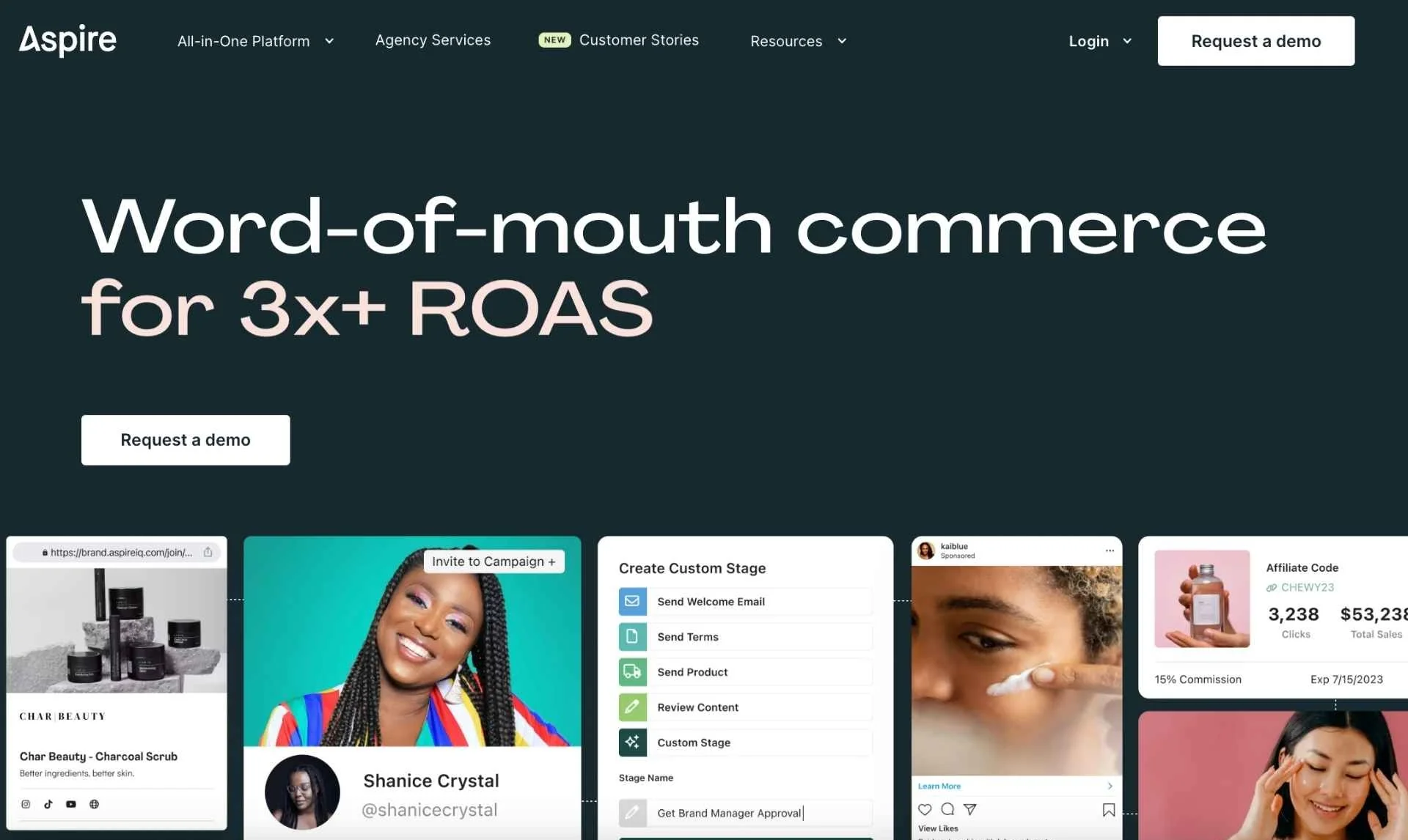
Aspire is an influencer marketing platform built for eCommerce brands that want to scale creator partnerships, affiliate campaigns, product seeding, and UGC workflows. It is especially well known for combining a searchable creator database with a large inbound marketplace, making it a strong option for brands that want both outbound sourcing and inbound creator applications.
Key Features
- Dual discovery model: Aspire combines creator search with a 1M+ creator marketplace, which gives brands both proactive discovery and inbound recruitment.
- Campaign workflow automation: The platform supports outreach, briefs, contracts, milestones, content approvals, and automated follow-ups from one dashboard.
- Shopify-native gifting and fulfillment: Aspire’s Shopify integration supports product selection, shipping, and tracking inside campaign workflows.
- Affiliate and sales tracking: Aspire supports discount links, codes, creator stores, and commission tracking, giving brands a commerce layer on top of creator campaigns.
- UGC and content licensing support: The platform collects campaign content and emphasizes usage rights and branded content reuse as part of workflow management.
- First-party data positioning: Aspire frequently emphasizes first-party data access and platform relationships as a trust and measurement advantage.
Platform Coverage
Instagram, TikTok, Pinterest, YouTube, and Facebook
Pricing
Aspire starts with tiered pricing and can be customized, with a mid-tier quote of about $2,300/month for a use case involving multiple team members and up to 500 creators in CRM.
Reviews
4.0 /5.0 (Capterra)
Standout Features
- Large inbound Creator Marketplace: Aspire’s marketplace remains one of its clearest differentiators, especially for brands that want creators to apply directly instead of relying only on outbound prospecting.
- CreatorStores and offer landing pages: Aspire has leaned into creator-led storefront experiences hosted on Shopify, including CreatorStores and offer landing pages that aim to improve conversion and capture first-party shopper data.
- Strong product seeding and content approval workflows: Aspire is especially strong when brands care about product gifting, shipping visibility, briefs, and pre-publish content approval in one workflow.
Sideqik vs Aspire
Sideqik is more discovery-and-analytics centered, while Aspire is stronger in hands-on creator collaboration and commerce-enabled campaign execution. For brands that care about application pages, gifting, approvals, and creator storefronts, Aspire usually feels more creator-operations heavy.
Sideqik, on the other hand, is the better fit when audience intelligence and broader creator management infrastructure matter more than creator marketplace dynamics. Aspire wins on recruitment and workflow depth; Sideqik wins on audience-led platform positioning.
SARAL

SARAL is an influencer marketing platform built for eCommerce brands that want a simpler, more operationally efficient way to run influencer seeding, outreach, relationship management, tracking, and payments. Its positioning is notably less enterprise-heavy than platforms like CreatorIQ or Sideqik, which is part of its appeal for leaner teams.
Key Features
- Large creator discovery engine: SARAL says brands can search more than 200M creator profiles across Instagram, TikTok, and YouTube, with no creator sign-up required.
- Automated outreach and relationship tracking: Its core promise is reducing spreadsheet work by centralizing prospecting, communication, relationship stages, and creator history.
- Chrome extension for in-flow sourcing: The extension lets teams save creators while browsing and surfaces engagement rate, predicted likes, fair fee estimates, and other quick insights.
- Performance tracking across major creator channels: SARAL’s performance tools track influencer content and results across Instagram, TikTok, and YouTube in a unified dashboard.
- Affiliate and payment workflows: The platform positions itself as an end-to-end system for finding creators, automating outreach, tracking results, and sending payments.
- Social listening on higher tiers: Its Business and Professional tiers include stronger post tracking and social listening capabilities for more mature programs.
Platform Coverage
Instagram, TikTok, and YouTube.
Pricing
There are different plans:
- Starter: $3.6k/quarter
- Business: $4.5k/quarter
- Professional: $7.5k/quarter
Reviews
4.7/5.0 (G2)
Standout Features
- Chrome extension with fair-fee guidance: SARAL’s extension is not just for saving creators; it also surfaces fee guidance and audience signals that help teams qualify partners faster.
- Simplicity-first operating model: SARAL’s product and customer messaging consistently emphasize reducing complexity, which differentiates it from more enterprise-heavy platforms.
- Transparent tiered pricing: Compared with many influencer platforms that hide pricing behind demos, SARAL openly publishes plan tiers and inclusions, which is a meaningful differentiator for smaller eCommerce teams.
Sideqik vs SARAL
Sideqik is the more enterprise-oriented platform, with broader creator management positioning and heavier emphasis on audience analytics and revenue measurement. SARAL is the leaner, easier-to-approach option for eCommerce teams that want fast influencer operations without the overhead of a more complex platform.
If Sideqik is designed to support larger, more structured creator programs, SARAL is better suited to teams prioritizing speed, simplicity, and transparent pricing. That makes SARAL a stronger fit for emerging DTC brands, while Sideqik fits brands needing a more expansive creator marketing system.
CreatorIQ
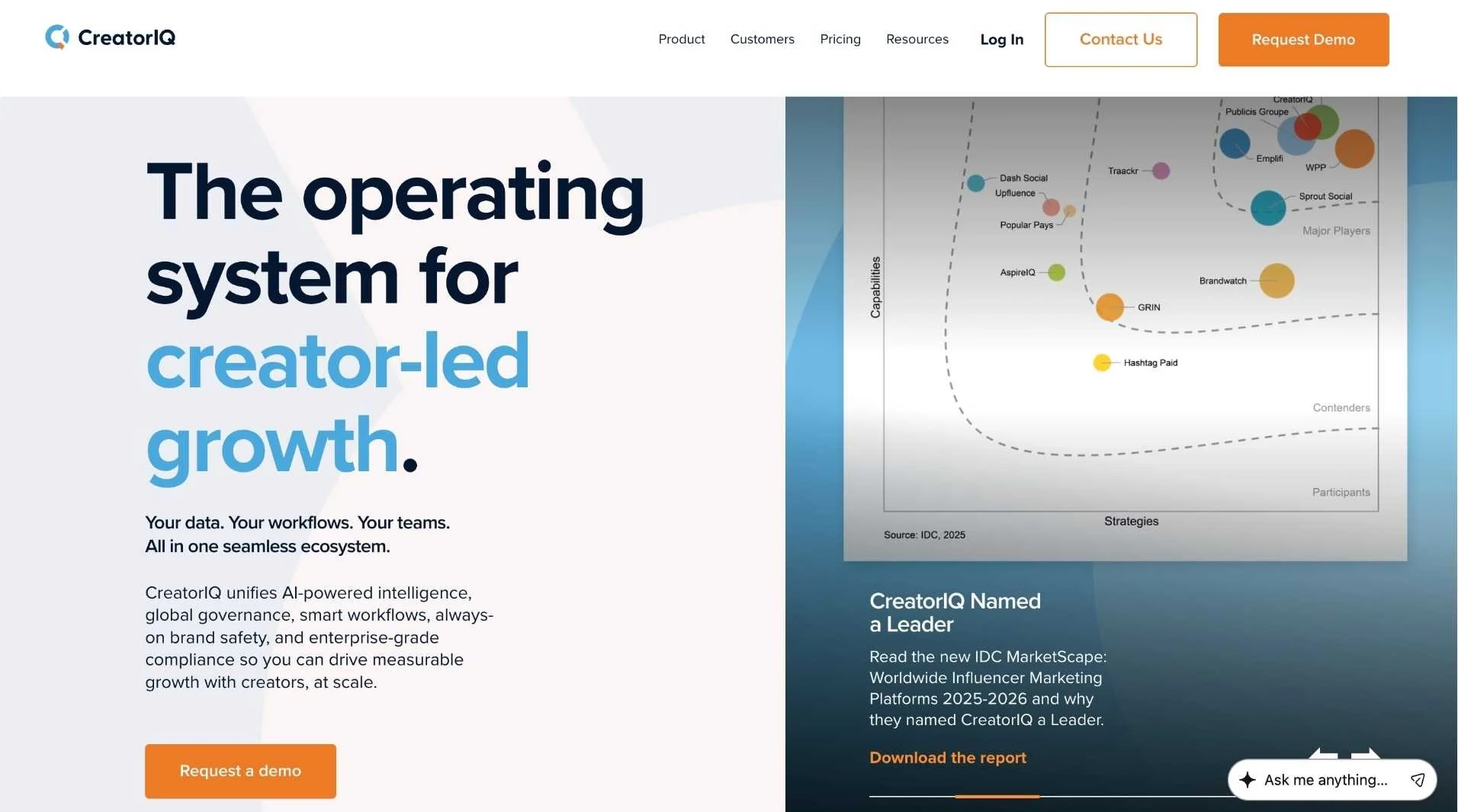
CreatorIQ is an enterprise creator marketing platform built for large brands and agencies that need creator discovery, global workflow management, measurement, approvals, and commerce support at scale. Its positioning is strongest around data depth, enterprise governance, API-connected reporting, and infrastructure for managing large creator ecosystems across markets and teams.
Key Features
- Content-first creator discovery: CreatorIQ emphasizes content-aligned discovery, surfacing actual creator posts in search and helping teams evaluate fit beyond profile stats.
- Organic brand momentum detection: The platform highlights recent brand mentions so teams can spot creators already talking about the brand and convert that momentum into partnerships.
- Enterprise creator management: CreatorIQ centralizes creator data, workflows, partnership history, and approvals across global teams, which is one of its clearest enterprise strengths.
- Sharable one-sheets and approval tools: The platform supports branded creator talent sheets and approval workflows that reduce manual stakeholder review.
- Affiliate and revenue tools: CreatorIQ positions affiliate marketing as a revenue engine and supports managing creator commerce programs with enterprise-grade integrations.
- Onboarding and recruitment flows: It offers recruitment and onboarding tools to centralize creator data and scale outreach.
Platform Coverage
Instagram, YouTube, TikTok, Facebook, Twitter, Pinterest, and more.
Pricing
- Basic Plan: Starts at $35,000/year. Includes 1,000 contact creators per month
- Standard Plan: Starts at $50,000/year. Includes 2,500 contact creators per month
- Professional Plan: Starts at $90,000/year. Includes 5,000 contact creators per month
- Enterprise Plan: Starts at $200,000/year. Includes 7,500 contact creators per month
Reviews
4.4 / 5.0 (Capterra)
Standout Features
- Content-first discovery built on Creator Graph positioning: CreatorIQ is leaning into AI-native, content-first discovery rather than simple profile lookup, which is meaningful for enterprise brands prioritizing fit and safety.
- Branded creator talent sheets and approvals: Its sharable, branded one-sheets are a strong differentiator for large internal teams that need smoother approvals from legal, brand, or executive stakeholders.
- Enterprise-scale workflow and governance: CreatorIQ is built for global, multi-team environments, with stronger emphasis on centralized controls and scalable management than most mid-market tools.
Sideqik vs CreatorIQ
Sideqik and CreatorIQ both serve sophisticated creator programs, but CreatorIQ is more overtly enterprise-grade in its pricing, governance, approvals, and global operating model. It is the better fit for brands running very large, data-heavy, multi-stakeholder programs.
Sideqik, by contrast, can still support serious creator marketing, but it feels more accessible and less infrastructure-heavy. CreatorIQ wins on enterprise scale and workflow rigor; Sideqik is the better option for teams that want strong discovery and measurement without stepping into the highest enterprise pricing tier.


Sprout Social

Sprout Social Influencer Marketing, built from Sprout’s acquisition and integration of Tagger, is an enterprise influencer marketing platform designed to help brands discover creators, manage campaign workflows, and measure performance from one system. Its strongest positioning is around analytics, brand safety, and structured campaign operations for larger teams that want influencer marketing tied into a broader social marketing stack.
Key Features
- AI-powered creator discovery: Sprout uses semantic search and AI-assisted topical matching to surface creators whose content aligns with a brand’s brief, then layers on audience and engagement analysis for vetting.
- Brand Fit Score: One of Sprout’s signature tools, Brand Fit Score helps teams quantify how well a creator aligns with their messaging and values before moving further into evaluation.
- Brand safety reporting: Sprout’s Brand Safety Reports let teams define risky keywords, hashtags, and thresholds so creator content can be screened before a partnership is activated.
- Campaign workflows and approvals: The platform brings outreach, contracts, content approvals, deliverables, spend tracking, and reporting into one modular workflow, which is especially useful for cross-functional teams.
- Creator lists and workspaces: Teams can organize creators into custom lists and manage separate brands or clients through workspaces with their own templates, metrics, and permissions.
- Commerce and reporting tools: Your product notes show Shopify-based gifting, discount-code tracking, affiliate payouts through PayPal, EMV reporting, and exportable reports in PDF, PNG, and JPEG formats.
Platform Coverage
Instagram, YouTube, Facebook, TikTok, and X (Twitter)
Pricing
Starts around $1,600/month per user plus $600 per extra user.
Reviews
4.5 / 5.0 (Capterra)
Standout Features
- Brand Fit Score: Sprout’s most recognizable differentiator is its AI-based alignment scoring, which helps teams standardize creator vetting beyond follower counts and basic demographics.
- Brand Safety Reports: The ability to screen creators against custom risk parameters before activation is a strong differentiator for regulated or reputation-sensitive brands.
- Workspace-based campaign operations: Sprout’s workspace model is unusually useful for multi-brand teams and agencies because each workspace can carry its own workflows, scoring criteria, metrics, and templates.
Sideqik vs Sprout Social
Sideqik and Sprout Social both serve brands that want more than basic outreach, but they emphasize different strengths. Sideqik leans more heavily into creator discovery, audience analytics, and influencer relationship management, while Sprout Social stands out more for structured workflows, stronger brand safety controls, and presentation-ready reporting for enterprise teams.
Another difference is how the platforms fit into the broader marketing stack. Sprout Social is especially appealing to brands that already operate within Sprout’s wider social ecosystem, whereas Sideqik feels more like a dedicated creator marketing platform first. Based on your notes, Sprout also carries a higher seat-based cost and more rigid annual commitment, while Sideqik is typically evaluated through custom pricing conversations.
GRIN
GRIN is a creator marketing platform built primarily for DTC and eCommerce brands that want to manage influencer discovery, outreach, gifting, affiliate programs, content collection, and payments in one place. Its positioning is strongest around operational workflows tied directly to commerce outcomes, especially for brands that run ongoing creator programs rather than one-off campaigns.
Key Features
- Creator discovery and vetting: GRIN’s discovery tools let brands search verified creators by niche, engagement, audience, and brand affinity, with AI-enhanced search now part of the product.
- Integrated creator CRM: GRIN centralizes relationship management with tagging, stage tracking, briefs, proposals, and creator-specific workflows.
- Email outreach and tracking: The platform includes integrated email and tracking so brands can keep creator communication inside the same system as campaign execution.
- Gifting and affiliate management: GRIN supports gifting, affiliate links, deep links, conversion tracking, and creator payments, making it especially attractive for revenue-focused programs.
- Content library and approvals: Brands can store, tag, repurpose, and approve creator content in-platform, which helps unify influencer output with the rest of the marketing mix.
- Payments and tax workflows: GRIN promotes integrated creator payments and 1099 handling, which reduces manual finance work for U.S.-based teams.
Platform Coverage
Facebook, Instagram, TikTok, X, Pinterest, YouTube, and Twitch
Pricing
Annual pricing starts at $25,000/year (approx. $2,050/month)
Reviews
4.5/5.0 (G2)
Standout Features
- Gia AI assistant: GRIN’s 2025 launch of Gia gives the platform a newer AI angle, with creator-marketer-specific assistance embedded into the workflow.
- Commerce-native workflow depth: GRIN’s product is unusually strong at tying gifting, affiliate links, conversion tracking, and payouts together, which is why it appeals so much to DTC brands.
- Built-in payments and tax handling: Integrated creator payments plus 1099 processing remain a meaningful differentiator for brands that want fewer external tools in the stack.
Sideqik vs GRIN
Sideqik is better known for audience-led discovery, creator analytics, and broader influencer relationship management, while GRIN is more commerce-native and operationally focused. If a brand cares most about product seeding, affiliate revenue, and creator payment workflows, GRIN is usually the stronger fit.
The pricing model is another big distinction. Sideqik is generally sold through custom quotes, whereas GRIN now offers transparent month-to-month tiers with a free trial. That makes GRIN easier for growing brands to test and scale incrementally, while Sideqik still feels more sales-led and enterprise-oriented.
Modash

Modash is an influencer marketing platform focused on helping brands discover creators, manage outreach, track performance, and pay partners from one connected workflow. It is especially popular with Shopify-based brands and teams that want strong discovery capabilities without the weight of a more enterprise-style platform.
Key Features
- Large creator database: Modash’s discovery product is built around a database of hundreds of millions of public creator profiles, with advanced search across Instagram, TikTok, and YouTube.
- AI-powered creator search: The platform supports AI-assisted search and, according to your notes, can even match creators based on visual or stylistic prompts.
- CRM and outreach tools: Modash includes relationship tracking, email unlocks, and creator communication features so teams can manage outreach inside the platform rather than across spreadsheets and inboxes.
- Performance tracking: Brands can monitor content performance, campaign outputs, and creator-level results from a unified dashboard.
- Affiliate and payout workflows: Modash supports affiliate links, sales tracking, and automated commission payouts, which makes it more useful for revenue-led campaigns than discovery-only tools.
- Shopify-based gifting: Your product notes highlight Shopify gifting workflows, auto-tagged fulfillment, and influencer dashboards showing sales and earnings.
Platform Coverage
Modash supports influencer marketing on platforms such as Instagram, YouTube, and TikTok, providing comprehensive campaign tracking and influencer management tools.
Pricing
- Essentials: $199/month (paid annually)
- Performance: $499/month (paid annually)
- Custom Enterprise: Contact for pricing
Reviews
4.9 / 5.0 (Capterra)
Standout Features
- AI and visual-style discovery: Modash’s AI search is one of its clearest differentiators, especially when brands want to find creators by vibe, aesthetic, or content style rather than plain keywords.
- Public-profile scale: Modash’s discovery engine is built on public creator data rather than only opt-in databases, which gives it unusually broad search coverage.
- Transparent, usage-based pricing: Compared with many influencer platforms that hide pricing behind demos, Modash is much easier to evaluate upfront.
Sideqik vs Modash
Sideqik is the more enterprise-oriented platform, with stronger emphasis on relationship management, audience analytics, and broader creator program infrastructure. Modash is leaner and more focused, with discovery, tracking, and affiliate workflows that are easier to adopt quickly.
The other major difference is flexibility. Modash publishes clear pricing and has a more straightforward product footprint, which makes it attractive to smaller or mid-market teams. Sideqik is more likely to suit brands that want deeper program structure and multi-stakeholder workflows, even if that comes with a heavier buying process.
Influencity

Influencity is an end-to-end influencer marketing platform that combines creator discovery, outreach, CRM, campaign management, analytics, and reporting in one system. Its positioning is strongest for brands and agencies that want broad creator search coverage, flexible campaign management, and detailed reporting without relying only on opt-in creator databases.
Key Features
- Broad creator discovery: Influencity says it supports search across more than 200 million influencers using public data, with extensive filters for audience, engagement, geography, and creator quality.
- Strong CRM and campaign boards: Your product notes highlight segmentation, tagging, list creation, and campaign boards designed to manage multiple creator programs at once.
- Outreach and reporting: Influencity supports outreach workflows, campaign tracking, and exportable reports, helping teams centralize creator management and performance measurement.
- Shopify integration: Your product notes show gifting and affiliate tracking through Shopify, which is useful for brands running commerce-led creator campaigns.
- Public-data search model: Because Influencity indexes public profiles rather than waiting for creator opt-in, it offers wider search coverage than many CRM-heavy platforms.
- Forecasting and analytics tools: The platform’s public description and user reviews emphasize analytics, campaign forecasting, and creator-level performance measurement.
Platform Coverage
Instagram, TikTok, YouTube, and X/Twitter
Pricing
- Professional Plan: $318/month or $3,816/year
- Business Plan: $798/month or $9,576/year
- Enterprise Plan: Custom pricing
- Auto-Tracker Add-On: $660/year (for 50 influencers)
Reviews
4.3 / 5.0 (G2)
Standout Features
- Public-data discovery model: Influencity’s biggest differentiator is breadth of discovery without requiring creator opt-ins, which can be especially useful for agencies and niche market research.
- Flexible end-to-end workflow: The platform combines discovery, CRM, outreach, tracking, and reporting in a relatively balanced way, rather than leaning too hard into only one part of the workflow.
- Lower apparent entry point: Compared with many enterprise competitors, Influencity appears easier to access from a budget perspective, especially for teams that do not need a full custom enterprise package on day one.
Sideqik vs Influencity
Sideqik is stronger for brands that want a more enterprise-style creator relationship platform with deeper audience-led discovery and structured program management. Influencity is the more flexible, lower-barrier alternative for brands or agencies that want broad public-data search and solid workflow coverage without as much commercial friction.
The biggest contrast is probably accessibility. Sideqik feels more tailored to established creator programs, while Influencity is easier to picture for agencies, regional teams, or brands that want strong search and campaign reporting without committing to a heavier enterprise setup.
IZEA

IZEA is a long-standing influencer marketing company that combines marketplace tools, self-serve software, and managed services for brands and agencies. Today, its positioning spans both the Creator Marketplace for direct brand-creator transactions and IZEA Flex for more structured influencer marketing workflows.
Key Features
- Creator marketplace access: IZEA’s marketplace lets brands search creator listings, launch casting calls, and collaborate with creators on custom projects.
- Discovery and relationship management: IZEA Flex includes creator discovery, contact management, smart lists, and influencer relationship management tools.
- Content and campaign tracking: Flex includes ContentMine, ShareMonitor, and tracking links so brands can associate creators and content with campaign KPIs.
- Payments and transactions: IZEA supports creator transactions inside Flex, and the product is built around making brand-creator collaboration and payment more structured.
- Casting calls and inbound applications: The marketplace includes casting calls, which can help brands recruit creators through inbound interest rather than only outbound prospecting.
- Managed services option: IZEA also offers fully managed influencer marketing services and a Flex Portal for stakeholders who want visibility into campaigns run by IZEA’s team.
Platform Coverage
Instagram, TikTok, YouTube, Facebook, Pinterest, Snapchat, Twitch, and X (Twitter).
Pricing
IZEA does not publicly list fixed pricing tiers for all products, but it offers two main approaches:
- IZEA Flex (self-serve SaaS): Typically offered via custom pricing based on usage, features, and scale.
- Managed Services: Fully customized pricing depending on campaign scope, creator volume, and level of service.
In practice, this means pricing is quote-based, often structured as annual contracts for software access or campaign-based pricing for managed services.
Reviews
3.9/ 5.0 (G2)
Standout Features
- Dual model of marketplace plus software: IZEA is unusual in offering both a direct creator marketplace and a more structured Flex platform, giving brands more than one path into influencer marketing.
- Casting calls for inbound recruitment: The marketplace’s casting-call model is useful for brands that want creators to pitch into opportunities instead of relying only on outbound discovery.
- Low-cost entry tiers: Compared with most influencer platforms in this list, IZEA has a much lower public starting price, which makes it more approachable for smaller teams or testing programs.
Sideqik vs IZEA
Sideqik is the more polished fit for brands that want a dedicated creator marketing platform with stronger audience intelligence and structured influencer management. IZEA is broader and more flexible in business model, offering marketplace access, lower-cost self-serve options, and managed services alongside Flex.
That usually means the two platforms appeal to different buyers. Sideqik is better suited to brands that want a more dedicated software layer for creator programs, while IZEA is appealing when marketplace access, casting calls, or a lower-cost starting point matter more than enterprise-grade analytics depth.
Final Thoughts on Sideqik Alternatives
Choosing the right Sideqik alternative ultimately depends on your priorities—whether that’s advanced audience analytics, eCommerce-driven workflows, ease of use, or enterprise-level scalability. Platforms like CreatorIQ and Sprout Social cater to large organizations needing robust data and governance, while tools such as GRIN, Influencer Hero, and Aspire focus more on end-to-end campaign execution and revenue tracking for DTC brands. Meanwhile, solutions like Modash, SARAL, and Influencity offer more accessible entry points with strong discovery and flexible pricing. Each platform brings a different balance of discovery, automation, and performance measurement, so the best fit comes down to your team size, budget, and how closely you want influencer marketing tied to measurable business outcomes.