

Starngage Alternatives: Best Influencer Marketing Platforms
Most influencer marketing software sells you a seat. Starngage sells you access to a marketplace and takes a cut of every deal that closes inside it. Signing up is free. The platform then adds 10% on top of what you pay creators, or 30% if its own team runs the campaign for you. Behind that fee sits real scale: more than five million creators across 180 countries, growing by around 200,000 a month, with depth in Asian markets that most Western tools cannot match. If your bottleneck is finding people, that is a strong offer.
The trouble tends to arrive later. A percentage fee has no ceiling, so the better your program performs, the more it costs you to run. The workflow around the marketplace is also thin. Engagement happens in live chat rather than sequenced outreach, there is no affiliate or storefront layer, and the Starngage Plus subscription tiers have no clear published price to budget against. Teams often stay for the supply and buy a second tool for the system. These ten Starngage alternatives are worth weighing when that happens: Aspire, Influencer Hero, CreatorIQ, NeoReach, Afluencer, IZEA, Later, Brandbassador, Lefty and Klear.
Criteria for Suggesting Platform Alternatives
Core Features
Evaluation of each platform's essential capabilities, including influencer discovery, outreach, CRM, campaign reporting, gifting, UGC and content collection, affiliate tracking and payments, storefronts, application pages, and AI-powered tools.
Supported Social Media Platforms
Assessment of how well each platform integrates with major social networks such as Instagram, YouTube, TikTok, Facebook, Pinterest, and many more
Pricing & Contract Flexibility
Comparison of pricing models, subscription costs, and contract requirements to help brands choose solutions that match their budget and scalability needs.
Standout & Differentiating Features
Highlighting unique or innovative functionalities that set each platform apart, such as real-time tracking dashboards, creator benchmarking, TikTok email discovery, or advanced automation tools.
Customer Reviews & User Satisfaction
Analysis of verified user feedback from credible platforms like G2, TrustRadius, Capterra, focusing on usability, reliability, value for money, customer support, and real-world performance.
Starngage Overview
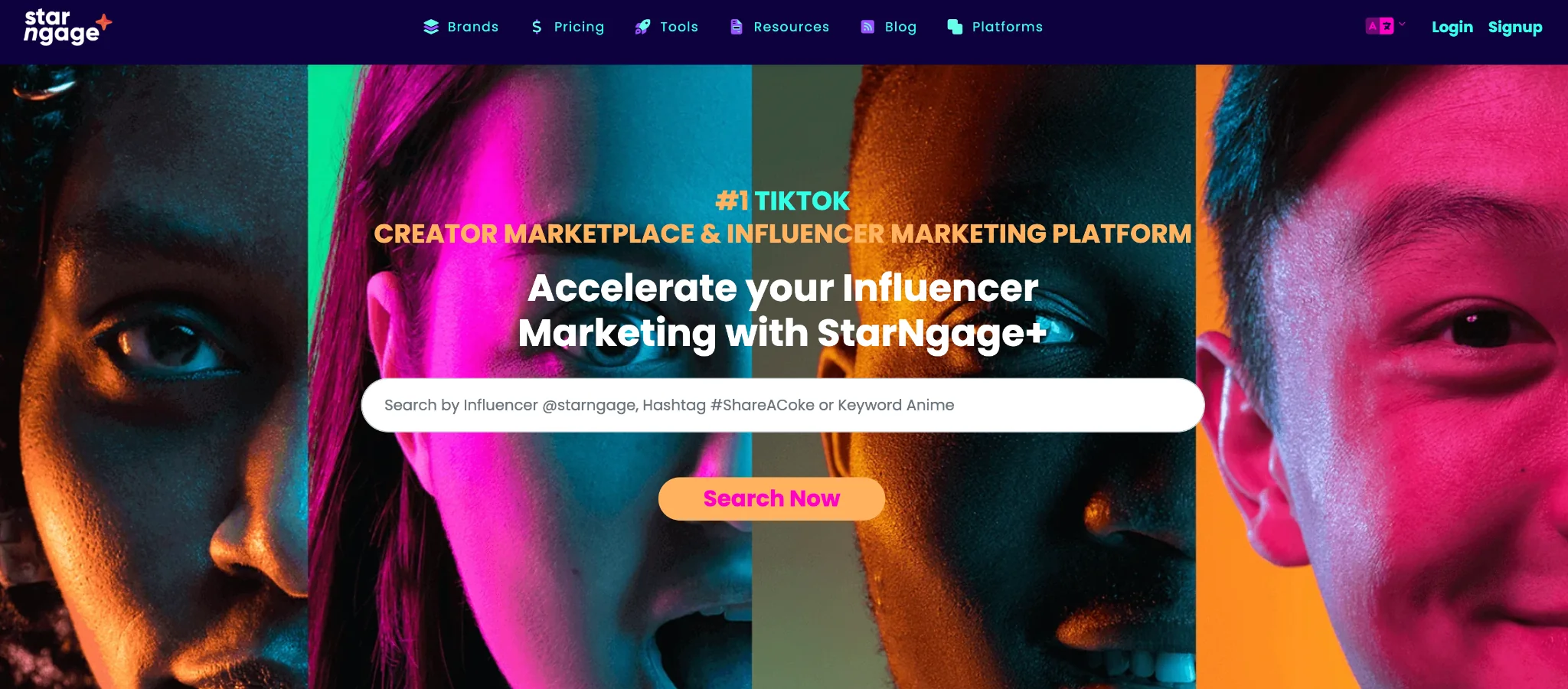
Starngage is a Singapore-based influencer marketing company that runs three things at once: a two-sided creator marketplace, a discovery and analytics product called Starngage Plus, and an optional managed service. It started as a public influencer-stats and ranking site, which is why its creator data runs deeper than its campaign tooling. Around 30,000 brands use it, mostly for reach into markets where local creator supply is hard to source. Our full Starngage pricing breakdown walks through the fee model in more detail.
Key Features
- Global Creator Marketplace: more than five million creators who apply to posted campaigns, growing by roughly 200,000 profiles a month.
- Ranking Databases and Discovery: searchable public rankings and filters by country, niche, follower count and engagement.
- Audience Insights: demographic and engagement data on each profile so you can check the audience before you pay for it.
- Fake-Follower Detection: screening that flags inflated or low-quality audiences across an open marketplace.
- Campaign Management: a create, approve and pay flow for brands, matched by a join, publish and get-paid flow for creators.
- Live Chat: brand-to-creator conversation inside the platform, attached to the campaign rather than an email thread.
- Rate Cards and Benchmarks: published pricing benchmarks you can use as leverage when you negotiate a fee.
- Hashtag and Performance Analytics: reach, engagement and campaign reporting on the content you paid for.
Platform Coverage
Starngage covers Instagram, TikTok, YouTube, Facebook and Threads across 180 countries, with far stronger creator density in Asia than most competing databases.
Pricing
- Self-service: free to sign up, with a 10% service fee added on top of what you pay each creator. A $200 collaboration costs you $220.
- VIP managed service: a 30% fee on campaign spend in exchange for strategy, casting, relationship management and reporting run by the Starngage team.
- Starngage Plus subscription: Lite, Essential and Advanced tiers exist for the discovery and analytics tooling, but there is no consistent published USD table and third-party listings vary widely by region.
- Terms: no upfront subscription and no lock-in on the marketplace side, with funds held in escrow until a campaign is approved.
Reviews
4.6/5.0 (G2, 20 reviews). That is a small sample for a platform claiming 30,000 brands, so treat it as directional.
Standout Features
- Creator Supply at Global Scale: five million profiles across 180 countries, with Asian coverage almost nobody else offers.
- Pay Only When a Campaign Runs: no monthly commitment on the marketplace, which suits occasional or seasonal programs.
- Discovery Data From a Ranking Site: years of public creator rankings sit underneath the search filters.
Limitations (Why Users Look For Starngage Alternatives)
The fee grows with every dollar you spend
There is no cap on the 10% service fee. Spend $50,000 on creators and you pay $5,000 to Starngage. The managed rate of 30% is steeper again. A flat subscription gets cheaper per campaign as you scale, and this does the opposite.
Subscription pricing is not published
Starngage Plus has named tiers but no clear rate card. Figures move by region and third-party listings disagree with each other. You cannot budget or compare properly without a sales conversation first.
Creator quality varies across an open marketplace
Anyone can join, so the pool mixes strong creators with weak ones. The fake-follower tools help, but the vetting work still lands on your team, and reviewers say so consistently.
Workflow automation is light
Outreach runs through live chat rather than sequenced email with follow-ups and reply tracking. There is no real CRM depth, no drip campaigns and no bulk sending. High-volume programs feel that gap quickly.
No affiliate, payouts or storefront layer
You can pay creators for a campaign, but there are no affiliate links, commission tracking or creator storefronts. Anything that ties content to revenue over time needs a second tool and a second budget line.
10 Best Influencer Marketing Platform Alternatives:
| TOOL | REVIEWS | BEST FOR | TRIAL INFO | PRICING | ||
|---|---|---|---|---|---|---|
1 |

|
⭐ | Influencer partnerships | Book Demo | Pricing | Website |
2 |

|
⭐ | Influencer CRM & automation | Book Demo | Pricing | Website |
3 |

|
⭐ | Enterprise influencer marketing | Book Demo | Pricing | Website |
4 |

|
⭐ | Influencer campaigns & data analytics | Book Demo | Pricing | Website |
5 |

|
⭐ | Influencer marketplace campaigns | Book Demo | Pricing | Website |
6 |

|
⭐ | Influencer marketplace | Book Demo | Pricing | Website |
7 |

|
⭐ | Social media & influencer campaigns | Book Demo | Pricing | Website |
8 |

|
⭐ | Ambassador Marketing | Book Demo | Pricing | Website |
9 |
|
⭐ | Influencer analytics & discovery | Book Demo | Pricing | Website |
10 |
|
⭐ | Influencer analytics | Book Demo | Pricing | Website |
Aspire

Aspire works mostly with beauty, apparel, food and beverage and health brands, roughly 800 of them, and the whole product is arranged around turning creator content into orders. Fulfilment, shoppable creator pages and conversion tracking all run natively through Shopify. That depth of commerce wiring is unusual at this end of the market.
Key Features
- Brand-Fit Matching: an AI layer that ranks creators by how well they suit your brand rather than by follower count.
- Brief Applications: you publish a campaign brief and interested creators opt in, which removes the cold-outreach step.
- Content Approvals: briefs, revisions and deliverable sign-off sit in the same place as the agreement.
- Commission and Promo Codes: affiliate links and discount codes with commission rules you set per creator.
- Paid Amplification: CreatorAds requests usage rights and pushes approved content into Meta as paid media.
Platform Coverage
Creators are tracked on TikTok, Instagram, Facebook, YouTube and Pinterest. On the commerce side, Shopify, PayPal and Klaviyo all connect.
Pricing
- Every plan: quote-only. There is no pricing page, and an old Capterra entry listing $2,499 per user per month is stale enough to ignore.
Reviews
4.6/5.0 (G2, 146 reviews)
Standout Features
- Shoppable Creator Pages: every partner gets a storefront, so the content has somewhere to convert.
- Usage Rights Handled In-App: whitelisting stops being a separate email negotiation.
- Creators Come to the Brief: recruitment runs inbound rather than outbound.
Starngage vs Aspire
Both let creators come to you instead of the other way round, so sourcing feels similar. What Aspire adds is everything that happens after the post goes live. Affiliate links, promo codes and commission rules live in the product. Creator storefronts turn a partnership into a page people can buy from. Usage rights get requested inside the campaign, so your best content can run as paid media. Starngage stops once it has reported what published.
Cost visibility runs the other way. Starngage charges nothing until a campaign happens, and you can see the fee before you commit. Aspire will not give you a number without a call, and it is built for mid-market and enterprise budgets. Aspire also covers Pinterest, which Starngage does not, while Starngage finds creators in markets Aspire barely indexes. Choose Aspire if your growth runs through Shopify. Choose Starngage if the hard part is finding people in Jakarta or Manila.
Influencer Hero

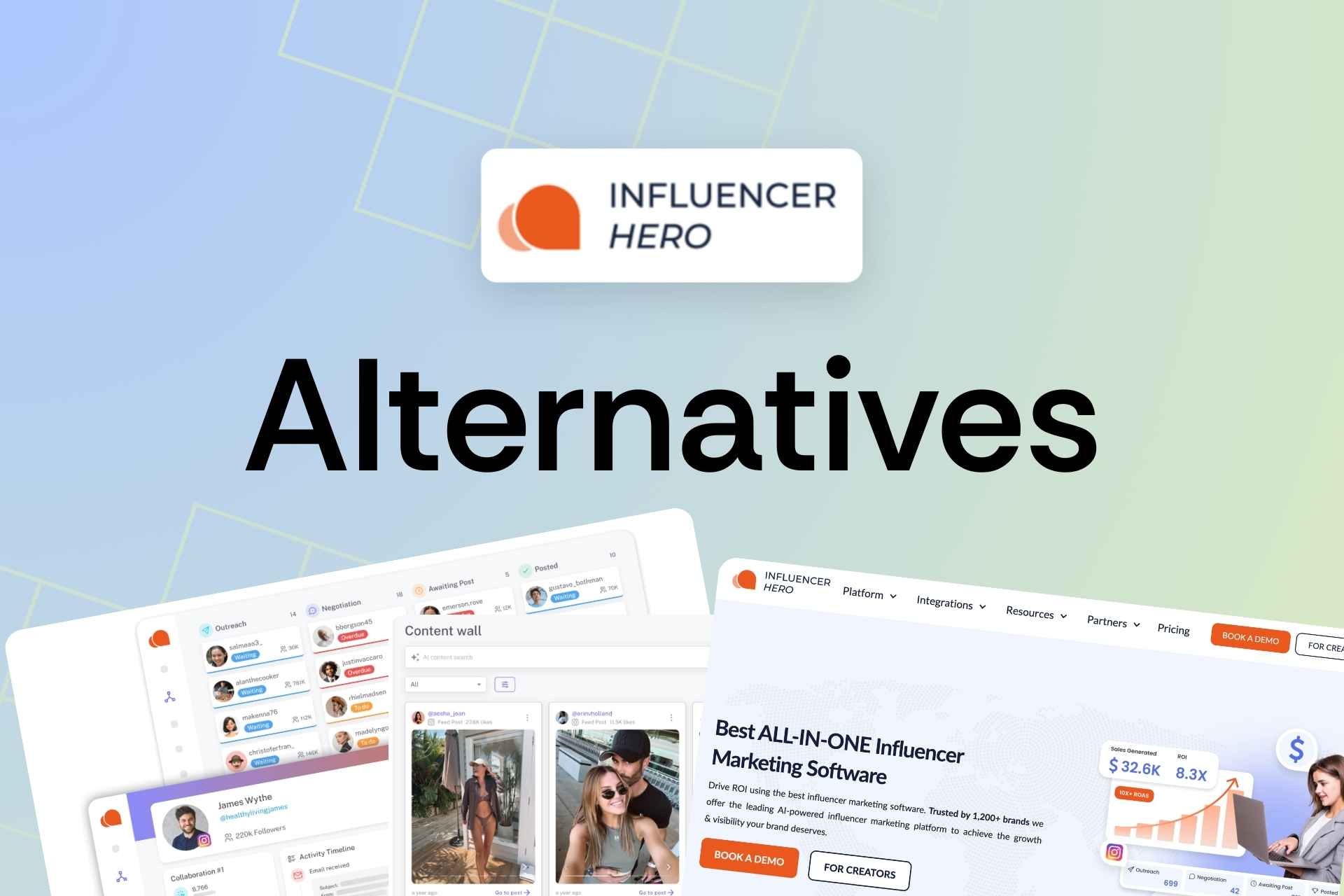
Influencer Hero puts the whole creator program in one place: finding creators, contacting them, tracking the relationship, sending product, running affiliate codes and paying people. It works across eight social networks and serves both growing D2C brands and enterprise teams. Its plans are listed publicly on the site instead of being gated behind a demo.
Key Features
- Creator Search With Quality Filters: location, demographics, interests, engagement and follower quality, plus fake-follower detection, lookalike search and brand-follower search.
- Chrome Extension: pull creator stats and import profiles in one click while you browse Instagram or TikTok.
- Email Sequences: send in bulk or one-to-one with AI-written personalisation, follow-up drips and reply tracking.
- Relationship Boards: an influencer CRM view of every creator, where the conversation stands and what they still owe you.
- Product Seeding: gifting orders fulfil automatically through Shopify or WooCommerce, with delivery tracked.
- Commission and Payouts: affiliate links and discount codes, commission worked out in the platform, payouts sent automatically.
- Storefronts and Application Pages: creator storefronts plus branded pages that collect inbound creator applications.
- UGC and Revenue Reporting: posts collected and downloadable, with dashboards showing clicks, affiliate sales and ROI per creator.
Platform Coverage
Eight networks are supported: Instagram, TikTok, YouTube, Facebook, Pinterest, Snapchat, X and Twitch.
Pricing
- Standard: $649/month for up to 1,000 creators and contacts.
- Pro: $1,049/month for up to 5,000.
- Business: $2,490/month for up to 10,000.
- Custom & Agency: tailored pricing for larger or multi-brand programs.
Reviews
5.0/5.0 (Capterra)
Standout Features
- A Bill That Does Not Follow Your Spend: cost is set by contact volume, so raising your creator budget does not raise the fee.
- Bulk Everything: outreach, follow-ups and gifting are all built to run across hundreds of creators at once.
- Revenue Attribution Per Creator: codes, links and payouts report against real orders, creator by creator.
Starngage vs Influencer Hero
StarNgage is built around creator discovery and inbound applications. Its large creator marketplace makes it easy to publish campaigns and let creators apply, but the workflow largely stops there. Influencer Hero is designed to manage what happens before and after discovery: you can search across eight social networks, vet creators with audience and follower-quality data, find lookalikes, run automated email outreach, manage relationships in a CRM, send products through Shopify, and track affiliate links, commissions, and payouts in the same platform.
The pricing models are also fundamentally different. StarNgage charges based on creator spend, while Influencer Hero uses a fixed subscription model starting at $649/month, with Pro at $1,049 and Business at $2,490. Quarterly and yearly commitments can reduce those rates further. That makes Influencer Hero easier to budget as creator spend grows: your software cost does not increase simply because you are paying creators more. The trade-off is that Influencer Hero has a higher upfront cost and no free trial, so StarNgage can make more sense for brands that mainly need a creator marketplace, while Influencer Hero is better suited to teams that want to run the entire influencer program from discovery through revenue tracking.
CreatorIQ
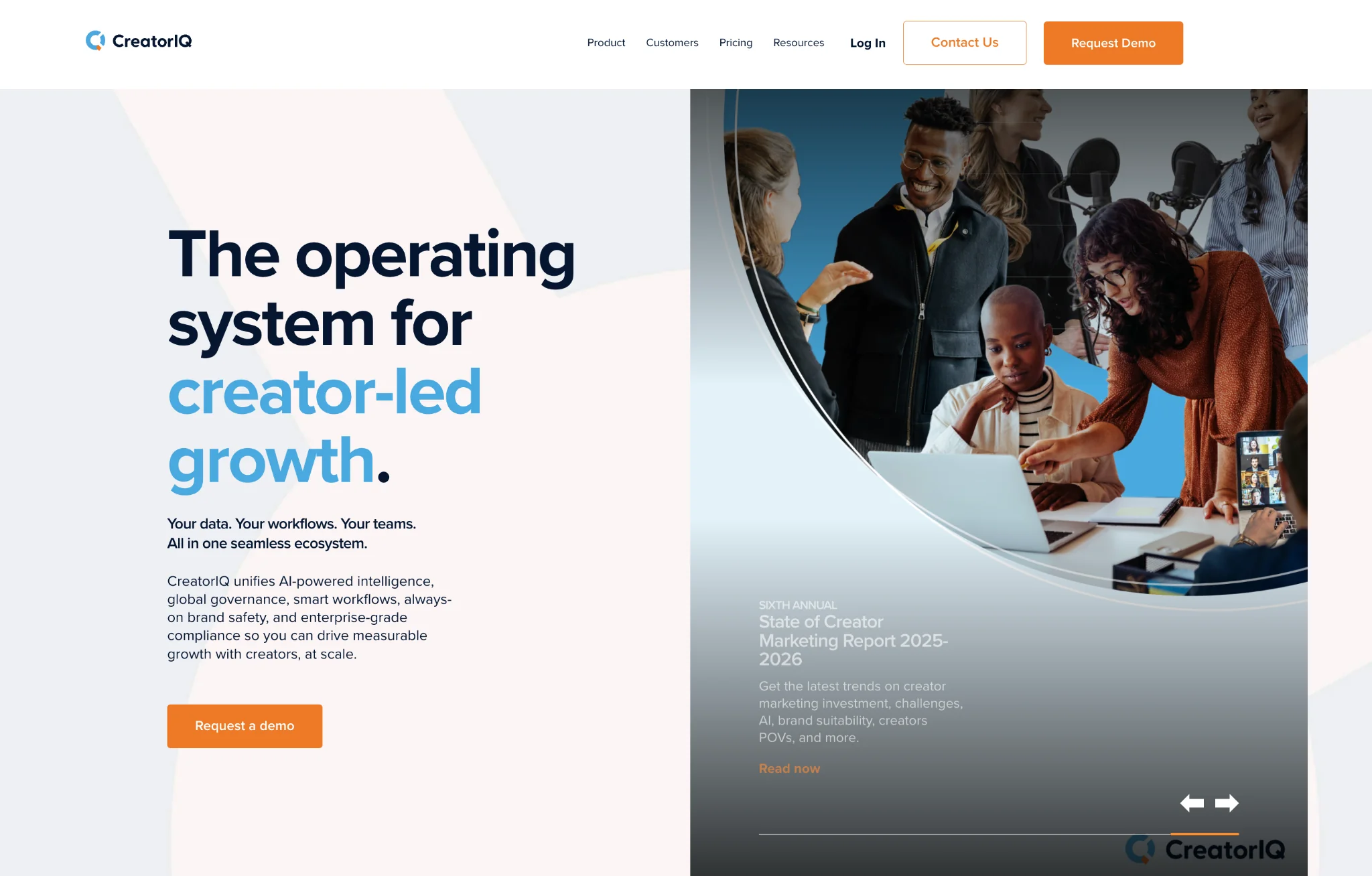
More than 1,300 brands and agencies run creator programs on CreatorIQ, and the product is shaped by what large organisations ask for: audit trails, brand safety sign-off, and separate permissions per brand and region. The data layer underneath it is the heaviest investment of any platform in this list.
Key Features
- Creator Graph: the profile and performance dataset every other module reads from.
- SafeIQ: automated screening of a creator's past content before anyone signs anything.
- BenchmarkIQ: shows how your program performs against direct rivals and where share of voice sits.
- CreatorIQ Pay: creator invoicing and payment run inside the platform.
- ExchangeIQ: APIs and permission controls for slotting into an existing martech stack.
Platform Coverage
Supported networks are Instagram, TikTok, YouTube, Facebook, Snapchat and Amazon.
Pricing
- Every plan: quote-only, with the pricing page routing you to a scheduled call.
Reviews
4.6/5.0 (G2, 581 reviews); 4.5/5.0 (Capterra, 17 reviews)
Standout Features
- Vetting Before Contracting: SafeIQ catches reputational risk while you can still walk away.
- Competitor Context: results are measured against category rivals, not only against last quarter.
- Built for Many Brands at Once: permissions and reporting split cleanly by brand and by region.
Starngage vs CreatorIQ
The gap here is worth seeing plainly. CreatorIQ screens creators before you sign anything, pays them inside the platform, benchmarks your results against competitors and controls who can see what across brands and regions. Starngage does none of it. Its 20 public reviews also sit awkwardly beside CreatorIQ's 581, which matters when procurement wants evidence before approving spend.
Proportion is the answer to that. CreatorIQ needs a quote, a contract and an implementation project before anyone runs a campaign, and a three-person brand doing two campaigns a quarter would be paying for governance it never opens. Starngage costs nothing until a campaign runs. There is also one thing Starngage does that CreatorIQ does not, which is reach Asian creator markets at depth, Threads included. Most brands move from one to the other over a few years rather than picking between them today.
NeoReach
NeoReach runs on an index of more than 250 million creators that it built itself and does not license out. What it sells is the campaign: strategy, casting, execution and measurement delivered by its own team. The client list leans enterprise across a dozen verticals, with NVIDIA, Netflix, Walmart and Airbnb among the published names.
Key Features
- Proprietary Creator Index: 250 million-plus profiles carrying over 400 data points each.
- Forty-Plus Filters: demographic, platform and audience filters for narrowing a cast list precisely.
- Done-For-You Campaigns: the NeoReach team handles strategy through to final reporting.
- Pre-Cast Screening: audience fraud and brand safety checks before a creator is approached.
- Compliance Support: campaign handling for finance, healthcare and other regulated categories.
Platform Coverage
TikTok, Instagram, YouTube, Twitch and LinkedIn are covered, and the last two are rare in this category.
Pricing
- Every engagement: quote-only and scoped per campaign, beginning with a strategy call and a proposal returned in roughly ten days. A legacy Capterra listing showing $399 per user per month reflects an older self-serve product and is not current.
Reviews
4.5/5.0 (G2, 11 reviews). The sample is as thin as Starngage's.
Standout Features
- A Team, Not a Login: you buy execution rather than software you still have to operate.
- Unusually Rich Profiles: 400-plus data points per creator makes casting a research exercise instead of a guess.
- Gaming and B2B Reach: Twitch and LinkedIn open audiences most tools skip.
Starngage vs NeoReach
Starngage already sells a managed option, which makes this the closest like-for-like pairing in the list. Both will run the campaign for you. The difference is what sits underneath the casting. NeoReach picks from 250 million profiles with 400 data points each, screens for fraud before contracting, and handles regulated categories where legal review is the hard part. Starngage picks from an open marketplace anyone can join.
Cost works the other way round. Starngage's managed rate is a published 30% of creator spend, so you can model it in a spreadsheet in two minutes. NeoReach scopes each engagement and returns a proposal, which usually means a larger minimum and a slower start. Starngage also reaches Asian markets NeoReach does not prioritise, while NeoReach covers Twitch and LinkedIn that Starngage cannot touch at all. Smaller budgets and Asian campaigns point to Starngage. Regulated industries and enterprise casting point to NeoReach.
Afluencer
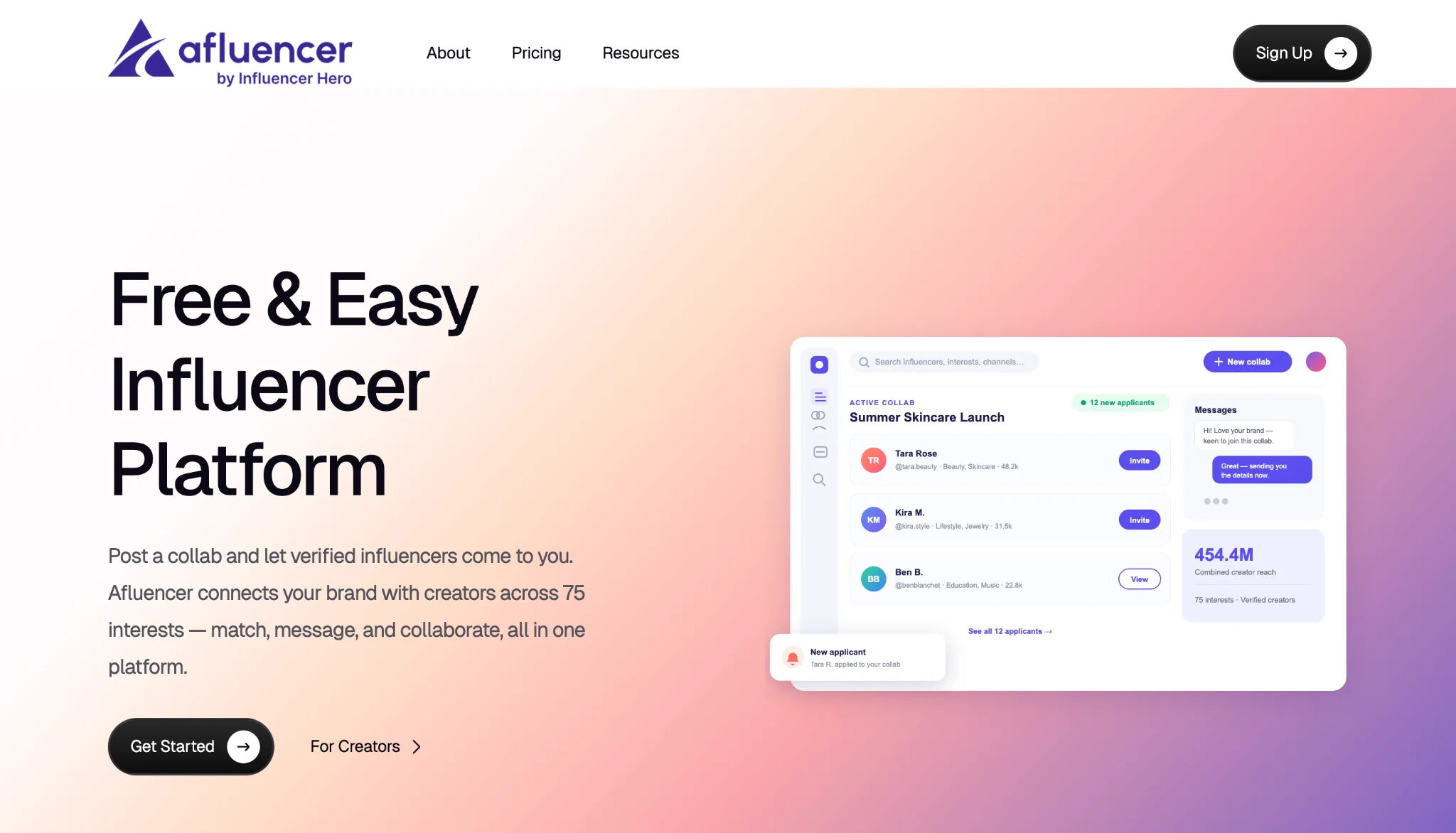
Afluencer is used by more than 7,000 brands, mostly SMBs and DTC teams assembling their first structured creator program. Creators sign up across more than 75 interest categories and apply to the collaborations brands post, so the brand's job becomes choosing rather than chasing. It now sits within Influencer Hero.
Key Features
- Collab Listings: post the collaboration and let interested creators come to you.
- Opt-In Profiles: every creator chose to be listed, across more than 75 categories.
- One Dashboard: matching, messaging and collaboration tracking without leaving the platform.
- Forty-Plus Integrations: Shopify, Klaviyo, Amazon and Slack among them.
- Profile Analytics: audience demographics and engagement data on every applicant.
Platform Coverage
Afluencer supports Instagram, TikTok, YouTube and X.
Pricing
- Marketplace: $49/month including 60 invitation credits.
- Standard: $649/month for 1,000 reach-outs, product send-outs and influencer payments.
- Pro: $1,049/month for 5,000 reach-outs, a dedicated account manager and three or more seats.
Reviews
4.6/5.0 (G2, 738 reviews). It is the largest sample here, though it covers creator-side users as well as brands.
Standout Features
- $49 to Start, Published: the cheapest transparent entry point in this comparison.
- Applications Instead of Outreach: response rates rise when the creator made the first move.
- A Verified Base: listings are opt-in rather than scraped.
Starngage vs Afluencer
These two run the same play, and the fee structure is the whole difference. Both are marketplaces where creators apply to your brief instead of ignoring your email. Starngage takes a percentage of every deal. Afluencer charges $49 a month flat on its entry plan. A brand paying creators $10,000 in a quarter hands Afluencer $147 and Starngage $1,000 for broadly the same job. Afluencer also covers X, includes creator payments on its higher tiers, and carries 738 G2 reviews against Starngage's 20.
Geography and volume are where Starngage answers. Five million creators across 180 countries beats Afluencer's base for anyone selling into Asia, and the ranking data behind the search is genuinely deeper. Threads coverage belongs to Starngage alone. If your campaigns run in the US, UK or Australia, Afluencer does the job for a fraction of the money. If your next launch is in Indonesia, Starngage is the one that will actually find you creators.


IZEA

IZEA replaced its long-running Flex product with ZED in March 2026, an AI-led system covering the full campaign lifecycle. The company behind it is publicly listed and sells three things at once: self-serve marketplace access, the ZED platform, and a managed team for enterprise brands.
Key Features
- ZED Workflow: plan, partner, produce, publish, promote and pay handled as one cycle.
- Creator Intelligence Analytics: campaign reporting with live optimisation while a campaign is still running.
- Open Marketplace: brands and creators match directly, with no account manager in between.
- FormAI: AI community tools layered onto the marketplace.
- Managed Team: strategy, content studio, social commerce and performance marketing delivered by IZEA staff.
Platform Coverage
No explicit network list is published. TikTok features heavily throughout its materials, with platform partnerships referenced only in general terms.
Pricing
- Free: $0 for basic marketplace membership.
- Creator Pro: $9/month, with AI tiers at $23 and $47/month.
- Marketer Pro: $129/month for brand-side marketplace access.
- Managed services: quote-only, scoped by proposal.
Reviews
3.9/5.0 (G2, 32 reviews). These are logged against the legacy Flex product, so they may not reflect ZED.
Standout Features
- Starts at Zero: a free marketplace tier plus published paid plans on both sides of the market.
- Software, Marketplace and Agency: three delivery models from one listed company.
- AI Through the Whole Cycle: ZED is built around AI assistance rather than having it bolted on.
Starngage vs IZEA
Both are marketplaces with a managed service attached, so the question is how you want to pay and how far the workflow runs. IZEA charges $129 a month for brand-side access, a fixed number no matter what you spend on creators, and its ZED cycle explicitly ends in payment. Starngage takes 10% of every deal instead, which is cheaper for one campaign a year and considerably worse for twelve.
Data and reach are Starngage's answer. Five million creators across 180 countries with ranking databases behind the search beats IZEA's discovery for most campaigns outside the US, and IZEA's 3.9 rating is the lowest here. IZEA also publishes no clear network list, which makes coverage hard to check before you buy. Read it as a straight trade: flat monthly access to a fuller workflow, or pay-per-deal access to a far bigger creator pool.
Later
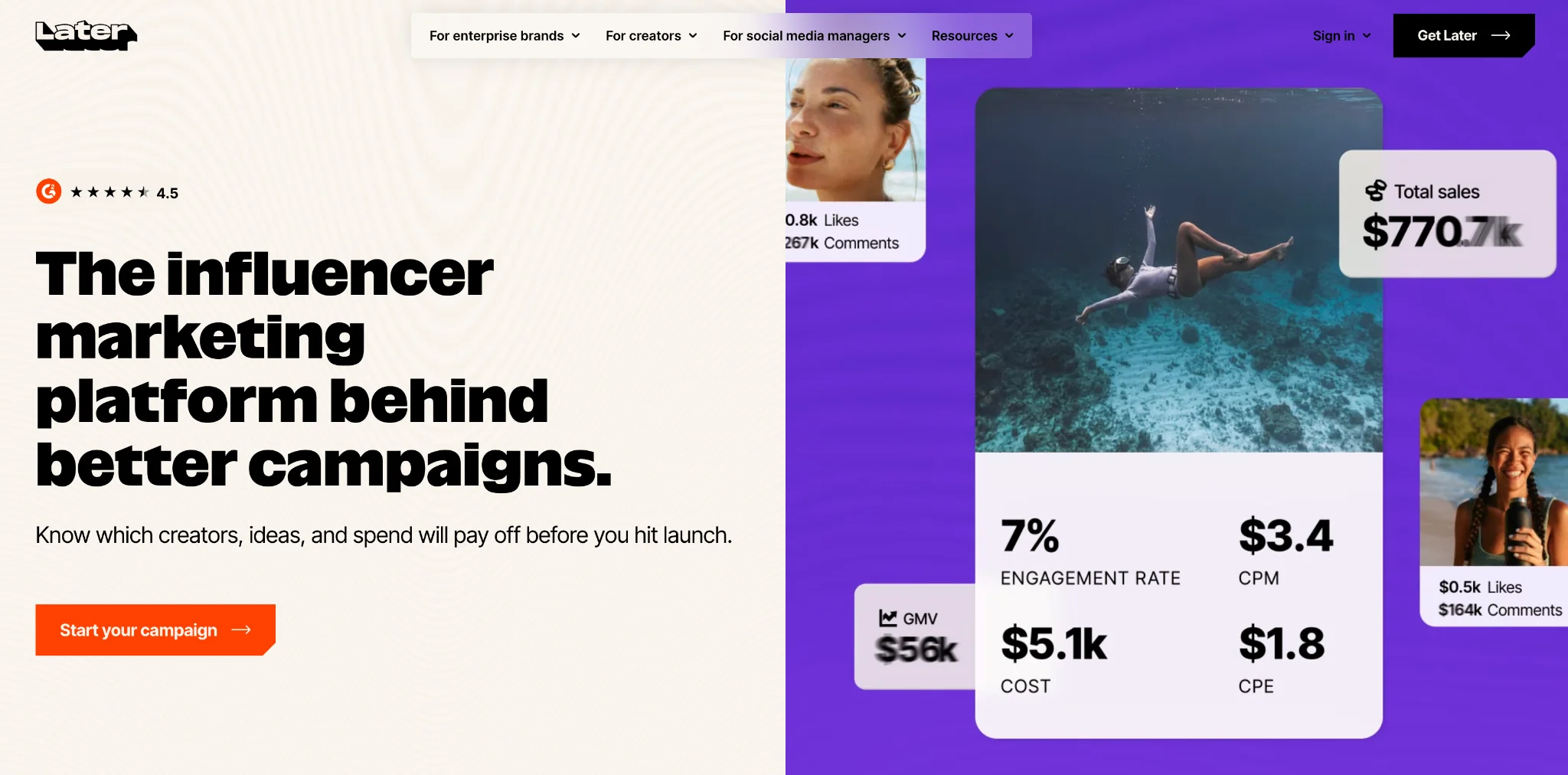
Later Influence is the platform formerly called Mavrck, an enterprise creator system used by Wayfair, Nike, Southwest, Unilever and Chewy, with an optional agency team attached. It shares a name with Later's social scheduling tool but is a separate product sold on separate terms, which catches out plenty of buyers.
Key Features
- 20 Million Creator Search: brand signals guide the results, with risk indicators surfaced early.
- Rate Benchmarks: Incentive Advisor shows what creators on each channel typically get paid.
- EdgeAI Forecasting: predicts how a campaign will perform before you approve the budget.
- One Reporting View: paid, organic and sales numbers arrive in the same dashboard.
- Audience Overlap: flags shortlisted creators sharing the same followers and suggests where budget should go.
Platform Coverage
No network list is published for Later Influence. Instagram and TikTok appear throughout its material, while the separate scheduling product covers the major networks.
Pricing
- Later Influence: quote-only, with access through a booked strategy call.
- Social media management (separate product): Starter $18.75/month, Growth $37.50/month and Scale $82.50/month, billed annually.
Reviews
4.5/5.0 (G2, 469 reviews); 4.6/5.0 (Capterra, 135 reviews under the legacy Mavrck listing)
Standout Features
- Forecasting Before Spend: EdgeAI turns budget approval into a modelled decision.
- Pay Benchmarks: rate negotiation starts from data rather than instinct.
- Run It or Hand It Over: the same platform works in-house or with Later's services team.
Starngage vs Later
Rate data is the interesting overlap. Starngage publishes rate cards you can use as leverage on the marketplace. Later goes further, benchmarking compensation channel by channel through Incentive Advisor and forecasting outcomes with EdgeAI before any money moves. Its reporting also pulls paid, organic and sales metrics into a single view, which is well beyond what Starngage's hashtag and performance analytics set out to do.
Access is the catch. Later Influence sells through a strategy call, quote-only, at enterprise prices. Starngage costs nothing to try and shows the fee up front. Watch the naming as well, because Later's cheap published plans belong to the scheduling tool rather than the creator platform. Mistaking one for the other makes Later look several hundred dollars a month cheaper than it is. Starngage stays the practical pick for a brand that wants a campaign live this week.
Brandbassador (Club)
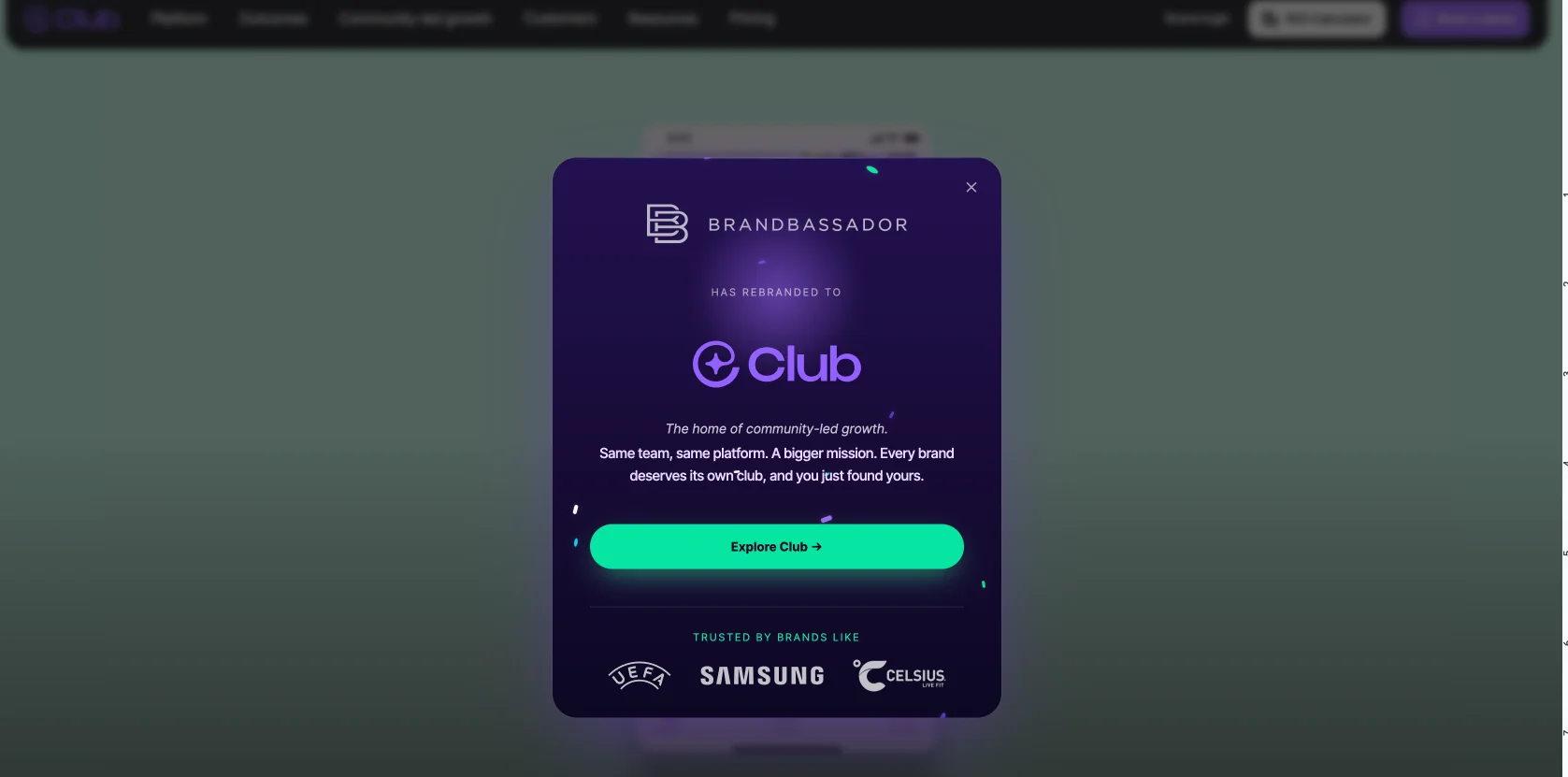
Brandbassador, now trading as Club after brandbassador.com moved to club.co, runs on missions. Your existing customers join an ambassador community, complete tasks for rewards, and the platform tracks and pays what they earn. Samsung, Celsius, Daniel Wellington and Fabletics are among the brands using it.
Key Features
- Mission Library: more than 100 ready-made task templates that ambassadors complete for rewards.
- Reward Automation: commission is calculated and paid without manual reconciliation.
- Your Own App: a white-labelled mobile and web portal carrying your branding.
- Group Activation: segment the community and push notifications to the group you want posting.
- Content and Reviews: UGC collection and review generation, with a Shopify connection.
Platform Coverage
Ambassador posting missions name Instagram and TikTok. No full network list is published.
Pricing
- Club Hub, Club Suite and Club Universe: all quote-only, with cost scaling by the number of active ambassadors and missions.
Reviews
4.7/5.0 (G2, 107 reviews, listed as Club formerly Brandbassador). It is the highest rating here on a solid sample.
Standout Features
- Repeatable Activation: the template library turns running hundreds of ambassadors into a process, not a project.
- Branded Community Experience: ambassadors see your brand, not the vendor's.
- Customers as the Source: the roster comes from people who already bought from you.
Starngage vs Brandbassador
Where the creators come from is the whole difference. Starngage introduces you to strangers who apply to your brief. Brandbassador turns people who already bought from you into an ambassador community, then runs missions to keep them posting. It calculates and pays rewards automatically and tracks affiliate revenue, both of which Starngage leaves on your desk.
Neither gives you a fixed bill, since both scale with activity. Brandbassador prices by active ambassadors and missions on a quote you have to ask for. Starngage takes a percentage you can calculate yourself. If you have no community yet and need reach in new markets, Starngage is the sensible starting point. If you already have thousands of customers who like you enough to post, Brandbassador makes better use of them.
Lefty
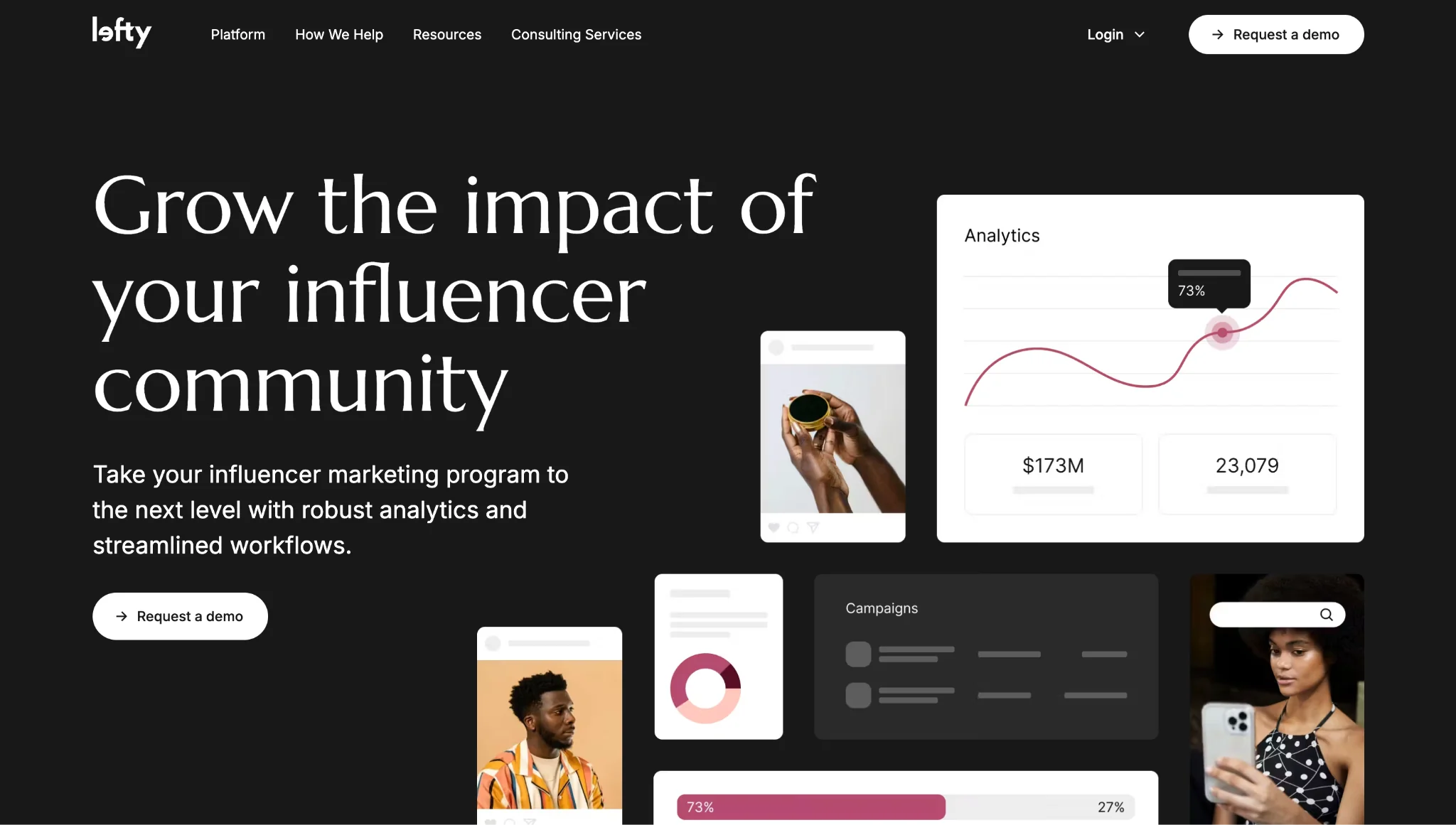
Lefty leans on campaign analytics rather than affiliate mechanics, and its network list reaches further east than anything comparable, taking in Weibo, Douyin and Red. Louis Vuitton, Tommy Hilfiger, Ralph Lauren and Guerlain are clients, which tells you where the casting and benchmarking have been tuned.
Key Features
- Vetted Database: more than 30 million profiles, curated rather than open signup.
- Team Casting: a CRM where several people shortlist and comment on the same campaign.
- Rival Benchmarking: performance measured against direct competitors in your category.
- Large-Scale Gifting: seeding workflows designed for programs sending to many creators at once.
- Affiliation: affiliate tracking is live, while creator payments are still listed as coming.
Platform Coverage
Lefty covers Instagram, TikTok, X, YouTube, Snapchat, Weibo, Douyin and Red.
Pricing
- Every plan: quote-only, by demo request, with no published figures.
Reviews
4.7/5.0 (G2, 92 reviews)
Standout Features
- Mainland China Networks: Weibo, Douyin and Red access that Western platforms almost never offer.
- Tuned for Luxury: casting and reporting built around fashion and beauty programs.
- Share of Voice: benchmarking against rivals rather than internal trend lines.
Starngage vs Lefty
This is the one place where Starngage's Asian strength meets a real rival. Lefty covers Weibo, Douyin and Red alongside the Western networks, which is mainland China access Starngage cannot match, and its 30 million profiles are vetted rather than open to anyone. For luxury and fashion brands the casting and share-of-voice analytics are built for precisely that work. Our guide to AnyTag alternatives covers more options for Asia-focused programs.
Lefty is quote-only and enterprise-priced, and creator payments are still on its roadmap rather than in the product. Starngage pays creators today through escrow, with no subscription attached. Threads is a Starngage-only network as well. A modest budget running Southeast Asia campaigns will find Lefty oversized. A brand whose growth depends on mainland China will find Starngage cannot reach the platforms that matter.
Klear

Klear is no longer sold as its own product. It is the influencer module inside Meltwater, and its old domain now redirects there. Buyers usually arrive through the wider media, social and consumer intelligence suite, which makes it a comfortable fit for PR and communications teams already tracking earned coverage.
Key Features
- AI-Assisted Search: more than 30 million profiles, with results tuned to your brand over time.
- True Reach: reach recalculated with fraudulent and suspicious followers stripped out.
- Approvals and Payments: content sign-off workflows plus creator payment processing.
- Discount Code Attribution: Shopify and WooCommerce conversions tied to unique codes.
- Global EMV Reporting: earned media value and return reporting across more than 190 countries.
Platform Coverage
Meltwater publishes no current network list for the module, so confirm coverage during evaluation.
Pricing
- Every plan: quote-only, by demo request, with no published figures.
Reviews
4.3/5.0 (Capterra, 13 reviews). These date from 2019 to 2023 and predate the Meltwater consolidation, so no current standalone rating exists.
Standout Features
- Reach You Can Trust: True Reach removes inflated followers before the number is reported.
- One Suite With PR Data: creator results sit beside media monitoring and consumer conversation.
- 190-Plus Countries: localised, multi-language search and reporting at global scale.
Starngage vs Klear
Audience quality is where these two meet. Starngage screens for fake followers on an open marketplace, which is exactly where that screening is needed. Klear goes deeper by removing suspicious followers from the reach figure itself, and it adds eCommerce attribution through Shopify and WooCommerce discount codes that Starngage has no equivalent for. It also processes creator payments and searches in multiple languages.
Transparency runs the other way. You can see Starngage's fee before signing up, and its 20 reviews are at least recent. Klear gives you a quote and nothing else, its brand now lives inside a much bigger suite, and its only public ratings were written before that happened. Communications teams already paying for Meltwater have an easy decision. Everyone else is weighing a free marketplace with a known percentage against an enterprise suite with no published price at all.
Final Thoughts on Starngage Alternatives
Work out which part of the fee is actually bothering you before you shortlist anything. If the 10% has quietly become your biggest line item, the fix is a flat subscription that spans the work: Influencer Hero at $649 a month covers discovery, outreach, CRM, gifting, affiliate tracking and payouts, and stops charging you more every time a campaign performs. If the marketplace model is fine but the price is not, Afluencer runs the same play from $49 with published pricing. If what you are missing is the layer after the post, Aspire ties creator content to Shopify revenue and Brandbassador turns your customers into a paying ambassador base. And if the reason you are on Starngage is Asian creator supply, be careful what you swap it for, because Lefty is the only tool here that reaches mainland China properly and most of the rest barely index the region at all.