


Upfluence Pricing Explained: Plans, Features & Review
Upfluence is an influencer marketing software built to help D2C brands manage creator discovery, outreach, affiliate tracking, gifting, payments, and campaign reporting in one platform. For founders and eCommerce teams, its biggest appeal is the ability to connect influencer campaigns directly to revenue through Shopify, Amazon, and affiliate integrations. However, its pricing, annual contracts, and advanced feature set may not suit every growing brand.
In this article, we break down Upfluence pricing, key features, reviews, limitations, and the best Upfluence alternatives to consider.
Upfluence Pricing
Based on available research and recent information, Upfluence pricing starts at approximately $1,276/month on an annual contract, billed monthly. Brands can also choose an upfront annual payment option of approximately $14,406 per year, compared to $16,007 per year when paying monthly. Pricing can vary depending on the number of users, required integrations, campaign volume, and whether optional modules are included.
Free Trial
Not publicly available. Brands typically need to book a demo and speak with sales to receive a customized quote and platform access.
Contract
Annual contract required, with some quarterly payment options available. Month-to-month subscriptions are generally not offered.
Upfluence Overview
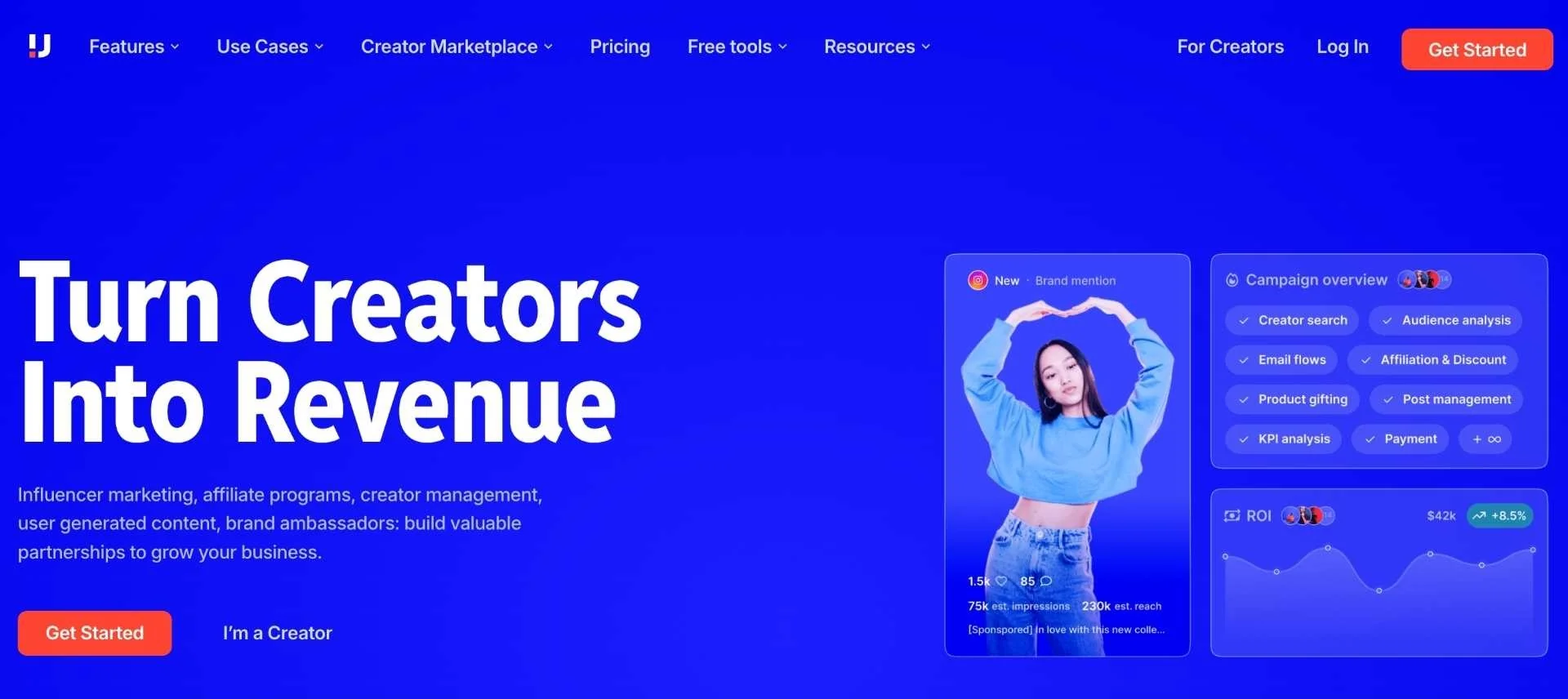
Upfluence is an all-in-one influencer and affiliate marketing platform built for eCommerce and DTC brands. It helps teams discover creators, manage influencer outreach, run campaigns, track affiliate sales, manage gifting, process creator payments, and measure ROI from one dashboard. Upfluence’s own positioning focuses heavily on eCommerce integrations, influencer discovery, affiliate tracking, and AI-assisted campaign workflows.
Key Features
Influencer Discovery
Upfluence gives brands access to a large creator database with filters for niche, location, follower size, engagement rate, audience demographics, and content topics. It supports discovery across Instagram, TikTok, YouTube, X, Twitch, Pinterest, and blogs.
AI Campaign Assistant
Upfluence includes Jaice/Jace AI for automating campaign setup, outreach, and workflow support. This can help teams create campaign flows, personalize outreach, and reduce manual campaign work.
Creator CRM and Campaign Management
Teams can manage creator lists, outreach, conversations, campaign stages, briefs, affiliate codes, deliverables, and performance tracking inside the platform.
Shopify Integration
Upfluence can connect with Shopify to identify influential customers, manage product gifting, track sales, and turn customers into affiliate or influencer partners.
Amazon Sales Tracking
Upfluence supports Amazon-focused influencer marketing by helping brands track affiliate links, sales, and campaign performance tied to Amazon activity.
Affiliate and Promo Code Management
Brands can generate unique promo codes, track affiliate revenue, monitor commissions, and measure revenue, ROI, AOV, and campaign performance from dashboards.
Creator Payments
Upfluence Pay supports bulk creator payments, useful for teams managing paid collaborations at scale.
Social Listening
Upfluence includes social listening features to monitor relevant conversations, competitor mentions, product topics, and high-performing posts.
Best For
Upfluence is best for eCommerce, DTC, Amazon sellers, Shopify brands, agencies, and mid-market to enterprise teams that want influencer discovery, affiliate tracking, creator payments, campaign management, and ROI reporting in one platform. It is especially useful for brands that want to turn customers into creators or manage influencer campaigns tied directly to sales.
Reviews
4.6/5.0 (G2)
Common praise includes strong influencer search, bulk outreach, Shopify/email integrations, and centralized campaign workflows, while some mention onboarding time and mixed support experiences.
Upfluence Standout Features
Customer-to-Creator Discovery
Upfluence’s Shopify integration can identify influential customers already buying from your store, helping brands recruit more authentic advocates instead of relying only on cold creator discovery.
Amazon + DTC Sales Attribution
Unlike many influencer platforms that focus mainly on social engagement, Upfluence supports both Shopify and Amazon tracking, making it stronger for brands selling across multiple commerce channels.
AI-Assisted Campaign Automation
Jaice/Jace AI helps streamline campaign setup, outreach, follow-ups, gifting workflows, approvals, and payments, which is useful for teams trying to scale beyond manual spreadsheets.
Upfluence Limitations
High pricing for smaller teams
Upfluence can be expensive for startups or small brands, especially with annual commitments and add-on modules.
Annual contract commitment
The platform is generally sold on annual terms, which may not suit brands testing influencer marketing for the first time.
Learning curve
Because Upfluence combines discovery, CRM, payments, affiliate tracking, eCommerce integrations, and reporting, new users may need time to fully understand the workflow.
Campaign editing can feel rigid
Some users report that certain campaign setup elements are difficult to edit once created, which can slow down teams that need flexible campaign changes.
Location and creator data may need verification
Like most influencer databases, creator location, audience, and profile data may not always be perfect, so manual vetting is still important.
Support experience can vary
While many users praise onboarding and support, others report slower issue resolution or inconsistent support quality.


Is Upfluence Worth It?
Yes—Upfluence is worth considering for established eCommerce brands that want an all-in-one influencer marketing platform with strong Shopify and Amazon integrations, affiliate tracking, creator payments, and campaign management. Its ability to identify influential customers, manage affiliate programs, and directly connect influencer activity to revenue makes it particularly attractive for brands focused on measurable ROI rather than awareness alone.
However, Upfluence may not be the best fit for every business. The platform comes with a relatively high price point, annual contract commitments, and a learning curve that can feel overwhelming for smaller teams. Some users also report limitations around campaign flexibility, data accuracy, and workflow usability compared to newer platforms.
Upfluence may not be ideal for:
- Small businesses and startups with limited influencer marketing budgets.
- Brands looking for a low-cost monthly subscription without long-term commitments.
- Teams that prioritize simplicity and ease of use over advanced functionality.
- Companies running primarily creator seeding campaigns that don't require robust affiliate tracking or eCommerce integrations.
For brands that find Upfluence too expensive, complex, or eCommerce-focused, several alternatives may offer a better fit depending on campaign goals:
- Influencer Hero – Best for brands looking for advanced CRM automation, AI-powered outreach, gifting, affiliate tracking, and flexible pricing without enterprise-level complexity.
- Afluencer – A strong choice for brands focused on discovering creators and managing partnerships through a marketplace-based approach.
- GRIN – Ideal for larger DTC brands that need deep eCommerce integrations and creator relationship management.
- Aspire – Well-suited for brands that value workflow automation, creator applications, and strong customer support.
- Influencity – A cost-effective all-in-one platform with strong influencer discovery, CRM, and reporting capabilities.
Overall, Upfluence remains one of the strongest influencer marketing platforms for eCommerce brands that need robust affiliate and revenue tracking, but brands prioritizing affordability, ease of use, or greater flexibility may find a better fit with newer alternatives.
Final Thoughts
Upfluence is a comprehensive influencer marketing platform that combines creator discovery, outreach, campaign management, affiliate tracking, payments, and ROI reporting in a single solution. While its advanced functionality and data-driven approach make it a powerful platform for growing and established brands, the high pricing, annual commitments, and learning curve may make it less suitable for smaller teams.
If Upfluence doesn’t seem like the right fit for your business, be sure to explore our guide to the best Upfluence Alternatives, where we compare leading platforms for influencer discovery, campaign management, affiliate marketing, and creator relationship management.