

Refersion Alternatives: Best Influencer Marketing Platforms
Most teams start comparing Refersion alternatives once their creator program needs more than affiliate tracking. Tracking shows which creators drove sales, but it does not help a brand find those creators, reach out to them, ship them products or collect the content they make. Refersion is a first-party affiliate tracking and payout platform for eCommerce stores, and it handles commission tracking well, while most growing D2C brands eventually need influencer marketing software that also covers influencer discovery, influencer outreach, product seeding and campaign management.
This guide compares Refersion with ten influencer marketing platforms that combine affiliate tracking with the rest of the creator workflow, looking at core features, platform coverage, pricing, reviews and the situations where each tool fits best. The ten alternatives covered are Influencer Hero, Upfluence, Afluencer, Aspire, SARAL, IMAI, Modash, Influencity, Kolsquare and Social Cat.
Criteria for Suggesting Platform Alternatives
Core Features
Evaluation of each platform's essential capabilities, including influencer discovery, outreach, CRM, campaign reporting, gifting, UGC and content collection, affiliate tracking and payments, storefronts, application pages, and AI-powered tools.
Supported Social Media Platforms
Assessment of how well each platform integrates with major social networks such as Instagram, YouTube, TikTok, Facebook, Pinterest, and many more
Pricing & Contract Flexibility
Comparison of pricing models, subscription costs, and contract requirements to help brands choose solutions that match their budget and scalability needs.
Standout & Differentiating Features
Highlighting unique or innovative functionalities that set each platform apart, such as real-time tracking dashboards, creator benchmarking, TikTok email discovery, or advanced automation tools.
Customer Reviews & User Satisfaction
Analysis of verified user feedback from credible platforms like G2, TrustRadius, Capterra, focusing on usability, reliability, value for money, customer support, and real-world performance.
Refersion Overview
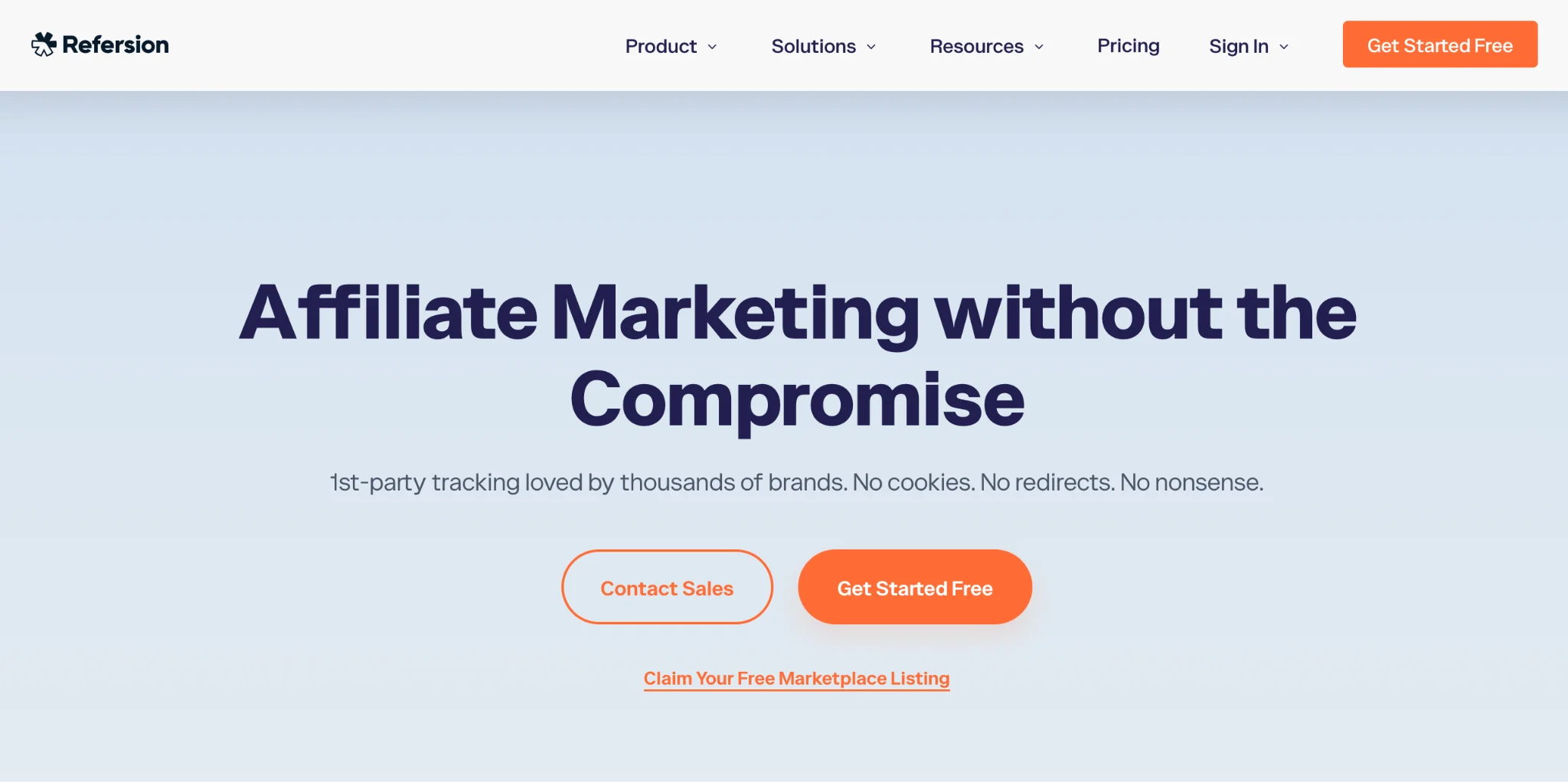
Refersion is an affiliate marketing platform built for eCommerce brands that want to track affiliate-driven sales, calculate commissions and pay partners from one dashboard. It runs first-party tracking without cookies or redirects, which helps attribution hold up as browsers restrict third-party cookies, and it connects with Shopify, WooCommerce and BigCommerce so brands can track sales without custom development. Its free Marketplace listing also gives brands a way to publish an offer and receive applications from affiliates before paying for a plan.
Key Features
- First-Party Affiliate Tracking: Sales are attributed without third-party cookies or redirects, so tracking stays accurate as browser privacy rules tighten.
- Unlimited Affiliates and Conversions: Paid plans place no cap on affiliates, clicks or conversions, which means brands are not charged extra per partner.
- Flexible Commission Structures: Brands can set percent-of-sale and subscription commissions, with product-level rules and different rates for new and returning customers on the Growth plan.
- One-Click Payouts: Affiliate payments go out through PayPal, with Stripe and Trolley available through integrations and tax forms collected in the platform.
- Refersion Marketplace: A free public listing lets affiliates browse a brand's offer and apply, which gives teams a simple way to test affiliate interest.
- API and Integrations: The Growth plan adds API access and 30+ marketing integrations, including Klaviyo, Attentive, Gorgias and Zapier.
Platform Coverage
Refersion does not search or analyze social networks, because it tracks affiliate links and codes wherever they are shared, so brands need a separate tool for creator data on Instagram, TikTok or YouTube.
Pricing
- Marketplace Listing: Free, with a public listing where affiliates can view and apply to a percent-of-sale offer.
- Launch: $39/month plus 3% of affiliate-driven sales, with a lower rate of $29/month shown for annual billing.
- Growth: $199/month plus 2% of affiliate-driven sales, with a lower rate of $159/month shown for annual billing, adding API access, advanced commissions and multi-store management.
- Scale: Custom pricing for brands above $1M GMV a year, billed as a flat monthly subscription without a percentage of sales.
Reviews
4.8/5.0 (Shopify App Store, 462 reviews), 4.2/5.0 (Capterra, 56 reviews) and 3.6/5.0 (G2, 22 reviews). The high Shopify score reflects easy setup and responsive support, while the smaller G2 sample carries most of the criticism about reporting and value for money.
Standout Features
- Cookieless Attribution: First-party tracking protects affiliate revenue data from browser changes that break cookie-based tools.
- Low-Risk Starting Point: A free Marketplace listing and a $39 entry plan let brands test an affiliate program before committing a larger budget.
- Wide eCommerce Integration List: Native connections to Shopify, Shopify Plus, WooCommerce and BigCommerce make it easy to plug into an existing D2C stack.
Limitations (Why Users Look For Refersion Alternatives)
The fee is charged on affiliate-driven sales
Launch adds 3% and Growth adds 2% of every affiliate-driven sale on top of the subscription, so the platform cost grows as the affiliate program grows. A brand generating $50,000 a month in affiliate sales pays $1,000 to $1,500 a month in percentage fees before the subscription is counted.
No influencer discovery or outreach
Refersion does not include a social creator database, search filters or outreach automation, so brands that need to find and recruit influencers have to run that work in another tool or by hand.
No gifting, content or campaign workflows
Product seeding, content approvals, UGC collection and campaign boards are not part of the platform, which means creator programs that go beyond commission tracking need a second system.
Reporting draws the most complaints
Users often describe the dashboard as hard to navigate and the reports as bulk exports, and some say custom reports require help from an account manager.
Affiliate approval can create fraud exposure
Some users note that affiliate sign-ups are approved instantly by default, which can let low-quality or fraudulent partners into a program unless the brand adds its own screening.
10 Best Influencer Marketing Platform Alternatives:
| TOOL | REVIEWS | BEST FOR | TRIAL INFO | PRICING | ||
|---|---|---|---|---|---|---|
1 |

|
⭐ | Influencer CRM & automation | Book Demo | Pricing | Website |
2 |

|
⭐ | Influencer discovery | Book Demo | Pricing | Website |
3 |

|
⭐ | Influencer marketplace campaigns | Book Demo | Pricing | Website |
4 |

|
⭐ | Influencer partnerships | Book Demo | Pricing | Website |
5 |

|
⭐ | Influencer outreach | Book Demo | Pricing | Website |
6 |
|
⭐ | AI influencer discovery & analytics | Book Demo | Pricing | Website |
7 |

|
⭐ | Influencer discovery | Book Demo | Pricing | Website |
8 |

|
⭐ | Campaign management | Book Demo | Pricing | Website |
9 |
|
⭐ | Data-driven influencer discovery & campaign analytics | Book Demo | Pricing | Website |
10 |
|
⭐ | Micro-Influencer Campaigns | Book Demo | Pricing | Website |
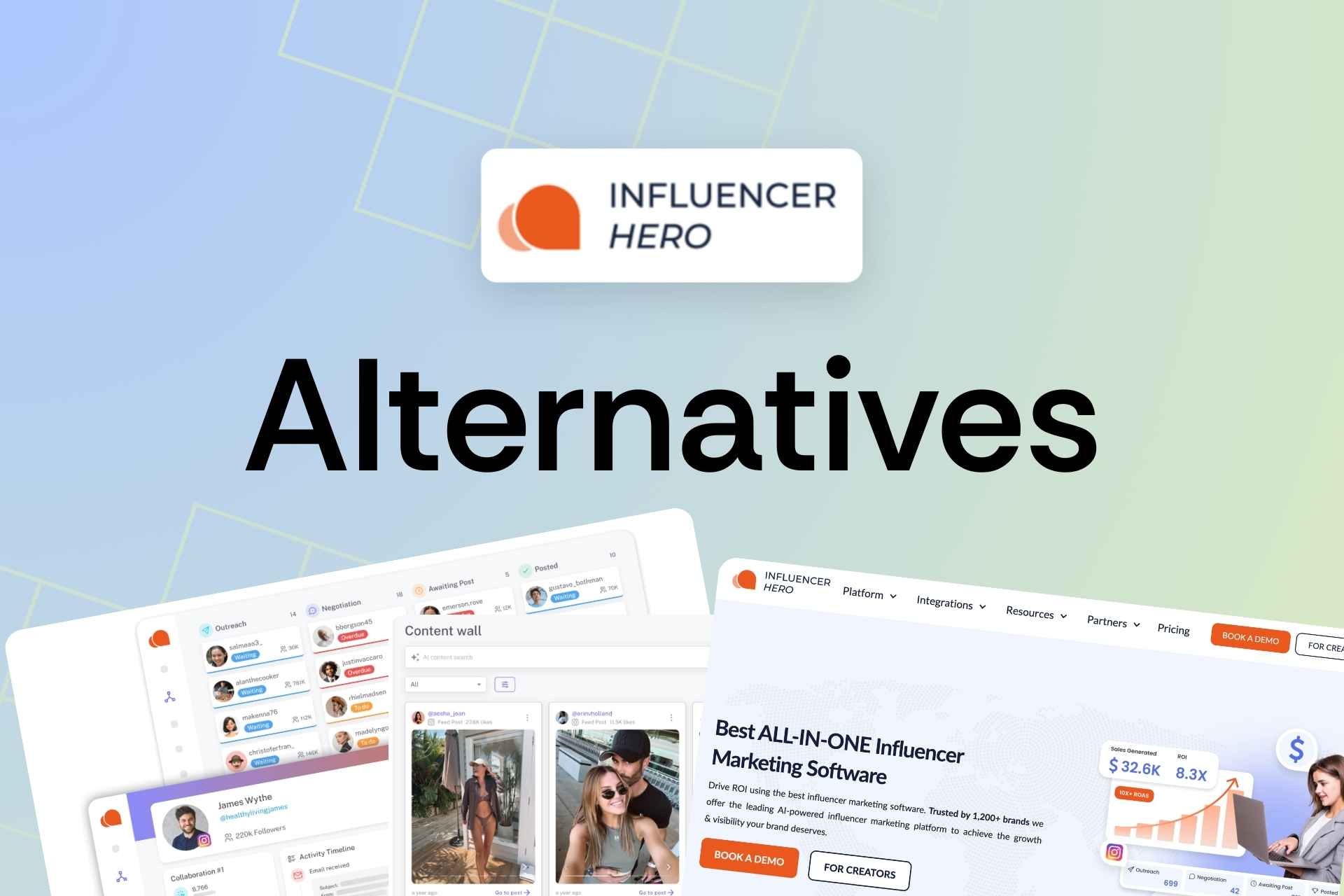
Influencer Hero

Influencer Hero is an all-in-one influencer marketing platform that covers influencer discovery, influencer outreach, CRM, product seeding, UGC collection, affiliate tracking and creator payouts in one workspace. It is used by growing D2C brands, eCommerce teams, agencies and enterprise brands that want to run the full creator program from one system and measure ROI per creator. The platform puts a strong focus on automation, so small teams can manage thousands of creator relationships without adding headcount.
Key Features
- Influencer Discovery: Brands can search a global database of 450M+ creators with 20+ filters for location, audience demographics, interests, engagement rate and follower quality, plus lookalike suggestions.
- Fake Follower Detection: Built-in authenticity checks flag inflated or purchased audiences, so budget goes to creators with real reach.
- Automated Influencer Outreach: AI-personalized email sequences, follow-up suggestions and reply tracking run in bulk or one-to-one, with Instagram DM and WhatsApp messages synced to the same inbox.
- Influencer CRM: Campaign Boards, custom fields and board automations show every creator's stage, deliverables and next step across campaigns.
- Product Seeding and Gifting: Shopify and WooCommerce integrations fulfill gifting orders automatically and track delivery, with script-based support for other eCommerce platforms.
- Affiliate Tracking and Payments: Custom links and discount codes track commissions and conversions, and the Payout Manager pays creators in bulk or on a schedule.
- UGC and Content Review: Posts are collected automatically into a searchable Content Wall, and content review workflows handle approvals and edit requests.
- Storefronts and Application Pages: Creator storefronts drive affiliate sales, while branded application pages bring in inbound creators with product selection built in.
Platform Coverage
Influencer Hero covers Instagram, TikTok and YouTube with a global database of 450M+ creators, 20+ search filters and built-in fraud detection, so brands can find real, relevant creators and get more ROI from every campaign.
Pricing
- Standard: $649/month for up to 1,000 reachouts a month.
- Pro: $1,049/month for up to 5,000 reachouts a month.
- Business: $2,490/month for up to 10,000 reachouts a month.
- Custom & Agency: Custom pricing for agencies and larger programs, with 20% off quarterly billing and 30% off yearly billing on all plans.
Reviews
5.0/5.0 (Capterra)
Standout Features
- End-to-End Payout and Invoicing Automation: The Payout Manager handles bulk payouts and automatic scheduled payments at fees of 0.1% to 0.4% via bank debit. Invoices can be requested automatically when a payout is triggered, and brands can require an approved invoice before money goes out, so payments and paperwork stay matched without manual reconciliation.
- AI-Powered Coupon Code Leakage Prevention: Influencer Hero monitors coupon sites, browser extensions and deal forums for leaked creator codes in real time. When a code is compromised, the platform rotates it automatically and notifies the creator, which protects margins and keeps affiliate attribution accurate instead of revealing the problem weeks later.
- Multi-Platform eCommerce Support: The platform works with Shopify, WooCommerce and custom eCommerce setups through an embedded script. This means brands can track gifting, discount codes and affiliate sales regardless of which store platform they use, which makes it one of the few influencer marketing platforms that is not limited to Shopify.
- Automated, Personalized Outreach: AI-enhanced email flows add personal sentences to every message, so large outreach campaigns still read as one-to-one conversations. The AI Response Drafter and AI Followup Suggestions speed up replies and follow-ups, which helps teams improve reply rates and build longer creator relationships.
Cons
- No free trial: Brands cannot test the platform on their own before paying, so a demo is the way to see how it works.
- Expensive for smaller brands: Plans start at $649 a month, which is a significant commitment for brands that are only starting with influencer marketing.
- Steep learning curve: The platform includes many features, so new teams need some time to set up workflows and learn where everything sits.
Refersion vs Influencer Hero
Refersion is a reliable choice for tracking affiliate-driven sales, and its cookieless attribution is one of the better options for protecting commission data. Its scope, however, starts once a creator is already in the program, so brands still need other tools to find influencers, contact them, ship products and review content. Influencer Hero covers those stages as well, combining a 450M+ creator database with fraud detection, automated outreach, a CRM with board automations, gifting fulfilled through Shopify or WooCommerce, and affiliate codes with commission tracking and coupon-leakage prevention. That makes Influencer Hero the platform that runs the whole influencer program, while Refersion covers the tracking and payout stage of it.
The pricing models also work in different directions. Refersion starts lower, at $39 a month plus 3% of affiliate-driven sales or $199 a month plus 2%, but the percentage grows with every sale, so at $25,000 a month in affiliate revenue the Growth plan already costs $699 a month. Influencer Hero publishes flat plans at $649, $1,049 and $2,490 a month based on monthly reachout volume, with 20% off quarterly and 30% off yearly billing, and it takes no percentage of sales, with creator payouts costing 0.1% to 0.4%. Once affiliate-driven sales pass about $22,500 a month, the flat fee is already the cheaper option, and every additional sale widens the gap, which makes Influencer Hero the stronger platform to build a performance-driven creator program on.
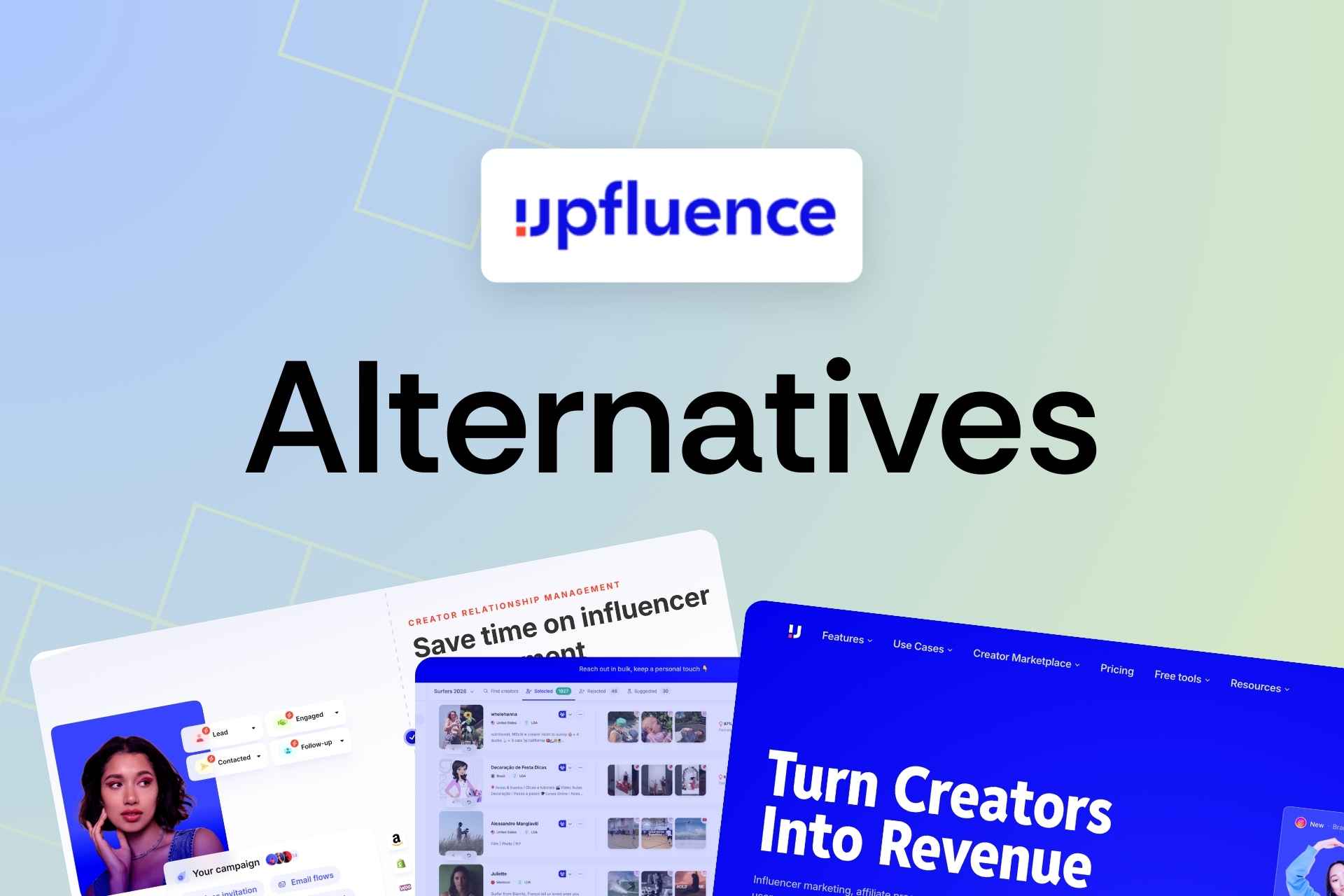
Upfluence
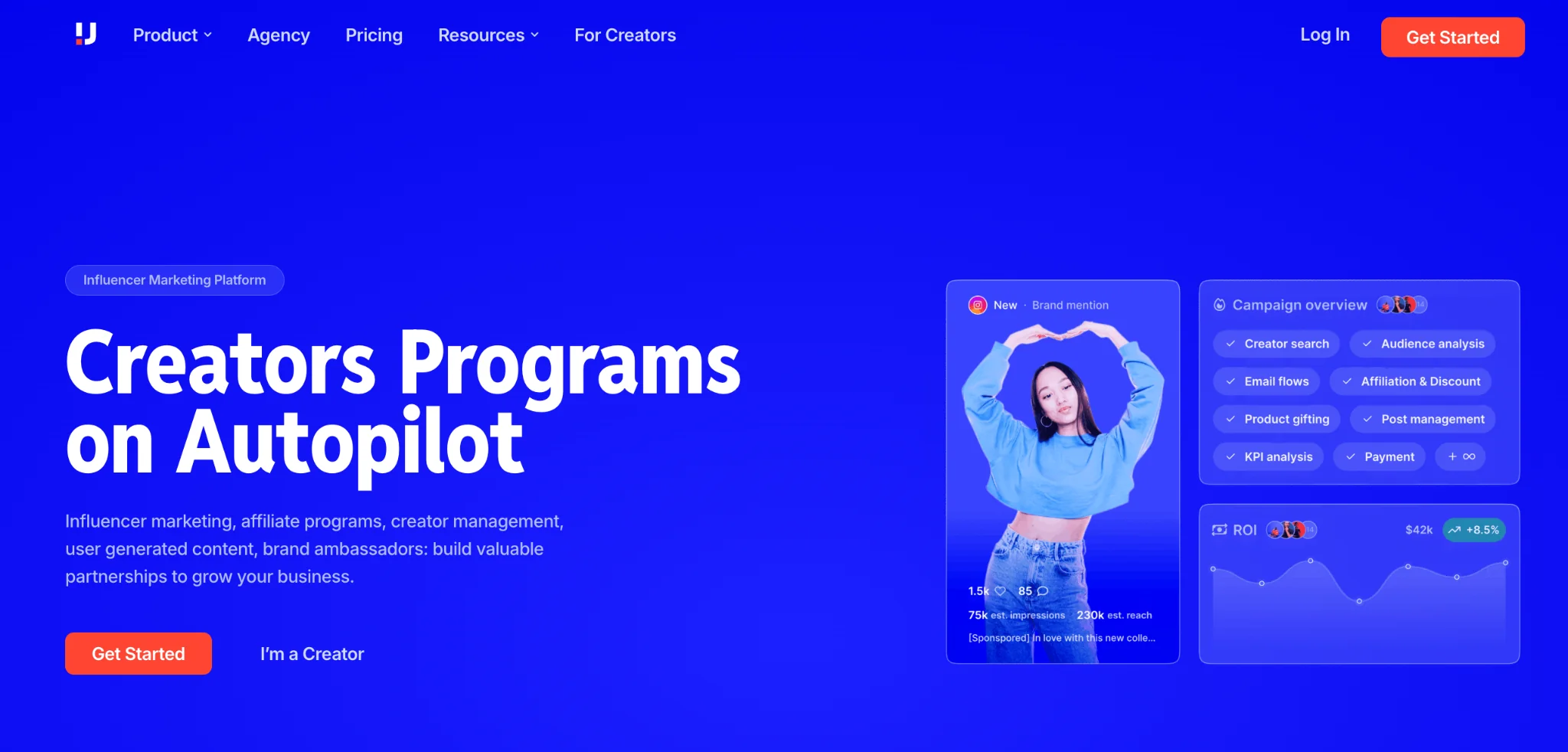
Upfluence is an influencer marketing platform built for eCommerce brands and agencies that want creator discovery, affiliate management and creator payments in one system. It is known for turning existing customers into creators through its store and email list integrations, and for its Jaice AI assistant, which helps teams build creator lists and draft outreach faster.
Key Features
- Influencer Discovery: Brands can search creators across six networks with audience, content and performance filters to build targeted lists.
- Customer-to-Creator Matching: Shopify and Klaviyo connections surface influencers who already buy from the brand or subscribe to its emails.
- Jaice AI: The AI assistant suggests creators and drafts outreach messages, which helps teams launch campaigns with less manual setup.
- Affiliate Management: Commission rules, promo codes and tracked links can be set per partner and matched back to store sales.
- Creator Payments: International payouts run through the platform with tax and compliance handling included.
Platform Coverage
Upfluence covers Instagram, TikTok, YouTube, Twitch, Pinterest and X.
Pricing
- Custom plans: Packages are quoted based on the modules and team size a brand needs, with a fixed platform fee and no share of creator sales.
- Contract terms: Plans usually run on annual agreements, and a trial is offered only after a consultation.
Reviews
4.6/5.0 (G2, 140 reviews)
Standout Features
- Existing Customers as Creators: Store and email integrations help brands recruit from people who already know the product.
- Global Payouts with Tax Handling: Creator payments across countries include the compliance paperwork, which reduces finance work.
- Dedicated Account Manager: Customers get a named contact from onboarding onward to help set up campaigns.
Refersion vs Upfluence
Both platforms handle affiliate tracking and creator payments, but Upfluence stands out with influencer discovery, outreach and customer-to-creator matching, so brands can recruit new partners inside the same tool that tracks their sales. It also charges a fixed platform fee rather than a share of affiliate revenue, which keeps costs more predictable as sales grow.
Refersion, on the other hand, focuses on affiliate tracking alone and is much cheaper to start, with published plans and a free listing, while Upfluence is quoted and usually signed as an annual agreement. For brands that sell on Shopify and want to activate their own customer base as affiliates with guided onboarding, Upfluence is the stronger match.
Afluencer
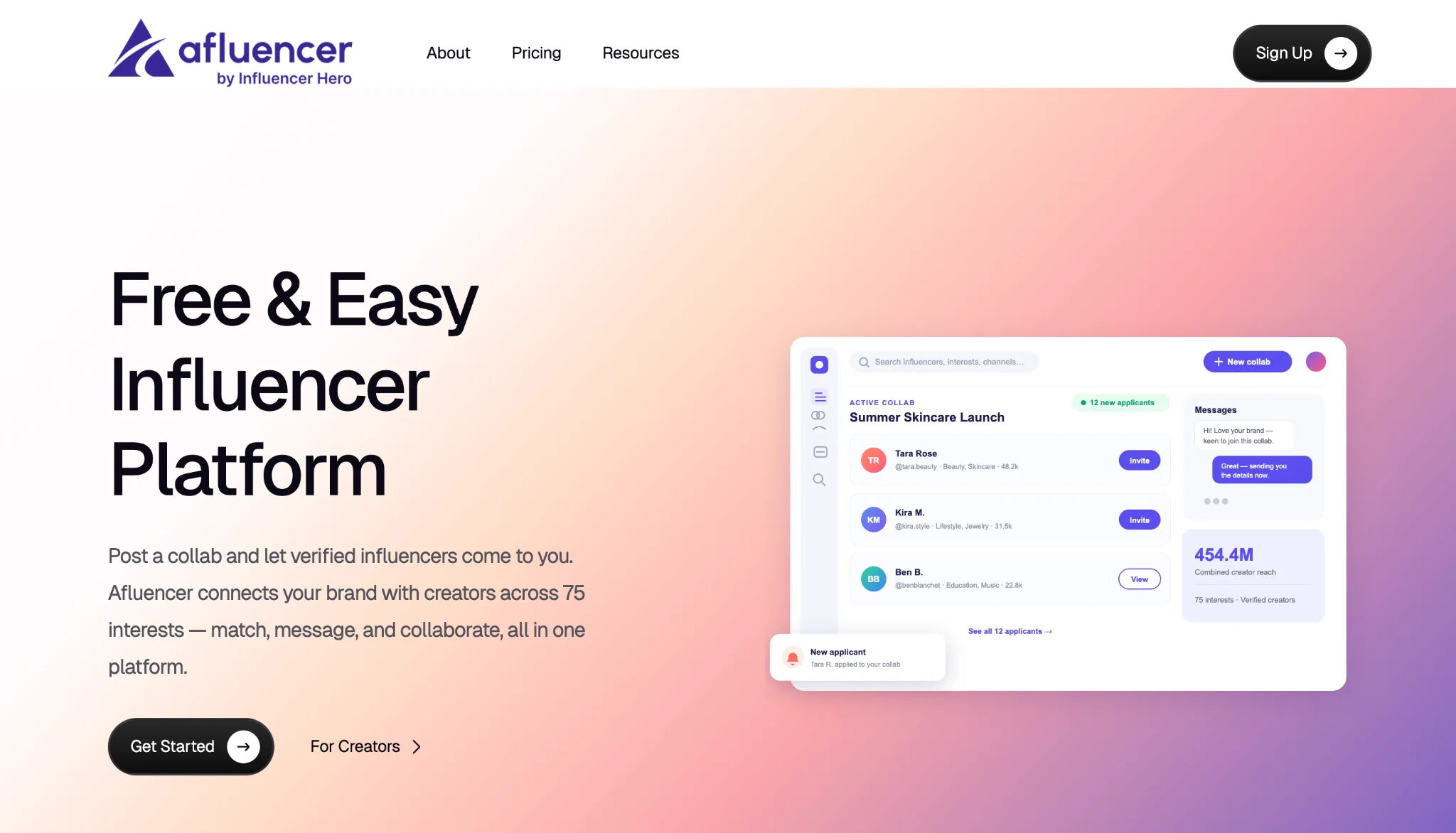
Afluencer is an influencer marketplace where brands post collaboration offers and verified creators apply to work with them. Creators join for free and are organized into more than 75 interest categories, which makes the platform a practical way for smaller brands to recruit affiliates and gifting partners without cold outreach. Its entry plan is priced for teams running their first creator campaigns.
Key Features
- Collab Listings: Brands post an offer with channel, niche and follower targeting, and interested creators apply directly.
- Invitation Credits: Teams can invite specific creators to a collab when they prefer not to wait for applications.
- Applicant Insights: Demographic and engagement data is shown for each applicant, which makes shortlisting faster.
- Premium Search Filters: Brands can filter the creator directory by category, platform and audience size.
- Product Send-Outs and Payments: Upper plans add shipping workflows and creator payments inside the platform.
Platform Coverage
Afluencer lists creators on Instagram, TikTok, YouTube and X.
Pricing
- Marketplace: $49/month with 60 invitations and premium filters.
- Standard: $649/month with up to 1,000 reach-outs, product send-outs and payments.
- Pro: $1,049/month with up to 5,000 reach-outs, three seats and a dedicated account manager.
Reviews
4.6/5.0 (G2, 738 reviews) and 4.7/5.0 (Trustpilot, 160 reviews), with creators writing a good share of the reviews on both sites.
Standout Features
- Opt-In Creator Directory: Every creator on the platform signed up to collaborate, so applicants are already interested in brand deals.
- Affordable Entry Plan: At $49 a month, brands can test creator recruitment without a long contract.
- Inbound Applications: Brands review applicants instead of writing hundreds of cold emails.
Refersion vs Afluencer
Both platforms give brands a way to receive applications from potential partners, but Afluencer stands out with a creator directory built around social profiles, so brands see follower counts, demographics and engagement for everyone who applies. It also adds invitations and filters that help teams actively recruit influencers rather than wait for affiliates to find the offer.
Refersion, on the other hand, focuses on tracking sales and paying commissions once partners are active, which Afluencer's entry plan does not cover in the same depth. For a small brand whose main challenge is finding its first twenty creators rather than tracking their sales, Afluencer is the one to look at.
Aspire

Aspire is an influencer marketing platform used by around 800 brands, mostly in beauty, apparel, food and health. It combines natural-language creator search with structured campaign workflows, and it is built closely around Shopify, so gifting, storefronts and sales reporting all connect back to the store.
Key Features
- Natural-Language Search: Brands describe the creator they want in plain words instead of building a long filter stack.
- Creator Applications: Campaign briefs can be published so creators from an opt-in pool apply to work with the brand.
- Content Approvals: Briefs, revisions and content sign-off are handled in one thread for each creator.
- Storefronts and Promo Codes: Creators get shoppable pages and codes, with sales attributed to each partner.
- CreatorAds: Rights-cleared creator content can be pushed into paid social campaigns.
Platform Coverage
Aspire supports creators on TikTok, Instagram, Facebook, YouTube and Pinterest, with Shopify, PayPal, Gmail and Klaviyo integrations.
Pricing
- Custom quotes only: Aspire does not publish plan prices, offers no free plan and does not provide a self-serve trial.
Reviews
4.6/5.0 (G2, 146 reviews). A separate Capterra listing shows 3.5/5.0 from only six reviews, so the G2 figure is the more reliable signal.
Standout Features
- Sales-Based Reporting: Storefronts and codes report the revenue each creator generated rather than estimated reach.
- Built-In Approval Workflow: Content review is part of every campaign, so teams avoid long email chains.
- Paid Amplification: Usage rights and whitelisting are handled before content goes into ads.
Refersion vs Aspire
Both platforms connect creator activity to Shopify sales through codes and tracked links, but Aspire stands out with creator search, casting briefs, content approvals and paid amplification, so it can run an influencer program from recruitment to ads. Its storefronts also give creators a more visual way to promote products than a standard affiliate link.
Refersion, on the other hand, is published, self-serve and inexpensive to start, while Aspire is quote-only with no trial and is usually priced for brands with a meaningful creator budget. For a mid-market Shopify brand that wants creator content feeding its paid social campaigns, Aspire is worth the call.


SARAL
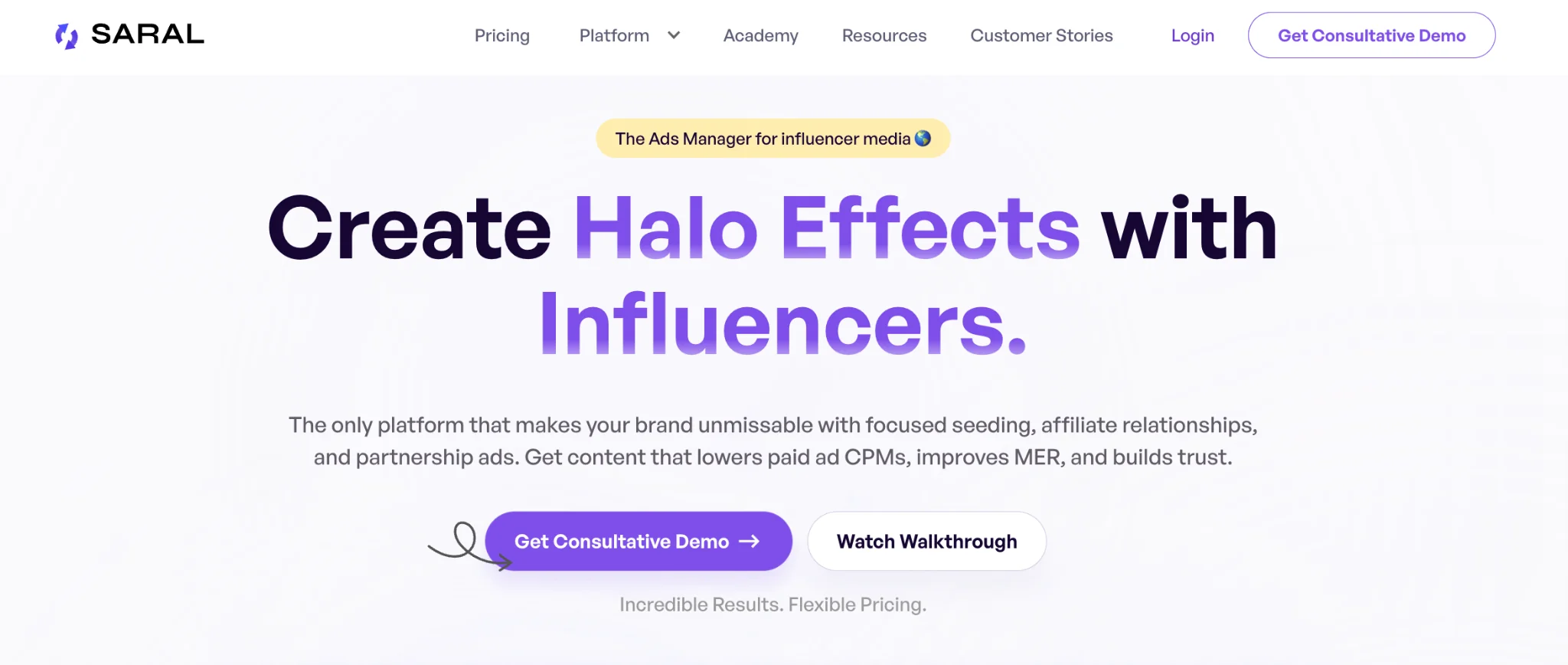
SARAL is an influencer CRM for D2C teams that manage creator programs in-house. It works mainly through a Chrome extension and the team's Gmail inbox, and it covers sourcing, outreach, product seeding, affiliate tracking and content rights in one workflow. Reviewers often highlight its responsive support team.
Key Features
- Chrome Extension Sourcing: Creators can be added to lists directly from their profile pages while browsing.
- Gmail Outreach: Sequences and follow-ups are sent from the brand's own inbox, which helps deliverability.
- Creator CRM: Every message, deal and shipment is stored against the creator record.
- Cookieless Affiliate Tracking: Commission tracking continues to work without third-party cookies.
- Automatic Content Rights: Posts are detected, usage permission is requested and files are downloaded automatically.
Platform Coverage
SARAL works with creators on Instagram, TikTok and YouTube.
Pricing
- Starter: $3,600 per quarter or $12,000 per year for 100 active partnerships and one seat.
- Business: $4,500 per quarter or $15,000 per year for 500 partnerships, three seats and unlimited post tracking.
- Professional: $7,500 per quarter or $25,000 per year for 1,000 partnerships and ten seats, with no monthly billing option on any plan.
Reviews
4.8/5.0 (G2, 56 reviews), a smaller sample than some tools but a consistently positive one.
Standout Features
- Familiar Working Environment: The browser extension and Gmail setup mean teams do not have to learn a new dashboard.
- Ambassador Pipelines: Existing customers and site visitors can be turned into ambassadors.
- Four Workflows in One Plan: Sourcing, outreach, seeding and affiliate tracking are included together.
Refersion vs SARAL
Both platforms track affiliate commissions without relying on third-party cookies, but SARAL stands out with creator sourcing, Gmail outreach sequences, product seeding and automatic content rights, which covers the recruiting side that affiliate-only tools leave out. Its CRM also keeps shipments and conversations next to the sales data.
Refersion, on the other hand, is far cheaper to begin with and bills monthly, while SARAL's smallest commitment is $3,600 a quarter. For a D2C team that already runs creator outreach every week and wants it organized in the inbox it uses daily, SARAL makes more sense.
IMAI
IMAI (InfluencerMarketing.AI) is an influencer discovery and campaign platform with creators indexed in 187 countries. Its database holds around 400 million profiles behind more than 50 filters, and agencies can run the platform under their own branding through white-label workspaces.
Key Features
- Global Influencer Discovery: Brands can search around 400 million creators across 187 countries with 50+ filters.
- Audience Quality Scores: Fake-follower and authenticity checks are shown for each profile.
- Bulk Briefs: Automated outreach sends the campaign brief to many creators at once.
- Link and EMV Tracking: Campaign ROI and earned media value are measured together.
- White-Label Workspaces: The Enterprise plan includes six brandable environments for agencies.
Platform Coverage
IMAI supports Instagram, TikTok, YouTube and X, with LinkedIn used in its B2B use cases.
Pricing
- Personal: $129/month with one seat and 20 creator unlocks.
- Starter: $299/month with two seats and 75 unlocks.
- Growth: $499/month with four seats, 200 unlocks and five campaigns.
- Scale: $1,200/month with seven seats, 500 unlocks and 12 campaigns.
- Enterprise: Custom pricing, with 20% off annual billing and a seven-day trial that does not require a card.
Reviews
4.5/5.0 (G2, 30 reviews) and 4.1/5.0 (Capterra, 16 reviews), with support scoring lowest among the Capterra subcategories.
Standout Features
- International Reach: Creators indexed in 187 countries help brands staff campaigns in many markets.
- Agency White-Labeling: Agencies can present the platform to clients under their own brand.
- Card-Free Trial: Brands can test the platform for a week before paying.
Refersion vs IMAI
Both platforms help brands measure creator-driven results, but IMAI stands out with a large influencer discovery database, audience quality scores and bulk briefing, so teams can build and contact a creator list in the same place they track campaign ROI. Its EMV reporting also gives brands a view of awareness value alongside clicks.
Refersion, on the other hand, goes deeper on commission rules, payouts and first-party sales attribution, which IMAI handles more lightly. For an agency that wants to offer creator discovery to clients under its own name, IMAI is the closer fit.
Modash
Modash is an influencer discovery and campaign platform that indexes every public Instagram, TikTok and YouTube account with more than 1,000 followers. More than 2,600 brands use it, including Birkenstock, Stanley and NordVPN, and it can track creator posts automatically without creators having to connect their accounts.
Key Features
- Complete Creator Index: All public accounts above 1,000 followers on its three networks are searchable.
- Audience Authenticity Checks: Audience quality is analyzed before a brand commits budget.
- Creator CRM: Notes, history and performance data are stored against each creator.
- Automatic Post Tracking: Content is captured whether or not the creator joins the platform.
- Shopify Sync: Discount codes, gifting orders and revenue data move between Modash and the store.
Platform Coverage
Modash covers Instagram, TikTok and YouTube.
Pricing
- Essentials: $199/month for up to 100 creators per campaign.
- Performance: $499/month, which adds affiliate management and creator payments.
- Enterprise: Custom pricing, starting at roughly $14,700 a year for 250 creators.
- Trial: A 14-day free trial with no card required, followed by month-to-month billing.
Reviews
4.9/5.0 (G2, 19 reviews) and 4.9/5.0 (Capterra, 15 reviews), which are high averages on a fairly small combined sample.
Standout Features
- Data Accuracy: Users frequently point to reliable creator data as the main reason they choose it.
- Self-Serve Buying: Published prices, a card-free trial and monthly billing make evaluation simple.
- Frequent Updates: New features are released often, according to users.
Refersion vs Modash
Both platforms offer affiliate tracking and payouts, since Modash's Performance plan includes them, but Modash stands out with a complete influencer discovery index, authenticity checks and automatic post tracking. That gives brands a way to find new partners and see their content, not only their sales.
Refersion, on the other hand, is more specialized in commission logic, with subscription commissions, multi-store management and new versus returning customer rates on its Growth plan. For a brand that wants to test a discovery tool for two weeks before signing anything, Modash is the easy one to start with.
Influencity

Influencity is a Spanish influencer marketing platform with clients such as Samsung, Netflix, Kellogg's and Air France across more than 70 countries. It sells discovery, campaign management, social media management and listening as modules, so brands can build a plan around the parts they actually use.
Key Features
- Influencer Discovery: Brands can search around 200 million profiles with detailed audience analysis.
- Custom Creator Databases: Teams can save and segment their own creator lists for reuse.
- Automated Outreach: Email sequences run inside the platform.
- Casting and Approvals: Proposals, casting calls and content validation steps are built into campaigns.
- Local Currency Payments: Creators can be paid in the currency they use at home.
Platform Coverage
Influencity supports creator search on Instagram, TikTok, YouTube and Twitch, with additional channels handled by its publishing module.
Pricing
- Module-based plans: Pricing is configured in the app based on the modules chosen, starting at around $168/month and rising through Professional, Business and Enterprise levels.
- Trial and billing: Every plan includes a seven-day trial, with monthly or annual billing and 20% off annual plans.
Reviews
4.5/5.0 (G2, 282 reviews), one of the largest review bases in this comparison.
Standout Features
- Large Review Base: Hundreds of user reviews give buyers a clear picture before they commit.
- Modular Plans: Brands pay for the modules they need instead of a fixed bundle.
- Strong European Data: Creator coverage holds up well in European markets.
Refersion vs Influencity
Both platforms support creator payments, but Influencity stands out with influencer discovery, outreach automation, casting workflows and social listening, so it can manage the full campaign cycle for brands running creator programs across many countries. Its local currency payouts also help with international partners.
Refersion, on the other hand, is more focused on affiliate sales attribution and commission tracking, which Influencity does not treat as its core strength. For a multinational team that runs creator campaigns and social media publishing from the same department, Influencity is worth a closer look.
Kolsquare
Kolsquare is a European influencer marketing platform that sells annual contracts to brands, agencies, enterprises and NGOs. It is known for compliance scoring, which checks creator posts against advertising disclosure rules market by market, and it offers a 30% discount for qualifying startups.
Key Features
- Compliance Scoring: Disclosure requirements are checked automatically across five European markets.
- Content-Aware Search: More than 100 filters include image recognition and audio transcription.
- Campaign Workspace: Briefs, approvals and creator messages are kept in one place.
- Creator Payouts: Payments are handled through a partner, GigaPay.
- EMV and ROI Reporting: Dashboards update while campaigns are running.
Platform Coverage
Kolsquare covers Instagram, TikTok, YouTube, Facebook and Snapchat.
Pricing
- Discovery, Listening and Enterprise: Three quoted packages based on users, markets and modules, with payments and API access reserved for Enterprise.
- Contract terms: Plans are sold annually with no self-serve trial, qualifying startups get 30% off, and NGOs are quoted separately.
Reviews
4.3/5.0 (G2, 93 reviews), with most criticism focused on data accuracy.
Standout Features
- Regulatory Checks: Compliance scoring helps legal teams confirm posts follow local rules.
- Search Inside Content: Image and speech analysis make it easier to find creators who already talk about a topic.
- Startup Discount: The 30% reduction makes an annual plan more accessible for young brands.
Refersion vs Kolsquare
Both platforms fit into a performance-focused marketing stack, but Kolsquare stands out with content-aware influencer discovery, compliance scoring and campaign reporting on earned media value, so it supports the brand and legal side of creator work. Its partner-based payouts also cover creator payments without a separate tool.
Refersion, on the other hand, is self-serve, month-to-month and centered on affiliate commissions, while Kolsquare requires an annual contract and does not focus on affiliate attribution. For a European brand whose legal team needs proof that creator posts meet disclosure rules in each market, Kolsquare fits that need best.
Social Cat
Social Cat is a curated influencer marketplace with around 500,000 vetted creators. More than 2,000 small D2C brands and apps have used it for gifted and low-cost paid campaigns, and content usage rights are included in every collaboration by default.
Key Features
- Vetted Creator Pool: Every creator is checked before they can apply to campaigns.
- Fast Applications: Creators often respond to a brief within hours.
- Usage Rights Included: Content licensing comes as standard on every plan.
- Shipping and Agreements: Product shipping and creator agreements are managed inside the campaign.
- Managed Service Option: A strategist can run campaigns for brands that prefer support.
Platform Coverage
Social Cat focuses on Instagram and TikTok.
Pricing
- Essentials: $99/month for five collaborations, 1,000 invitations and one campaign.
- Performance: $199/month for 15 collaborations, 2,500 invitations and three campaigns.
- Pro: $299/month for 30 collaborations, unlimited campaigns and ten seats.
- Annual billing: Brands pay for ten months and get twelve, with a trial available on every plan.
Reviews
3.9/5.0 (Trustpilot, 364 reviews). The vendor's own widget shows a higher score, but it includes many creator reviews, and there is no G2 or Capterra listing.
Standout Features
- Low Entry Price: Plans start at $99 a month without a long contract.
- Rights Without Upsells: Content licensing is included at every level.
- Quick Turnaround: Applications arrive fast and content usually follows within days.
Refersion vs Social Cat
Both platforms are affordable to start, but Social Cat stands out with a vetted creator marketplace, gifting logistics and included usage rights, so brands can get creator content quickly without searching for partners themselves. Its collaboration-based plans also make costs easy to predict.
Refersion, on the other hand, is built for tracking commissions over time, while Social Cat caps collaborations at 5 to 30 a month and is not designed for long-term affiliate programs. For an early-stage brand that wants gifted creator content for its product pages this month, Social Cat might suit you better.
Final Thoughts on Refersion Alternatives
Refersion does its main job well, with first-party tracking, unlimited affiliates, fast payouts and a long list of eCommerce integrations that make it easy to add to a Shopify or WooCommerce store. The questions start when the affiliate program grows, because the percentage fee rises with every sale and the platform does not help brands find creators, send products or manage content. Brands comparing Refersion alternatives should look at how much of the creator workflow they want in one tool and what the percentage will cost at next year's sales volume, not today's. Our breakdown of Refersion pricing walks through those numbers plan by plan.